


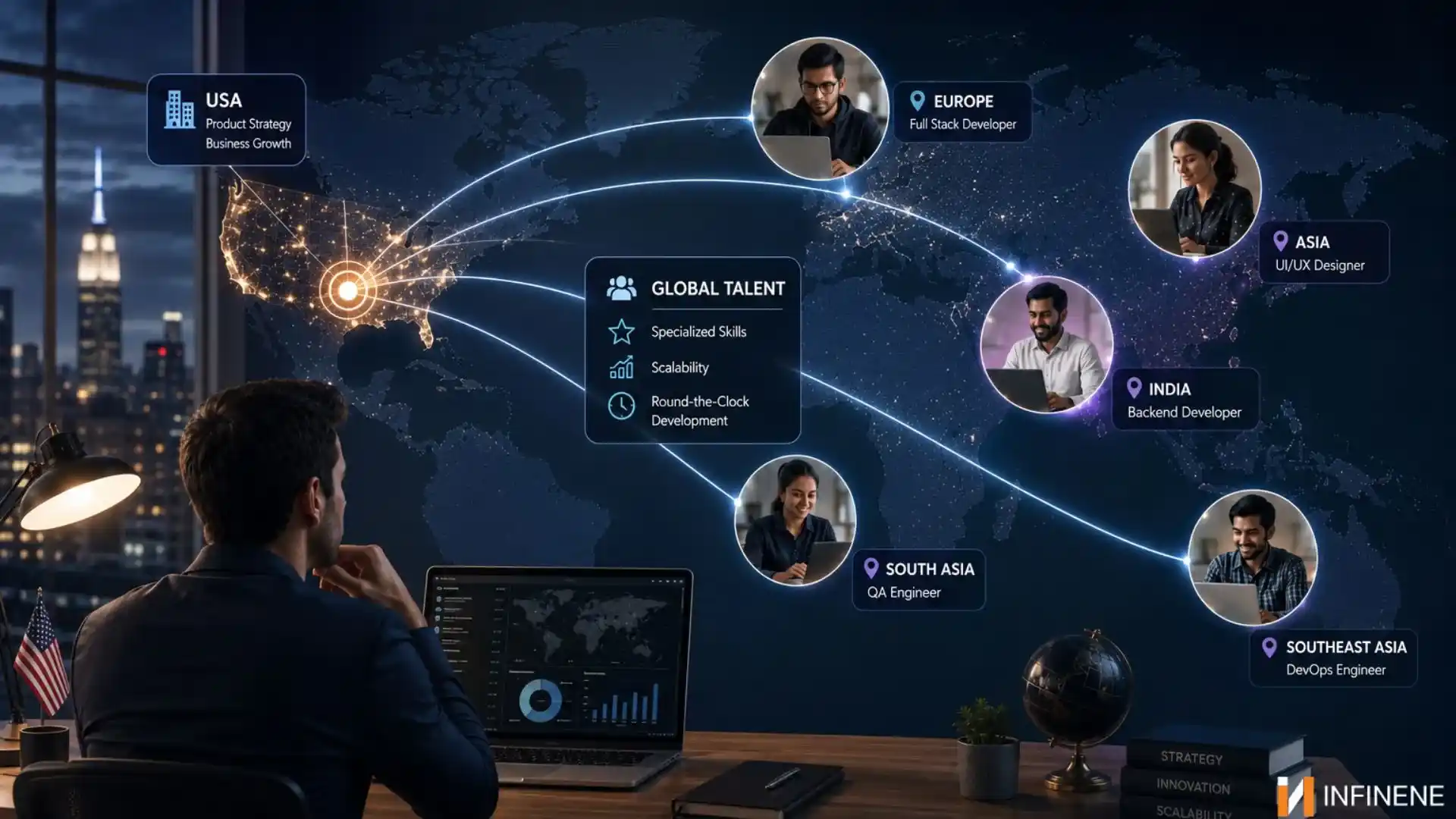
For most of the last two decades, the case for hiring an offshore software development company in the US was built almost entirely around one number: the hourly rate. Businesses compared what a developer cost in Austin against what a developer cost in Krakow or Bangalore, did the math, and signed the contract. Cost was the pitch, and cost was the reason.
That reasoning is no longer holding up. At least not on its own. According to research from DECODE, only 34% of companies now cite cost as their primary reason for outsourcing software development, down sharply from 70% in 2020. The number that has taken its place is talent access. And the shift isn't happening because offshore rates have stopped being competitive. It's happening because the US domestic talent pool has a structural problem that pricing alone can't fix.
This matters for how American businesses should be thinking about offshore software development company US partnerships going forward. The economics still work. But treating offshore development as primarily a budget lever, rather than a way to solve a talent supply problem, is more of a framing that mostly misses the point.
The US Bureau of Labor Statistics has been tracking a widening gap between the demand for software developers and the supply of qualified candidates for several years now. Multiple industry analyses built on BLS data point to a shortfall approaching 1.2 million software developers in the US by 2026 and 2027. It's driven by projected employment growth of roughly 15% to 18% between 2023 and 2034. This rate is more than twice the average across all US occupations.
That growth isn't being matched by the pipeline feeding it. Only about 51% of US high schools currently offer a computer science course, according to data compiled by workforce research firm Mismo, which creates a structural bottleneck well before candidates ever reach the job market. In 2023, the US had roughly 1.48 million open software developer positions against a supply of new graduates that left, by some estimates, only about 65 qualified candidates for every 100 open roles.
There's a more precise picture emerging in 2026 research, and it complicates the "shortage" narrative in a useful way. Analysis from Global Software Companies found that overall software development job postings have fallen roughly 70% from their February 2022 peak, and entry-level postings specifically are down 34% compared to 2020. In other words, the shortage isn't uniform across all developer roles. It's concentrated at the senior end where engineers can own production systems and operate at scale. At the same time, junior and generalist roles have actually softened.
That distinction matters for how US businesses should approach offshore hiring. The problem isn't a lack of people who can write code. It's a lack of people who can be trusted to write code that holds up in production without constant oversight. An offshore software development company in the US context isn't competing to fill entry-level seats. It's increasingly being asked to solve for exactly the specialized capacity that domestic hiring pipelines are struggling to produce.
To be clear, offshore development remains meaningfully cheaper than domestic hiring in most cases. Reports from Devico put potential savings at up to 60% compared with hiring locally. The average IT specialist wages in outsourcing hubs like India remain in the range of $15 to $35 an hour. While the median US software developer compensation has climbed 24% since 2018. Mid-level engineers in the US now typically command $90,000 to $150,000 in total compensation. While the senior roles run at $150,000 to $250,000 or more.
But if cost were still the dominant driver, the market's growth pattern would look different than it does. The global offshore software development market is valued at roughly $198 to $204 billion right now. It is projected to grow at a compound annual rate of around 14% through 2030. These figures show that it is the fastest-growing segment.
Growth at that pace points to something other than budget optimization. Research cited by DECODE puts the more likely explanation plainly. 76% of global IT employers report they're unable to find the skilled talent they need domestically. When the shortage is that widespread, offshore development stops functioning as a discount option. It starts functioning as the only realistic way to access certain categories of expertise at all.
It's worth being specific about what shifts when a company reframes offshore development as a talent strategy rather than a cost-cutting one, because the practical differences are significant.
The evaluation criteria change. Research from DECODE found that 84% of executives now rank service quality as their top factor in selecting an outsourcing partner, ahead of price. Three-quarters expect their offshore partners to contribute to strategic transformation, not simply execute a fixed scope of work. That's a materially different relationship than the transactional, lowest-bidder model that defined offshore outsourcing in its earlier decades.
The engagement model changes too. Companies pursuing a cost-cutting strategy tend to default to fixed-scope project outsourcing. They hand off a defined deliverable, get it back, move on. Companies pursuing a talent strategy are more likely to use IT staff augmentation or dedicated development team models, where offshore engineers integrate directly into existing US-based teams, participate in the same sprint cycles, and contribute to architecture and product decisions over an extended period rather than a single deliverable. This model exists specifically to solve the senior-talent gap described above, rather than to offload low-complexity work.
AI has become a baseline expectation, not a differentiator. According to DECODE's 2026 research, 83% of outsourcing executives are already integrating AI tooling into their delivery workflows, and developers using AI coding assistants are completing tasks roughly 55% faster on average. Forrester's 2025 software development outlook similarly found that close to half of developers are already using, or expect to adopt, AI coding assistants as standard practice. For a US business evaluating an offshore software development company in the US market today, the presence or absence of a mature AI-augmented workflow has become one of the clearer signals of whether a partner is operating at a senior level or still running an older, lower-margin outsourcing playbook.
If cost is no longer the primary reason companies choose offshore development, it's also worth noting that cost is rarely what causes those partnerships to fail. According to DECODE's research, 60% of outsourced software projects fail specifically due to poor cultural compatibility and misaligned expectations around communication. The decision-making authority and working norms are major issues rather than technical shortcomings or pricing disputes.
This is a meaningful data point for US businesses to sit with. It cuts against the instinct to treat offshore vendor selection as primarily a technical or financial evaluation. Time zone overlap and how a partner handles ambiguity tends to determine outcomes more reliably than the hourly rate on the contract. It's part of why nearshore models. Particularly partnerships with teams in Latin America have grown alongside traditional offshore markets in Eastern Europe and South Asia. Even though nearshore rates are typically higher.
None of this diminishes the case for offshore development. It reframes what due diligence should actually focus on: not simply who offers the lowest rate, but who has a demonstrated process for integrating with a US team, communicating clearly across time zones, and taking ownership of outcomes rather than just tickets.
The reframing from cost to talent isn't evenly distributed across sectors, and the pattern is telling. Industries with the tightest regulatory or compliance requirements in which a coding mistake carries legal as well as financial consequences are among the most active adopters of offshore development. This runs counter to the assumption that regulated industries would be the most cautious about working offshore.
Healthcare technology companies are a clear example. US healthcare software has to satisfy HIPAA requirements regardless of where the engineering work is performed, which means the offshore partners winning healthcare contracts are the ones that have built compliance expertise directly into their delivery process, not the ones offering the lowest rate. The same pattern holds in fintech, where offshore teams are increasingly evaluated on their familiarity with frameworks like PCI DSS and SOC 2 as a baseline requirement, not a value-add.
E-commerce and retail technology present a different version of the same shift. These businesses tend to use offshore and nearshore teams less for cost reasons and more because release velocity is a competitive necessity. The ability to ship features, run experiments, and iterate on a compressed timeline matters more than shaving a percentage off the development budget. And government contractors, where offshore work is far more tightly restricted by procurement and security rules, illustrate the limits of the model: even as talent access drives adoption elsewhere, compliance constraints mean offshore development isn't a universal fit, and businesses in that category typically need domestic or cleared-personnel arrangements regardless of the broader market trend.
Given that cultural compatibility, not price, is the leading predictor of whether an offshore engagement succeeds, the due-diligence process should weigh accordingly. A few questions tend to surface the gap between vendors running a talent-focused delivery model and those still operating on the cost-first playbook:
How much working-hour overlap will the team realistically provide? What's the plan for the hours that don't overlap? Would this require asynchronous handoff documentation, a dedicated liaison, or something more ad hoc?
What does the AI-augmented delivery workflow actually look like? It should be beyond a general claim that the team "uses AI tools"? Which parts of the development and QA process are AI-assisted, and how is output reviewed?
What's the seniority mix of the proposed team? Given that the documented shortage is concentrated at the senior level. A team weighted toward junior engineers may not close the specific capability gap a business is trying to solve.
How does the partner handle scope changes and ambiguity, since this is where cultural misalignment tends to surface first, well before any technical issue does.
What compliance frameworks does the team have direct, demonstrable experience with? HIPAA, SOC 2, PCI DSS, or others relevant to the industry rather than a general assurance that compliance "isn't a problem."
Is the engagement structured as staff augmentation or fixed-scope project outsourcing? And does that structure actually match the goal? Ongoing capability building versus a one-time deliverable?
None of these questions are about price. That's largely the point: a due-diligence process built entirely around rate comparison is optimized for a version of offshore development that the market has, by its own data, already moved past.
Put together, the data suggests a fairly clear picture. The US software developer shortage is real, structurally driven by education-pipeline gaps and accelerating demand, and concentrated most acutely at the senior and specialized end of the market. This is precisely where domestic hiring is slowest and most expensive. Offshore development has responded by maturing past its origins as a cost play. AI adoption has become table stakes rather than a competitive edge. The metrics that actually predict partnership success have moved from price to cultural fit and delivery quality.
For a US business evaluating whether to work with an offshore software development company, the practical takeaway isn't that the cost no longer matters. It clearly still does, and the savings remain substantial. The takeaway is that cost savings are increasingly a secondary benefit of a decision that's really being driven by something else: the inability to hire the specific technical expertise a business needs, fast enough, inside the US alone. Companies that continue to evaluate offshore partnerships purely on rate are optimizing for a problem the market has largely already solved. At the same time, overlooking talent access that's actually driving the decision for most of their competitors.
Infinenetech.com works with US businesses on exactly this kind of engagement. Staff augmentation and dedicated development teams built to close specific technical gaps. Not just add headcount at a lower rate. For companies weighing whether an offshore or nearshore partnership makes sense for their next project, that distinction is usually the right place to start the conversation.