



Blog Details
HomeBlog Details
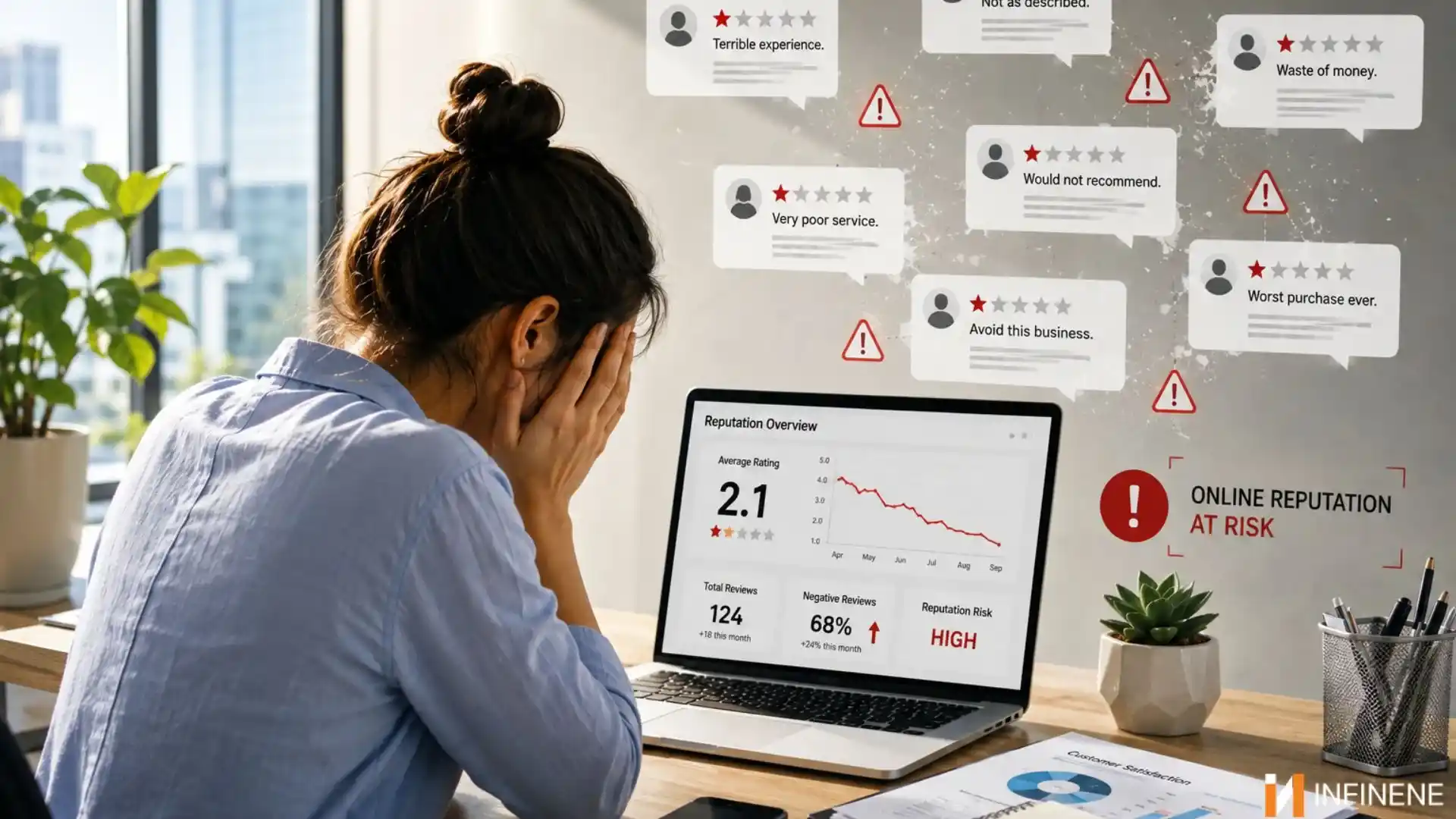
Why Online Reputation Management Is Getting Harder in the Age of AI
Ask ten business owners what online reputation management means and most will say the same thing. Watch your star rating. Respond to complaints. Ask happy customers to leave a review. That answer used to be enough. It isn't anymore.
Generative AI has changed the whole game. Anyone with a laptop can now generate dozens of realistic reviews in minutes. The feedback could be for a product that might not even work or a business that might not even deserve them. A hotel in Miami sits at 4.9 stars on Google. The reviews read as real guests wrote them. Warm. Specific. Grateful. Except several of those guests never checked in. Their profile photos are AI generated. Their stays never happened. And the business paying for those reviews knows exactly what it's doing.
This isn't a one off. It's happening across US industries right now, and it's forcing a hard reset on how companies protect their name online. Businesses still relying on old school reputation tactics are getting blindsided.
The Problem of Online Reputation Management is Bigger than Businesses Realize
The numbers are blunt. The Transparency Company, a firm that analyzes consumer reviews for signs of manipulation, looked at 73 million reviews across the home, legal, and medical services sectors. Nearly 14% were likely fake. The firm said it had high confidence that 2.3 million of those reviews were partly or entirely written by AI. That's not a fringe problem. That's a huge chunk of the information people rely on to pick a plumber, a lawyer, or a doctor.
And the trend line is worse than the snapshot. The same firm found that around 3% of reviews across all sectors it studied in 2024 were AI generated. It also found that fake AI reviews had been growing 80% month over month since mid-2023. The numbers double every 30 days. Run that forward and it's easy to see why 2026 feels different from 2023. The tools got better. The reviews got more convincing. And the volume exploded.
Why would a business take that risk? Simple. Money. The FTC has found that buying fake reviews can generate up to 1,900% ROI for businesses that don't get caught. That's an absurd incentive. It's also why an entire underground economy of review brokers has sprung up to serve it.
Meanwhile, reviews matter more than ever to how people shop. Most recent surveys put the share of US consumers who read reviews before buying somewhere in the low to mid 90s. A similar share say reviews directly shape their purchase decisions. A lot of shoppers say they trust online reviews as much as a recommendation from a friend. Some say they need at least five reviews on a business before they'll trust it at all. One survey found people spend close to 14 minutes reading reviews before choosing a local business. That's not a glance. That's homework.
Recency matters too. A good chunk of consumers says they only trust reviews from the last month. A business can't coast on old praise. It needs a steady stream of fresh, credible reviews to keep converting. That pressure is part of why fake reviews are so tempting. Buying a batch of five-star reviews is faster than earning them.
Put it together. Reviews carry enormous weight in purchase decisions. Consumers want proof that's fresh and abundant. And a growing share of the reviews meeting that demand are fabricated. That's a real crisis for online reputation management. It's not only those fake reviews exist. The whole incentive structure of modern shopping is quietly rewarding businesses that manufacture trust instead of earning it.
Why Fake AI Reviews are So Hard to Catch
The old advice for spotting a fake review was simple. Look for broken English, generic praise, and five stars with no detail. That advice doesn't work anymore.
Large language models don't write "very good products are happy." They write fluent, specific sounding, emotionally warm prose that mimics a real customer's voice. The text isn't bad grammar anymore. It's the opposite. Perfect, frictionless writing that never mentions anything mildly annoying is now one of the more reliable warning signs. Real customers complain about the manual. They mention the noise. They gripe about the shipping box. AI generated reviews tend to skip all of that.
This is exactly why online reputation management has become harder. Watching your average star rating isn't enough anymore. Businesses, and the people reading their reviews, need to look at review sets the way a fraud analyst would. Look for patterns, not just content.
How to Spot Fake Reviews in 2026
Whether you're a business owner or a shopper trying to figure out if a product is actually good, the method to identify the right reviews has changed. It's less about judging one review and more about spotting patterns across many. Here's what actually works now.
Watch for velocity spikes. A sudden burst of reviews landing in a short window, say a dozen five-star reviews in two days after months of quiet, is one of the clearest signs of manipulation. Real review activity tends to trickle in over time. It doesn't arrive in waves.
Look for repeated phrasing across different reviewers. When one AI prompt or one review broker generates dozens of reviews, certain patterns show up again and again across different reviews. If three reviewers call something a "game changer for busy professionals" with the same rhythm, you're probably reading reviews from the same author.
Check whether the review describes anything specific. Real experiences include small, unglamorous details. A delayed delivery. A confusing setup. A staff member's name. Reviews that praise enthusiastically but never mention anything concrete are worth a second look.
Check the reviewer's profile. Accounts that never respond to a business's follow up questions or use a stock looking photo deserve extra scrutiny. None of these signs alone proves a review is fake. But several stacking up on one account means something.
Compare ratings across platforms. If a business looks close to perfect on its own site but noticeably more mixed on independent platforms it doesn't control, that gap tells you something. Fake review campaigns tend to concentrate where the business controls the review flow.
Be suspicious of an all five-star pattern. Genuine review sets are messy. A mix of good and bad is actually a trust signal. Real customers complain about small things even when they're happy overall. A page of nothing but five-star raves, especially for anything complex, doesn't reflect how real customers actually behave.
Use detection tools as a second opinion. AI content detectors and browser extensions built to flag suspicious reviews have gotten better. That's partly because the same models used to write fake AI reviews are now being used to catch them. But these tools still produce false positives. Combine them with a manual scan instead of trusting a single score.
For businesses, the practical version of all this is a habit. Pull your review data on a regular schedule. Sort by date. Scan for clusters, sentiment shifts, and sudden spikes. Most fake review campaigns get caught in hindsight through an audit like this, not through a real time alert. The patterns are usually obvious once you're actually looking for them.
The Regulatory Rules Have Changed
Online reputation management isn't just a marketing job anymore. It's increasingly a compliance one. In August 2024, the Federal Trade Commission finalized a rule that directly targets fake and AI generated reviews. It took effect that October. The rule is specific, and it has real teeth.
It bans businesses from creating or selling fake reviews or testimonials. It also bars them from buying such reviews or getting them from company insiders. It keeps from spreading testimonials they knew or should have known were fake. Then FTC Chair Lina Khan didn't soften the message. She said fake reviews waste people's time and money and pull business away from honest competitors.
The rule doesn't treat AI generated fakes as some smaller, separate issue. It folds them into the same ban. The FTC said that AI tools make it easy for bad actors to churn out large volumes of realistic fake reviews across different platforms. It confirmed that AI generated reviews are covered by the rule.
The rule also closes off tactics businesses might not think of as "fake reviews" at all. It restricts buying or using fake indicators of social media influence, things like bots or hijacked accounts used to inflate followers or views. Separately, it targets reviews and testimonials generated by AI.
There's an important nuance for businesses that solicit reviews honestly. A safe harbor exists for businesses that generally collect reviews in good faith but end up with the occasional fake submission slipping through. That protection disappears if a business selectively asks for reviews in a way built to skew sentiment positively. In other words, one fake review getting through isn't automatically a violation. A strategy built around filtering out negative feedback is.
The penalties aren't symbolic either. The FTC can pursue enforcement seeking well over $50,000 per violation. It has already started sending warning letters over non-compliant review practices. That's a sign more enforcement is coming, not a onetime announcement.
For anyone handling online reputation management, this changes the math. It's no longer just "does this hurt our star rating." It's "does this expose us to federal liability." Review solicitation scripts and moderation policies that were standard five years ago might now sit on the wrong side of the law.
How Your Online Reputation Management Strategy Needs to Adapt
The right way to handle this well is by treating online reputation management as an ongoing operational habit. A few shifts are worth making now.
Audit your own review profile first. Make sure your review collection process is clean. If any agency or internal team is buying reviews or suppressing negative feedback, that's a compliance risk.
Build pattern detection into your routine. A quarterly review of your review data, sorted by date and scanned for spikes and repeated phrasing, catches manipulation that a simple star rating dashboard misses. That's true whether the manipulation is coming from a competitor attacking you or a well-meaning employee cutting corners.
Respond publicly and consistently. Public responses do two things at once. They show real customers you're paying attention, and they tend to expose fake reviewers, who almost never engage back when a business asks a follow up question. Businesses that respond to reviews also tend to get rated more positively by customers, even when the underlying issue wasn't fully solved.
Spread your reviews across platforms. Relying on one platform you control makes manipulation, yours or someone else's, easier to hide and worse when it's finally caught. A reputation spread across Google, industry specific sites, and independent review platforms holds up better and reads as more credible to shoppers who now cross check multiple sources before trusting a rating.
Treat compliance and reputation as one function. With the FTC actively enforcing this rule, legal and marketing teams need to be on the same page about review solicitation, not working in separate lanes. A review incentive program approved two years ago should get a compliance check before it runs again.
The Stakes Are Different Depending on Your Industry
Not every sector faces the same exposure, and that matters for where businesses should focus their online reputation management effort.
Home services, legal services, and medical services showed up as the highest risk categories in the Transparency Company's analysis. That's probably because these are high trust, high stakes purchases where people lean hard on reviews to make up for their own lack of expertise. Someone hiring a contractor or picking a lawyer usually can't judge quality firsthand before committing, so they outsource that judgment to strangers online. That makes these categories more attractive targets for fake review brokers, and more damaging when the manipulation gets exposed. E-commerce and hospitality carry a different kind of risk. Volume. A product listing or hotel page can rack up hundreds of reviews fast. This makes pattern-based detection and repeated phrasing easier to spot.
B2B and SaaS businesses face a similar issue. Buyers in these categories often lean on customer references and case studies. But the underlying issue is the same. A buyer's confidence rests on proof that other customers had a real experience, and AI can now fake that proof too, whether it's a written testimonial, a quote pulled from a "verified" case study, or a fake review on a software marketplace. Whatever the category, the response looks the same. Know what normal review activity looks like for your business. Treat any sharp deviation from that baseline as suspicious.
Online reputation management used to mean managing what real customers said about the business. Now it increasingly means proving what real customers said about you actually happened at all. That means separating authentic feedback from a growing wave of AI generated noise, while staying inside a regulatory line that's newer and stricter than most businesses realize. The businesses taking this seriously now, auditing their own practices, building real detection habits, and keeping compliance in the loop, will be the ones people still trust as fake AI reviews get harder to spot. The ones that don't are the ones the FTC is increasingly likely to notice first.
Related Reads
- How Small Businesses Can Compete with Amazon-Level Customer Service on A Fraction of The Budget
- Deepfake Scams Just Cost a Company $25 Million — Here's How US Businesses Are Fighting Back
- Business Email Compromise Scams Getting Harder to Spot - Here's What Attackers Doing
- How B2B Companies Are Using AI Search to Get Cited as a Source, Not Just Ranked