


For the longest time, I thought the outsourcing conversation had become predictable.
Whenever a company said they were planning to outsource any department, the chat almost always kept circling back to labor costs. Which country had the lowest wages? How many full-time employees could actually be swapped out? How much money would the company pocket over the next five years and so on…It wasn’t exactly a thrilling discussion, but it was pretty straightforward.
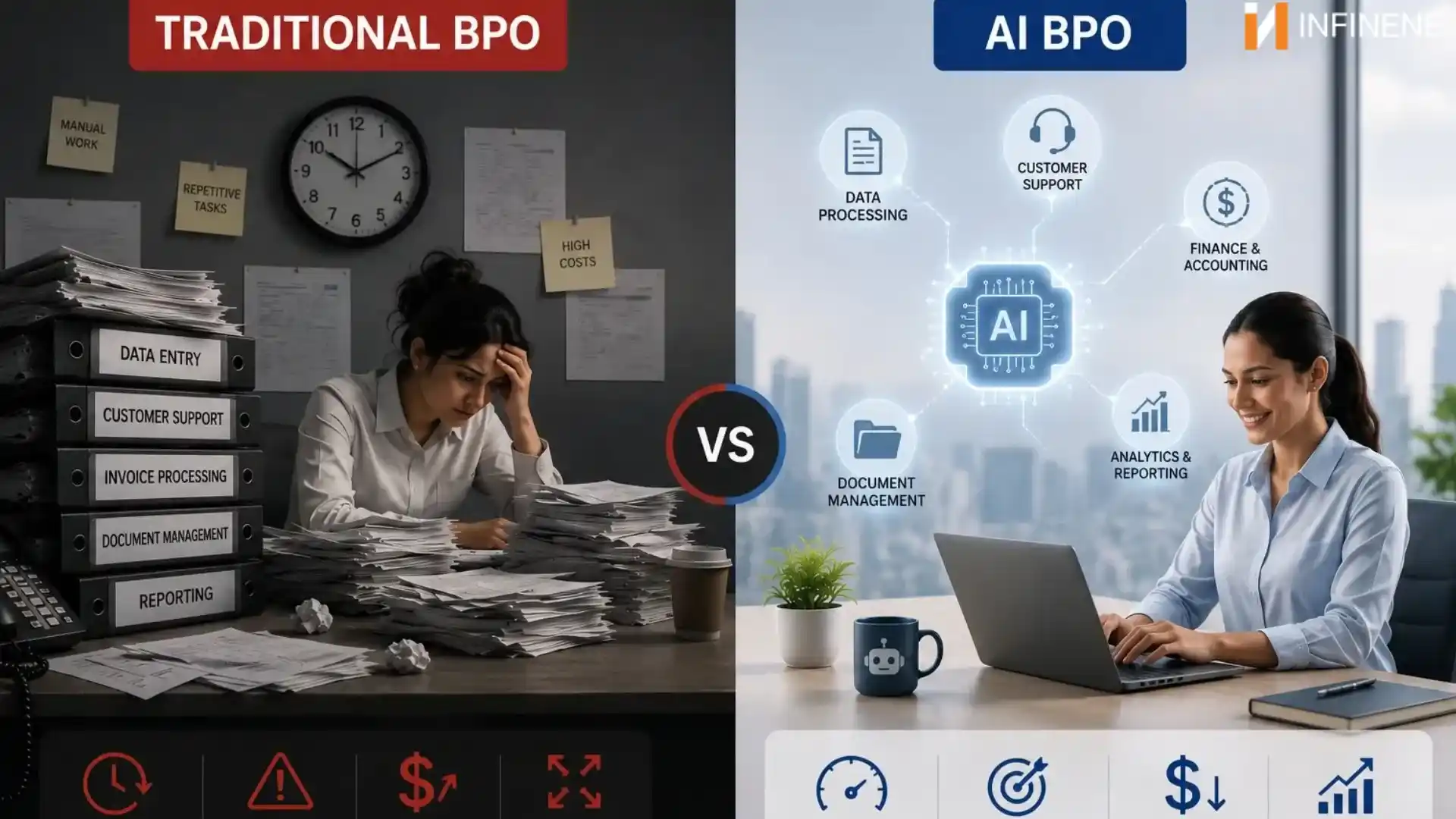
Over the last two years, I’ve seen another question slowly slide in and replace the old ones. Companies aren’t really asking anymore whether outsourcing cuts costs, they already assume it does. What they’re trying to figure out now is whether AI BPO can bring a stronger return on investment than the usual outsourcing model they’ve leaned on for decades.
It feels subtle, but it matters.
Instead of comparing labor markets, executives are comparing operating models now. Like, instead of simply calculating hourly wages, they are measuring productivity, automation rates, and customer satisfaction. The goal hasn’t changed at all. Every company still wants to run more efficiently, but the road to getting there looks way different in 2026 than it did even just three years ago. That doesn’t mean traditional BPO is going obsolete. I mean, honestly, I’d say that’s one of the biggest misunderstandings about AI right now.
Every week, another headline drops, claiming AI will replace customer support agents, human labor, or operations teams. Sure, those stories get attention, but they rarely match what’s happening inside big organizations in reality.
Businesses aren’t removing entire departments and swapping them out for AI. They’re redesigning workflows. And this is a key distinction, because ROI isn’t really measured by how much human labor disappears. It’s measured by how much value the business creates after it adopts a new operating model. That’s also where this whole comparison starts getting much more interesting.
Before comparing AI with traditional outsourcing, I think it's worth remembering why BPO became such a dominant business strategy in the first place.
For decades, the formula worked remarkably well. Organizations transferred repetitive operational work to specialized providers that could perform the same work at significantly lower costs. Everyone benefited from this model. Businesses reduced operational expenses. BPO providers developed specialized expertise. Customers often received longer support hours than companies could provide internally. The model scaled because labor remained cheaper than investing heavily in technology. Even as automation improved throughout the 2010s, most outsourcing contracts still revolved around people. More customer inquiries required more agents. Larger operations required more supervisors. Growth almost always meant expanding the workforce.
That approach still works.
If a company needs multilingual support across dozens of markets, experienced customer service reps stay incredibly valuable. They help with many languages and a lot of subtle contexts. It also matters how fast they respond and how calm they stay when things get complicated. If healthcare providers require medical claims specialists familiar with regulatory requirements, human expertise matters far more than processing speed. Financial institutions dealing with fraud investigations or compliance reviews can't simply automate judgment.
This is one reason traditional BPO continues to generate billions of dollars in annual revenue despite the rapid rise of AI. The model solves real operational problems. But it also has limitations that have become increasingly difficult to ignore.
When I hear companies compare outsourcing providers, the talk almost always starts with hourly rates. That kind of makes sense. Labor is usually the biggest line item in most outsourcing agreements, and it’s the simplest number to compare. One provider charge less than another, the sheet shows quick savings, and suddenly the choice looks almost obvious. But honestly, I’ve noticed the hourly rate rarely tells the whole story. The true cost of traditional outsourcing starts to pop out after the contract is signed.
Every new agent has to be recruited, onboarded, trained, and evaluated before they become fully productive, and honestly. Managers still have to watch performance, plus quality assurance groups review call messages, the whole thing too. Supervisors coach employees, refresh procedures, and make sure the service-level promises are actually being met. None of that is strange. It’s simply the operating side of a people-heavy, hand-on operation. The tricky part is that those expenses don’t stay still. They tend to climb as the business grows.
As customer volumes rise, organizations need more agents. More agents require more team leads, and bigger teams often lead to additional trainers, workforce planners, quality analysts, and operational managers. Scaling isn’t just about adding headcount either, it’s also about building out the support machinery for that headcount. And then employee turnover shows up too, like an extra complication you don’t really see until later.
The BPO industry has been seeing fairly high attrition for a long time, especially in the customer-facing roles. Each time an experienced person moves on, someone else has to be taken on, trained, and brought back up to speed. The institutional memory just walks out the door, and then the whole cycle starts again. Even if the vacancies get filled fast, output usually doesn’t bounce back immediately. And then there’s demand too.
Like, picture an e-commerce retailer getting ready for Black Friday or Cyber Monday. Customer questions can spike a lot, and it can happen within just a few days. Traditional outsourcing providers can manage that kind of surge but it only really works if they plan it months ahead. Temporary agents have to be sourced. Training sessions need to be tightened up without lowering the standard. Team leads must reschedule, estimate headcount, and line up for work that might only last a few weeks. The whole setup functions because it is built around people. Still, people can’t be multiplied instantly.
This isn’t meant as a criticism of conventional BPO. It’s more like a basic trait of the system. Expansion relies on recruiting, training, and supervising bigger squads, and every one of those stages adds extra cost and operational friction. Businesses accepted those compromises for years because there weren’t many real alternatives. But that situation is starting to shift now.
This is where I think many discussions about AI BPO become overly simplistic. AI is usually referred to as a cheaper employee. I don't think that's an accurate comparison. AI doesn't behave like an employee at all. Once integrated into business workflows, AI can perform a lot of tasks all at a scale that doesn't increase proportionally with demand.
That's different from hiring additional people. Instead of paying for every incremental task, organizations invest in systems capable of handling thousands of repetitive interactions simultaneously. The economics change. An AI assistant doesn't become tired during peak shopping seasons. It doesn't require overnight staffing schedules. It doesn't need weeks of onboarding before becoming productive. That doesn't automatically make AI less expensive.
Integrating AI into existing software and continuously refining workflows requires significant investment. Implementation costs can be substantial. But once those systems mature, the cost per transaction often begins to decline in ways traditional labor models simply can't match. That's why ROI has become the real conversation. Not because AI is free. Because its economics improve as organizations scale.
One mistake I see companies make is assuming ROI starts and ends with labor savings. That's only one part of the equation. When I evaluate whether AI BPO creates more value than traditional outsourcing, I find it more useful to examine five different areas.
Can work be completed faster without sacrificing quality?
Do customers receive the same level of service?
How difficult and expensive is it to deploy the new operating model?
How easily can the business respond to sudden changes in demand?
Can today's investment continue generating value as customer expectations and business requirements evolve?
Looking at ROI through this broader lens produces a much more balanced comparison than simply asking which option costs less today. And interestingly, the answer isn't always AI.
If there’s one takeaway I’ve run into again and again while doing research on enterprise AI adoption, it’s basically this: not every business process really needs to be automated.
The companies that are seeing the biggest returns usually aren’t trying to replace entire departments overnight. Instead, they’re spotting repetitive and high-volume tasks that quietly eat up thousands of employee hours every month. And they ask a pretty simple question. Does a human actually need to do this?
Take customer support, for instance. A sizable portion of incoming tickets tends to be about password resets or order tracking or billing questions. They matter, but they’re also super repeatable. Having trained support agents answer the same kind of request hundreds of times a day isn’t only costly. It also blocks them from engaging in the interactions that truly call for critical thinking, or even a bit of empathy.
This is where AI BPO starts to bend the economics in a more favorable way. Rather than adding agents every time ticket volume rises, businesses can automate that first layer of customer interactions. AI can spot customer intent and handle the straightforward stuff before a human ever has to jump in. And the upside isn’t just “lower labor costs.” It’s also about quicker responses and better customer satisfaction.
AI doesn’t really erase the departments. It simply removes the repetitive work surrounding it. That allows experienced professionals to focus on activities that contribute far more value to the business. The result is a different kind of productivity gain. Employees aren't working harder. They're working on problems that actually require their expertise.
Whether you’re looking at a classic outsourcing provider or an AI‑driven one, there’s usually this habit in sales decks to show the best‑case outcomes. But the truth is typically more intricate than that.
Traditional BPO has its own “behind the curtain” expenses. One of the biggest operational headaches is employee turnover. Hiring and training new people takes time. Every replacement comes with a ramp up period before it’s actually fully productive. And getting steady quality across hundreds, or even sometimes thousands of agents doesn’t just happen. It takes ongoing funding for coaching, monitoring, and quality assurance.
AI brings a whole other bucket of costs. Putting an AI solution in place isn’t just about buying software and flipping a switch. Organizations have to weave AI into their existing business systems and keep an eye on outputs for accuracy. If the business environment is complex, deployment can stretch for months before anything measurable starts showing up.
There’s also a cost nobody talks about enough: change management. People need to understand how AI slots into their day-to-day tasks. Managers need revised performance targets and metrics. And many workflows need redesign, not just “simple automation.” Without this internal alignment, even when the AI itself works, the project can still miss meaningful ROI because adoption and process coherence were never really addressed. That’s one reason some of the early AI efforts didn’t match expectations. The technology itself wasn’t always the issue. The implementation plan was.
If I had written this article five years ago, the debate probably would have revolved around whether automation might eventually end up replacing outsourcing. But in 2026, that feels like the wrong question, somehow. The more I watch how enterprises are actually deploying AI, the more the picture sharpens into something simpler. They’re not so much swapping out people as they are redefining their roles.
Customer service agents, for example, spend less time on those repetitive questions. They spend more time resolving the escalated ones. Finance professionals lean on AI to process standard documentation, while they keep their attention on analysis and strategic planning. HR teams automate resume screening but then they still run interviews and own hiring decisions. That’s not a replacement. It’s specialization, with a quieter kind of logic.
The companies seeing the strongest ROI from AI BPO are using tech to amplify human capabilities rather than erase them. AI brings speed. People bring judgment. AI moves information at scale. People interpret context. AI follows patterns. People handle exceptions. And when those strengths are stitched together thoughtfully, businesses often realize they can lower operating costs while also improving customer experience. That's something neither standalone AI nor traditional outsourcing tends to land reliably on its own. In a lot of ways, this is the actual narrative behind AI in 2026. Not a humans vs machines choice. More like designing operations where each side contributes what it does best, and nothing more.