


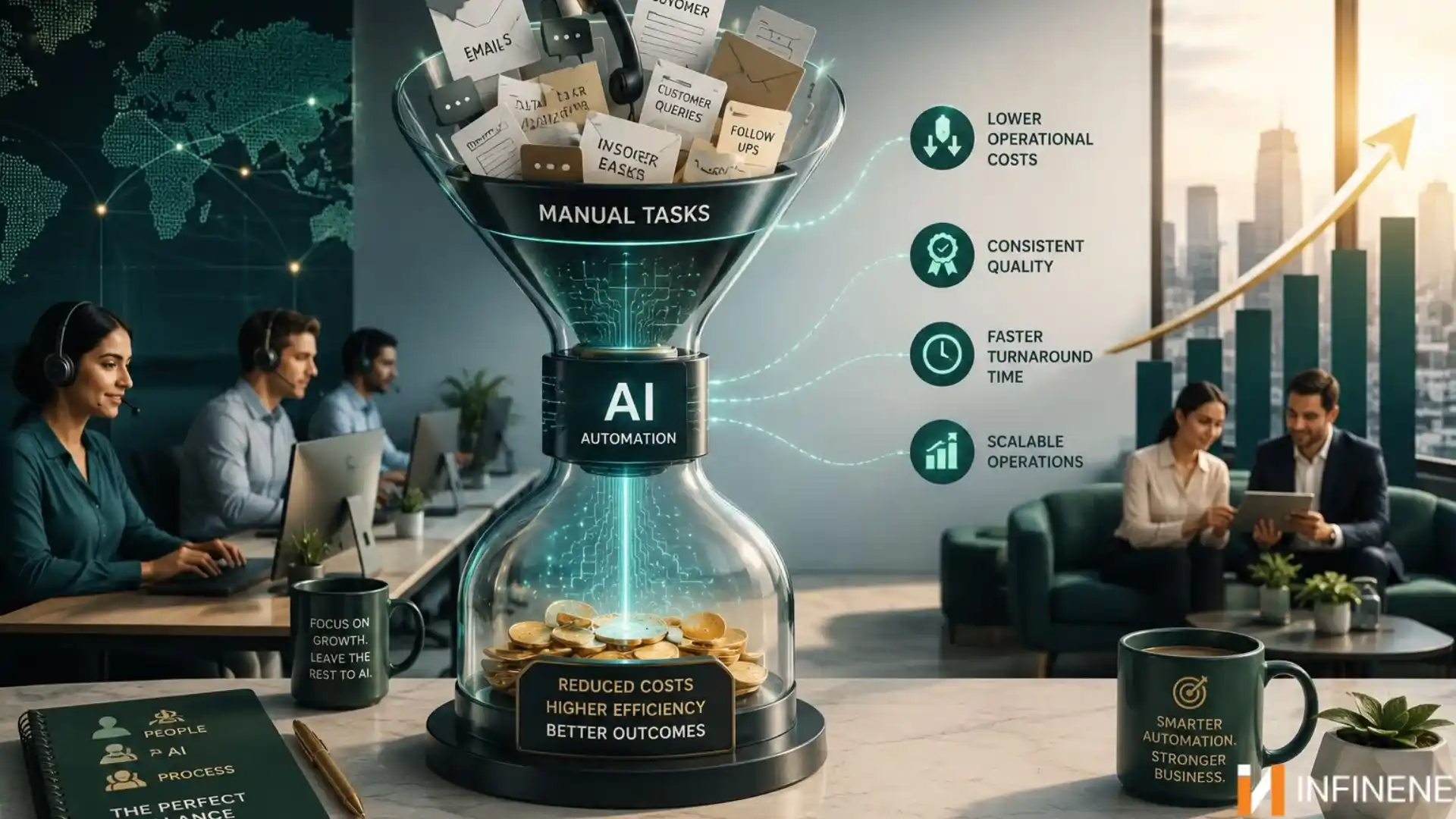
What if your company could cut operational costs by 30% without compromising on customer satisfaction?
For years, US businesses dealt with a rough trade-off when they outsourced business processes. It was “Lower the Costs or Keep the Quality”. In practice, companies often get stuck picking between operational efficiency and customer satisfaction, with very few ways to actually get both at once.
But now, that equation is different.
The growth of AI BPO services is giving organizations a chance to raise service quality and reduce costs at the same time. When outsourcing knowledge meets advanced artificial intelligence tools, BPO providers can offer smarter and more scalable solutions than before.
From customer support and data handling to back-office tasks, AI driven BPO solutions are changing how US firms run day to day. In this article, we’ll look at how BPO automation trends are reshaping business operations and why organizations across the United States are putting real investment into BPO artificial intelligence strategies.
Not long ago, businesses saw outsourcing mostly as a way to cut costs, as simple as that. But now, another model is showing up in the matrix - one that tries to keep the outsourcing efficiency while also adding the kind of “thinking” you get from advanced technologies. This shift is often called AI BPO and its quietly helping US companies simplify day to day operations and raise customer satisfaction without stacking extra overhead.
At the heart of it, AI BPO brings artificial intelligence into the usual business process outsourcing setup. Instead of relying only on human agents, newer BPO providers pull in things like machine learning and generative AI. These capabilities can sift through data and automate workflows for faster operations.
And the goal really isn’t to replace people. It’s more like making them more effective. When repetitive tasks get automated, teams can put their attention into higher level work that needs human touch. The outcome is a more intelligent operating approach and better productivity without slipping on quality or customer satisfaction.
The digitalization in the BPO market is changing the way enterprises think about outsourcing. What used to be a cost saving move has now turned into a technology driven strategy. To keep up with expectations, BPO providers are putting serious money into advanced tools and platforms. Here are some major reasons why BPO providers are working towards digitalization.
Artificial intelligence, along with automation technologies, is kind of at the center of this shift. BPO providers are leaning on these solutions to auto-run repetitive tasks and smooth out workflows across business functions. From customer support to finance, automation improves productivity and reduces pricey mistakes.
Modern businesses, every day, generate these huge piles of operational data and customer data. It feels like nonstop. Advanced analytics platforms help organizations to take all that info and turn it into something actually useful on a dashboard. When teams use operational metrics, they can spot where improvements are possible and decide in a more informed way that supports growth and efficiency.
The BPO industry is getting more and more away from the classic pricing approaches that are based only on headcount or hours worked. Many organizations start selecting outsourcing partners not just on how much labor they can offer but on whether they can deliver trackable results and measurable effects, in a more practical sense.
The growth of the cloud based BPO market is accelerating digital transformation across industries. Cloud infrastructure gives businesses this sort of flexibility to scale operations quickly, while also trimming the costs tied to traditional on-premise systems. Cloud based solutions also support remote and hybrid work environments, enabling quicker rollouts of new technologies, and improving cooperation among teams that are spread out.
As more businesses start leaning on digital platforms, protecting sensitive information is getting more critical than ever. Top BPO providers are putting money into advanced cybersecurity frameworks and real time threat monitoring. All these efforts help companies defend client data and lower the dangers tied to daily digital operations.
Customer expectations keep rising, and the whole experience part becomes this critical, competitive advantage thing. So, BPO providers are increasingly picking up newer tech like conversational AI and omnichannel engagement platforms. With these systems, companies can answer more quickly and still keep a steadier level of service across various channels.
The role of outsourcing providers is moving past just task execution, kind of beyond that. Today, modern BPO companies are acting more and more like strategic partners that help organizations put new technologies in place, improve business processes, and speed up digital transformation efforts. With this change, businesses can get specialized know-how and even a bit of novelty without the need to form huge internal capabilities from scratch.
Another important trend in the digitalization in the BPO market is the growing number of solutions that are specific to the industry. Providers don’t just push generic services anymore. Instead, they’re building specialized platforms, and they even use AI models that fit sectors such as healthcare, financial services, insurance, retail, and logistics. These tailored setups help organizations tackle sector specific obstacles, while also speeding up deployment and, improving outcomes overall.
The fast evolution of artificial intelligence is changing the outsourcing industry at a really unusual pace. As AI BPO adoption keeps accelerating, new BPO automation trends are starting to reshape how organizations handle both front-of-house customer work and the quieter back-office tasks.
Hyperautomation is moving businesses past those lone automation efforts into kinda fully connected digital workflows. When teams merge AI with robotic process automation, plus analytics and process mining, they can automate whole business functions. Not just one-off tasks anymore. Hyperautomation is a real centerpiece in enterprise transformation plans, not just a side initiative.
The ongoing growth of the cloud-based BPO market is kinda helping companies roll out AI solutions quicker, and at a lower total cost. In this way, cloud-native outsourcing platforms offer more wiggle room, scalability, and general accessibility than the old school infrastructure approach that people used to rely on.
Basically, organizations can bring in new tech and scale operations without having to drop a lot into infrastructure upgrades.
AI-powered security systems can keep an eye on activity in real time and spot possible threats. It can even answer or react to risks more quickly than the usual methods.
Also, a lot of BPO providers are adding AI based security solutions to better safeguard data protection and to stay aligned with compliance rules that keep shifting over time, and it feels like it changes faster than before.
Digital twin technology is starting to lean into the future of AI driven outsourcing, somehow. With a digital twin, you get a virtual representation of a business process. Organizations can simulate changes and even try to foresee outcomes before it’s actually rolled out.
Lately, a newer trend gaining more traction is multimodal AI. It can process and assess several types of information at the same time. This tech lets businesses simplify tangled service workflows. As multimodal AI keeps getting more sophisticated, it will probably end up playing a bigger role in how companies manage customer engagement strategies.
With AI-powered quality monitoring, you can actually scan virtually every single conversation. These platforms also spot compliance risks on the fly and even surface coaching opportunities for agents. The bigger picture this gives teams is pretty hard to beat. It supports stronger service standards and still helps performance keep improving.
Gaining a feel for customer emotions has become a sort of competitive advantage lately. With AI-powered sentiment analysis tools, teams can watch conversations in real time to figure out customers’ emotions. That means organizations can step in early and tune the interaction to what the person actually needs. Since customer experience is turning into a major differentiator, sentiment analysis is now sliding into a standard feature across many AI-powered BPO solutions.
Workforce management is getting more and more intelligent, not in a sci-fi way but still really noticeable. AI tools can look at past patterns and also spot productivity trends that nobody would catch. Organizations can put their resources in the right places and keep service levels steady when demand suddenly spikes. And since labor shortages keep hitting a lot of industries, AI-driven workforce planning is turning out to be more and more valuable.
Process mining techs give businesses a kind of very clear view of what their workflows actually do, like in real life. When you analyze digital actions across different systems, AI can spot trouble spots, inefficiencies, and even those automation chances that people might not notice right away.
More and more organizations are using process mining not just for productivity gains, but also for better compliance, and to surface operational costs that were kind of hiding in plain sight. Being able to keep tuning and refining workflows, again and again, is turning into a real advantage in markets that are extremely competitive, which is kind of expected now.
Maybe one of the most important trends steering where artificial intelligence BPO is going is the move toward co-working spaces where humans and AI basically share the same stage. AI is acting more like a digital aide that boosts how well staff perform instead of replacing employees. Organizations that manage to blend human know-how with AI skills are seeing real gains and longer-lasting growth.
Traditional outsourcing can cut expenses but AI BPO feels like a more strategic direction because it blends outsourcing know-how with advanced technologies. Here are a few of the main reasons why US companies are investing in BPO.
Reduce operating costs by automating repetitive work and everyday customer support tasks while still keeping service quality steady.
Lower human errors in data processing responsibilities. This avoids costly rework and operational downtime that happens when things have to be redone or corrected later.
Generate usable business insights by analyzing huge sets of operational and customer data. So, companies can spot patterns and find where improvements are actually needed.
Strengthen customer experiences through quicker response times and support that can run around the clock.
Speed up turnaround times by simplifying workflows and processing requests in real time without the usual delays.
Scale operations in a more efficient manner without adding a big workforce or major infrastructure expenses. This makes it easier to handle growth and seasonal spikes.
Optimize the way the workforce is used by automating day to day tasks and basically letting employees put their energy into higher-value activities.
Pulling employees away from admin duties so they can concentrate on strategic initiatives and more customer-facing roles.
The right AI BPO partner should help your organization sharpen workflows and back long-term digital reinvention goals. Before US businesses make a choice, they should carefully look at a few critical factors first.
One of the first considerations should be industry-specific experience, because every industry has its own quirky set of processes. Also, compliance requirements, customer expectations, and operational challenges all matter. A provider that really understands your sector will be better able to implement solutions that line up with your business objectives. For instance, in healthcare, organizations may need know-how in patient data management whereas financial institutions may focus more on fraud detection. So, when you choose a partner with a proven track record in your industry, it typically lowers implementation risks.
The impact of an AI BPO provider really hinges on the technologies they run on. In practice, companies should check if the vendor has a modern tech stack, like artificial intelligence, automation, analytics, and cloud solutions, not just “some tools”. You know, the basics, but done properly.
Try to see what they can actually do, for example
Generative AI and chat-based conversational AI.
Robotic Process Automation (RPA).
Predictive analytics and other kinds of forecasting.
Intelligent document processing.
Machine learning models.
Workflow automation platforms.
Cloud native infrastructure.
And the tech should be more than a quick fix for today’s issues. It needs to support tomorrow too, as business needs shift.
As businesses start to share sensitive customer and operational info with outsourcing providers, security is sort of a top priority now, not later. A solid AI BPO partner should really have robust cybersecurity practices and compliance frameworks already set in place… somehow, ready to go. You should evaluate if the provider actually sticks to the industry standards and the regulations that matter to your specific business. Depending on what you do, that can cover data privacy obligations, financial rules, healthcare compliance expectations, and other niche mandates that come up now and then. Some key areas to look at are:
Data encryption and access controls.
Threat monitoring along with incident response.
Regulatory compliance certifications.
Disaster recovery capabilities.
Data governance policies.
Step 4: Scalability and Long-Term FlexibilityBusiness needs rarely stay the same. A scalable provider can ramp resources up or down quickly, and swap technologies and support levels accordingly, without throwing your day-to-day operations off course. Cloud based platforms and automation capabilities matter a lot here. They give businesses room to increase capacity in a clean way, without major infrastructure spending or all that extra hassle.
AI solutions should click right into your current tech setup. If a provider wants, like extensive system overhauls, or forces a bunch of tricky manual workarounds, it often ends up costing more, and delaying things longer than they should. Take a close look at how well the provider can mesh with your core business applications.
While AI does play this central role in modern outsourcing, human expertise still has to be there, you know, in practice. The best AI BPO providers mix advanced tech with real experienced people who can decode business routines, handle customer service, work on analytics, and also meet industry specific needs. So, take a close look at the provider’s workforce capabilities. A solid team will squeeze the most value out of AI tools.
Tech and know-how do matter, but the whole “partnership” thing also relies on communication that actually lands, plus shared business values, even when it’s a bit messy. A good provider ought to grasp what you are aiming for not just the technical side. When there are clear communication lanes, the relationship grows steadier. It also helps keep alignment in place through the engagement.
Before making a final decision, businesses should ask potential partners a bit more directly. For example:
What AI technologies and, or automation capabilities do you offer?
Do you have experience in our industry or something adjacent to it?
How do you measure and report performance in a way we can trust?
What security and compliance standards do you follow, exactly?
How easily can your services scale as our business starts to grow?
Can you provide case studies or client references, even if they are anonymized?
How do you support continuous process improvement?
The answers to these questions can give valuable insight into whether a provider is properly equipped to support your organization's objectives, and not just promise them on paper.
AI adoption in outsourcing is expected to keep speeding up over the next few years. As the technologies become more and more advanced, companies will end up with access to smarter solutions that can deal with trickier jobs with better precision. Down the line, you might see things like advanced dialog-based AI, self-directed workflow oversight, real-time decision intelligence, enhanced forecasting intelligence, and fully connected digital operations.
In other words, Organizations that start early with AI powered outsourcing strategies will likely be more ready to pivot when market conditions shift, and when customer expectations change.
Get a Free consultation and see how AI-powered BPO services can create real, measurable growth, stronger efficiency, and long-term competitive advantages for your organization.
At InfineneTech.com, we assist businesses in using AI driven outsourcing approaches that cut costs, make workflows smoother, and improve customer experiences. Whether you’re looking at automation chances, updating back-office processes, or scaling customer support, our specialists can help you shape a tailored plan that matches your business aims.