



Blog Details
HomeBlog Details
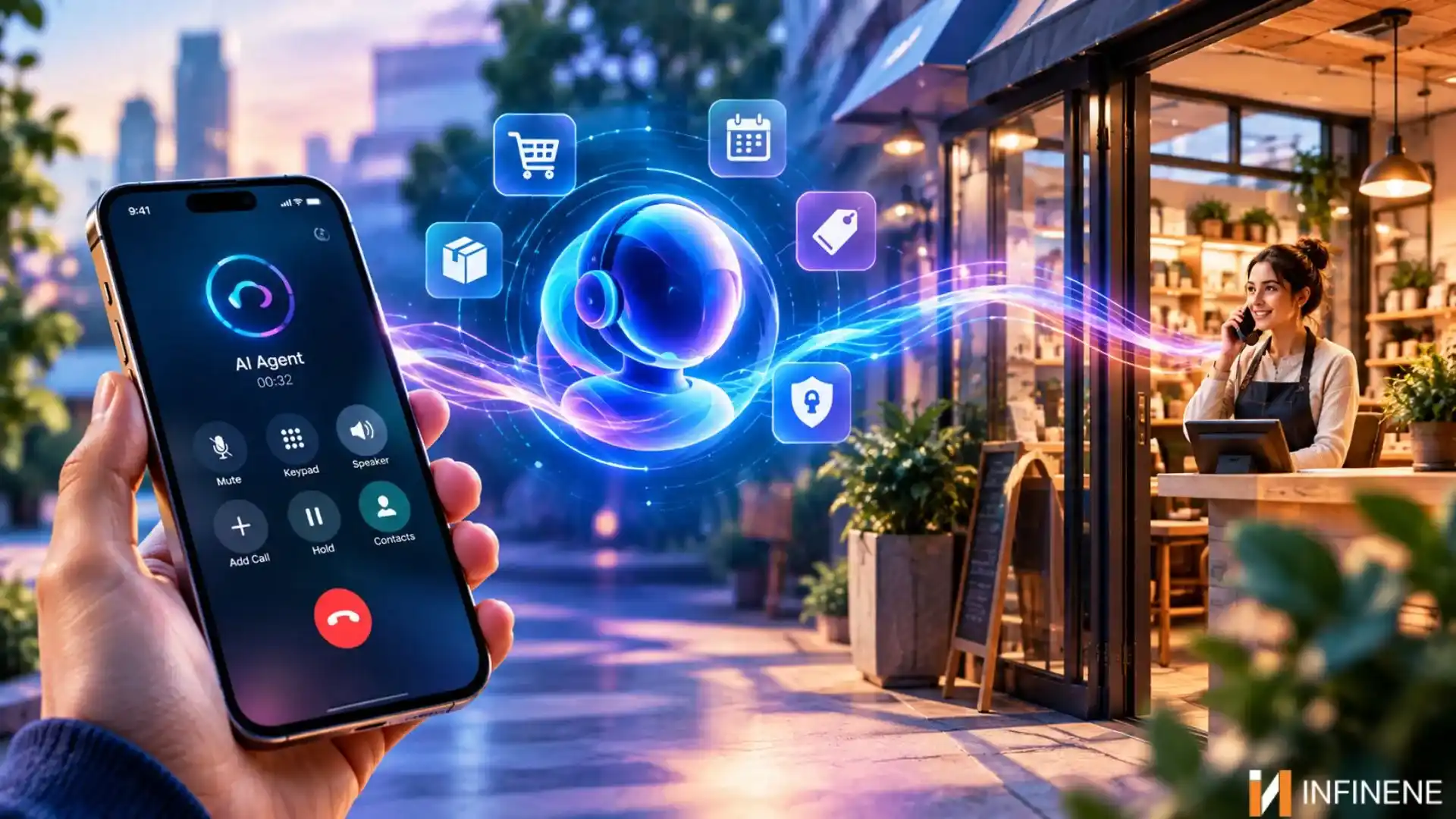
AI Agents Can Now Call Businesses for You: What Happens When AI Acts on Your Behalf?
You need to find out if a store has a specific espresso machine in stock. That means calling, sitting through a hold message, explaining what you want to whoever picks up, and probably repeating yourself once because the line cut out. Twenty minutes gone, and you still don't know if the trip across town is worth it.
Now picture the same errand handled differently. You type a request into an app. Somewhere in the background, software identifies the store, dials the number, talks to whoever answers, asks about stock and price, and texts you a summary a few minutes later. You never touched the phone.
That is not a thought experiment. Google already ships a version of it. Search for certain products "near me" in the US, and a "Let Google Call" button appears, built on the company's Duplex voice technology, which places the call, asks about inventory and pricing, and sends back a summary by text or email. The tool rolled out for categories like electronics, toys, and health and beauty, and it's a small but real answer to a question that used to belong to science fiction: what happens when an AI stop waiting for instructions and starts acting on our behalf?
The rest of this piece is about that question, not about defining artificial intelligence in general. Because once software can pick up a phone and speak for you, a whole set of practical and uncomfortable issues shows up that never mattered when AI only answered questions.
AI Agents Are Moving from Answers to Actions
For most of the last decade, "AI" meant a system that responded. You asked a chatbot a question, it gave you text back, and the interaction ended there. Nothing in the world changed because of that exchange.
An AI assistant improved on that by adding memory and context. A copilot went further, sitting inside a workflow and offering suggestions as you worked. But in every one of those cases, a human still had to take the final step. The AI proposed. The person disposed.
An agent breaks that pattern. Give it a goal instead of a question, and it plans a sequence of steps, calls the tools it needs, and carries the task through to a result without asking for confirmation at every stage. That distinction sounds subtle. It isn't. A chatbot that gives you wrong information wastes a few minutes. An agent that acts on wrong information can book the wrong appointment, buy the wrong item, or promise something to a business that you never intended to promise.
This is why the shift from chatbot to agent gets treated as a bigger deal than the jump from search engine to chatbot. Answering is reversible. Acting often isn't.
How Can an AI Agent Actually Call a Business?
Strip away the marketing language and an AI phone call is a stack of separate technologies working in sequence.
Speech recognition converts the human voice on the other end of the line into text the model can read. A large language model interprets that text, decides what to say next based on the goal it was given, and generates a response. Text-to-speech turns that response back into audio that sounds close enough to natural conversation that most people don't immediately register it as synthetic. None of this is new by itself; voice assistants have used pieces of this pipeline for years.
What changed is the layer sitting on top: tool access and orchestration. The agent isn't just generating a reply, it's deciding when to look up a calendar, when to check a price feed, when to place an outbound call through a telephony API, and when to stop and hand the interaction back to a person. That decision-making runs on instructions the user or the platform set in advance, plus whatever context the agent has been given, such as your address, your preferred appointment times, or a maximum price you're willing to pay.
Authentication and identity checks matter here too. Before an agent can act on your behalf, something has to confirm it actually has permission to represent you and to access the accounts or payment methods involved. That's a quieter part of the story than the phone call itself, but it's the part that determines how much damage a mistake or a hijacked agent can do.
What Happens During an AI-Made Phone Call?
Walk through a realistic version of the interaction, using something close to Google's shopping tool as the template.
First, you give the agent an objective: find out if a nearby store has a specific air purifier and how much it costs. The agent identifies which businesses are worth calling, using location data and whatever the platform already knows about nearby retailers. It figures out what information it needs before dialing, such as the model number and your acceptable price range. It places the call.
A person at the store answers. Depending on the platform and local rules, the agent identifies itself as automated, though the exact disclosure language varies by product and jurisdiction. It states the request in plain language. The employee might ask a clarifying question, like whether you want a specific color or size, and the agent responds within the boundaries it was given. If the employee asks something outside those boundaries, a well-built agent recognizes the limit and either says it doesn't have that information or flags the call for a human to finish. Once the call wraps up, the agent confirms what it learned and reports back to you, usually as a short text or email summary rather than a full transcript.
That flow works fine for a routine inventory check. It gets shakier fast once the request involves negotiation, medical detail, or anything where a wrong answer has real consequences. Capability here is not uniform. What one vendor's agent handles cleanly, another's might mishandle entirely, and the difference often comes down to how narrowly the task was scoped.
What Can AI Agents Do on Your Behalf?
The realistic list of tasks today leans toward the routine and low-stakes:
Checking whether a product is in stock at a nearby store.
Asking about pricing or an active promotion.
Scheduling or confirming a straightforward appointment.
Following up on an order or delivery status.
Answering basic administrative questions, like store hours or return policies.
Comparing prices or availability across a few businesses.
Every one of these shares a trait: the cost of a mistake is small and easy to correct. If the agent gets a store's hours wrong, you call back or check a website. Nothing about that is likely to hurt you financially or legally, which is exactly why these are the tasks companies have been comfortable automating first.
What AI Agents Should NOT Be Allowed to Do Without You
The flip side of that list is longer and more consequential, and it's where most of the current caution in the industry sits.
Financial transactions above a small, preset threshold, medical decisions or the disclosure of health information, anything involving a legal contract, high-value purchases, identity verification, account recovery, and password resets all sit in a category where a mistake isn't easily undone. An agent that books the wrong hair appointment is a minor annoyance. An agent that agrees to a service contract on your behalf, misreads a return policy and confirms a non-refundable purchase, or hands over a Social Security number to the wrong party on a phone call, is a different kind of problem entirely.
The operating principle here is permission boundaries: an agent should only be able to do what it has been explicitly authorized to do, and anything irreversible or high-stakes should require the human to step back in before it happens. Google's own shopping rollout reflects this. Even its automated checkout, which monitors prices and buys an item once a shopper's condition is met, still requires the shopper to set that rule and confirm it upfront rather than letting the agent decide independently what counts as a good deal.
Do Businesses Know When an AI Is Calling?
This is one of the murkier parts of the story, and it's moving because regulators are forcing it to move.
In the United States, the Federal Communications Commission has already ruled that AI-generated voices in unsolicited robocalls fall under the Telephone Consumer Protection Act, which effectively makes that category of AI-voiced calling illegal without the recipient's consent, and the agency has separately pushed toward requiring disclosure whenever AI is used in an automated call or text. That rulemaking grew directly out of AI-generated robocalls that impersonated a public figure to discourage people from voting, so the regulatory pressure here is real and specific, not hypothetical.
None of that map perfectly onto a consumer using an agent to call a local store on their own behalf, which is a different situation than mass robocalling, but it signals where the expectations are heading. Businesses increasingly want to know whether they're talking to a person or a system, both for legal reasons and because the two require different handling. A store employee negotiating with a human customer might offer flexibility they wouldn't offer to a script. Transparency about who or what is on the line protects both sides from misunderstandings that could otherwise turn into disputes.
What Happens When an AI Agent Makes a Mistake?
Agents fail in fairly predictable ways. They mishear a price or an address. They accept an appointment slot that doesn't actually work for the person's schedule. They get stuck looping through an automated phone tree designed for humans, not machines. They run into a question they weren't built to answer and either guess or freeze.
The mitigations that matter is less about making the model smarter and more about limiting what it's allowed to do without checking in first. That means requiring explicit confirmation before anything consequential happens, setting hard spending limits, building in a clear path to hand a stuck interaction to a human, and keeping a call summary or audit log so a mistake can actually be traced afterward instead of disappearing into a black box. None of this eliminates errors. It just keeps them small and recoverable, which is the entire point of scoping an agent's authority narrowly in the first place.
The Privacy Problem: How Much Should Your AI Know?
An agent that can act well needs context: your name, phone number, address, maybe payment details, your calendar, your preferences. The more it knows, the smoother the interaction, and the more convincing it sounds when it's speaking for you.
That's also exactly the trade-off worth sitting with for a second. Every piece of personal information an agent carries into a phone call is information that now exists in a system you don't fully control, being spoken out loud to a stranger on the other end of a line. This isn't a reason to avoid these tools, and it isn't a five-alarm privacy crisis either. It's a genuine trade-off between convenience and exposure, and the sensible response is to give an agent only what a specific task actually requires rather than granting broad, standing access to everything it might someday need.
AI Agent Security Risks
An AI that only generates text can produce a bad answer. An AI that can act can produce a bad action, and that difference is the reason security researchers have started treating agents as a distinct category of risk rather than a bigger chatbot.
Prompt injection now sits at the top of OWASP's ranking of AI security risks, and the organization built that ranking from a database of roughly ten thousand real-world incidents rather than expert guesswork. The attack itself is simple to describe: hidden instructions, buried in a document, a webpage, or even a spreadsheet cell, get read by the agent and mistaken for legitimate commands. Against a chatbot, that produces an odd answer. Against an agent that can place calls, move money, or access accounts, the same trick can trigger an action nobody authorized.
Excessive permissions compound the problem. An agent holding more access than a given task requires is a bigger liability every time it's tricked or simply makes a mistake on its own. Voice spoofing and impersonation raise a parallel concern specific to phone-based agents: if a system can convincingly mimic natural speech, the same technology can be misused to convince a business, or a person, that they're talking to someone they aren't. None of this means agents are too dangerous to use. It means the industry consensus, echoed by OWASP and by companies like Microsoft in their own agent security research, is that tightly scoped permissions and human checkpoints matter more than any single detection tool.
AI Agents vs. Chatbots: What's Actually Different?
 The lines blur in practice. Plenty of products
marketed as "assistants" already do things that fit the agent column,
and plenty of so-called agents still ask for confirmation more often than the
label suggests. Treat this table as a rough map of a spectrum, not a
strict taxonomy.
The lines blur in practice. Plenty of products
marketed as "assistants" already do things that fit the agent column,
and plenty of so-called agents still ask for confirmation more often than the
label suggests. Treat this table as a rough map of a spectrum, not a
strict taxonomy.
Could AI Agents Become Your Digital Proxy?
This is the part of the story worth sitting with rather than rushing past. If an agent can call a store today, there's no obvious technical reason it couldn't eventually coordinate a doctor's appointment, follow up with a contractor, compare insurance quotes, or handle the small administrative tasks that quietly eat up an afternoon.
That points toward something bigger than a productivity feature. It points toward a version of AI that functions as a digital proxy, standing in for a person across a string of small interactions rather than just one call. And that raises a genuinely open question that has nothing to do with what the technology can technically do: how much of your own judgment are you willing to hand over for the sake of convenience?
Delegating a small decision, like which store to call first, is easy to feel fine about. Delegating a slightly bigger one, like which price counts as good enough to accept, is less obvious. There's no universal answer to where that line should sit. What matters is that the line gets drawn deliberately, by the person granting the authority, rather than by default settings nobody thought carefully about.
Will Businesses Need to Prepare for AI Callers?
Flip the perspective and a parallel challenge shows up on the other end of the phone. A business that has spent years training staff to handle human callers now has to handle AI callers too, and the two don't behave the same way. An AI caller won't respond to charm, won't fill dead air with small talk, and will ask exactly the question it was built to ask before hanging up to report back.
That's pushing some businesses toward thinking about AI-readable information: structured data about pricing and availability that an agent can pull without needing a full conversation, clearer disclosure practices so an AI caller identifies itself upfront, and in some cases, tools designed specifically to detect and route automated calls differently than human ones. None of this is standard practice yet. It's an emerging consideration, most visible right now among the retailers already fielding Google's shopping-related calls, rather than something every business needs to solve immediately.
What Happens Next?
A few developments look likely to keep shaping this space over the next year or two. Personal AI agents will keep expanding beyond shopping into other everyday errands, following the same pattern of starting narrow and low-risk before widening scope. Voice agents will keep improving at handling interruptions and unexpected questions, closing some of the gap between "sounds natural" and "actually understands." Authentication and permission systems will get more granular, because that's the piece regulators and security researchers keep pointing to as the real lever for keeping this safe. And multi-agent setups, where one agent coordinates with another rather than a human directly, will start showing up more in enterprise settings before they become common for individual consumers.
None of these points toward agents operating with unlimited independence any time soon. The direction of travel is narrower and more supervised than that, even as the range of tasks these systems handle keeps growing.
The Bigger Question Isn't Whether AI Can Call. It's Whether We Should Let It Decide
The remarkable part of all this was never really that software can talk to another person over the phone. Speech synthesis convincing enough to pass in a short exchange has been technically possible for a while now.
The actual shift is that people can now delegate real decisions, even small ones, to that software. Which store to call. What price to accept. Whether an answer is good enough to act on without asking first. Each of those choices used to require a person, and now some of them don't.
That's why the useful question going forward isn't "can AI do this." Increasingly, the answer is yes, at least for a growing set of narrow tasks. The question that actually matters is what any of us should let AI decide on our behalf, under what permissions, and with how much of a human still watching before it hits send.
Related Reads
- The Complete Guide to Agentic AI Development Services for US Businesses in 2026
- AI for Business Process Automation: A 2026 Strategy Guide for US Enterprise Leaders
- The End of Chatbots? How Multimodal AI Captures More Customer Intent
- How AI Is Transforming Shopping, Banking, Healthcare, and Travel
- How AI Is Reshaping the US Job Market in 2026