


I have sat through enough vendor demos over the past two years to spot the pattern. A company shows you a chatbot, calls it transformative, and waits for applause. Most of those tools did one thing. They answered questions. They did not actually do the work. Holding that distinction in your head is the easiest way to understand what changed in 2026.
The newer systems plan a task, take actions across the tools you already use, check whether they got it right, and finish the job with a person stepping in only when something looks off. People call these systems AI agents, and the work of building them is what vendors mean when they pitch Agentic AI Development Services. If you run a business in the US and you have watched a competitor quietly trim its costs or turn work around faster, agents are usually somewhere behind it.
What follows is meant for the people who own the budget and the outcome. I will walk through what these projects actually involve, where they earn their keep, what they run, and the mistakes I keep seeing sink the early ones.
A regular AI tool sits there until you prompt it, then hands back a response. An agent behaves more like a junior employee with a checklist. You give it a goal. It figures out the steps, decides which systems or data it needs, runs through them, and judges whether the result met the objective. When a step fails, a decent agent retries or flags a human instead of quietly giving up.
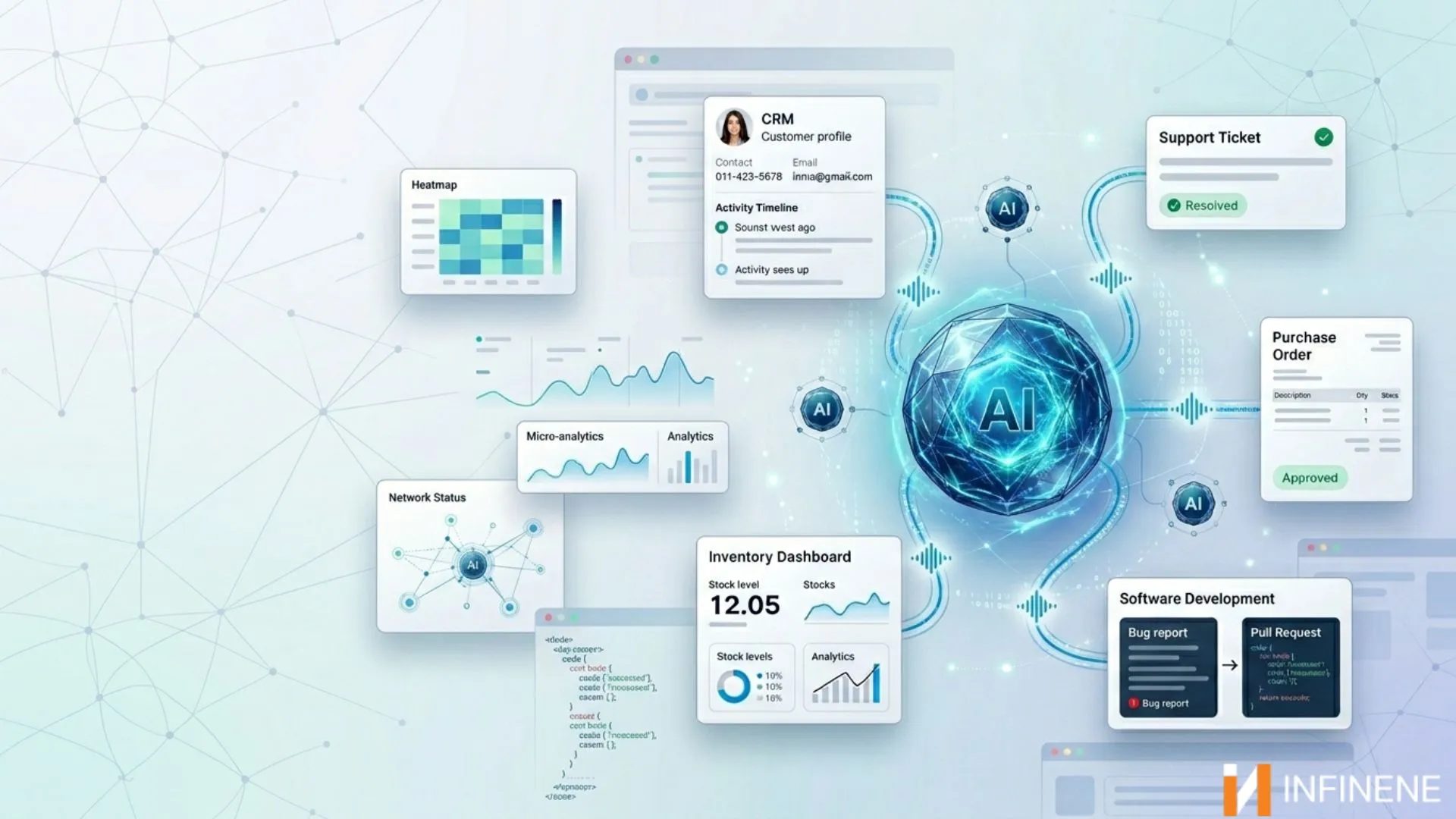
Procurement is a clean example. A chatbot can recite your approved vendor list. An agent can read a purchase request, confirm there is budget in the ERP, run the vendor against your compliance rules, draft the purchase order, send it for approval, and ping the requester once it clears. One answers a question. The other closes out the task.
That gap is the whole reason Custom AI Agent Development moved out of the research corner and onto operations budgets. The payoff stopped being a slide and started showing up in the numbers.
Three things lined up at roughly the same time. The models got reliable enough to trust in production. The plumbing for wiring agents into business systems matured. Moreover, the cost of running them dropped far enough that automating a mid-volume workflow finally pencils out.
For American firms in particular, flat headcount and stubborn labor costs have made Agentic AI Solutions appealing in industries that shrugged off earlier automation waves. Hospital back offices, regional banks, freight operators, and professional services shops are all running pilots this year. The ones getting somewhere are not chasing the slickest demo. They picked a single expensive, repetitive process and automated it from start to finish.
The best results I have seen come from work that is rule-heavy, high in volume, and currently done by capable people stuck on tedious tasks.
In financial services, agents reconcile transactions across systems, flag the odd one out for a human, and assemble draft regulatory filings. In healthcare, they grind through prior authorization paperwork, the kind of thing that eats clinician hours for no good reason. In e-commerce, they process returns, adjust inventory, and react to a supplier slipping a deadline without waiting on a manager to notice.
Software teams turned into heavy users almost overnight. Agents triage incoming bug reports, reproduce the issue, suggest a fix, and open a pull request for an engineer to review. This flavor of Enterprise AI Agent Development tends to pay back fastest, because the people whose time you free up are expensive and the tasks are already well documented.
Customer operations is where most companies start. An agent that reads a ticket, pulls the customer record, checks the order history, issues a refund inside policy limits, and updates the case notes clears a big chunk of routine tickets off human queues. The ones that work are kept on a short leash. Anything unusual is handed to a person instead of improvised.
Vendors break these engagements into stages. Knowing the order helps, you tell a serious proposal from a hopeful one.
The first phase is not technical at all. A good partner spends real time mapping your workflows and figuring out which ones are worth automating. The strong candidates share three traits: clear rules, measurable outcomes, and enough volume to justify the build. If a vendor skips this and jumps straight to architecture, treat it as a warning.
Once you have settled on a workflow, the team designs how the agent sees information and what it is allowed to do. That means connecting it to your CRM, your databases, your ticketing system, and your internal APIs. This integration work is usually the biggest part of the job, far bigger than anything touching the model itself is. This is where an experienced AI Agent Development Company USA earns its fee, because tangled enterprise systems are where most projects quietly die.
Agents take actions, so they need limits. The build spells out what the agent can do on its own, what needs a human signature, and what it must never touch. A refund agent might clear anything under a set dollar amount and route the rest to a person. Those boundaries are central to responsible Custom AI Agent Development, and they belong in the conversation early rather than bolted on at the end.
Before an agent touches anything live, it gets tested against real historical cases. The team tracks how often it succeeds, what kinds of errors it makes, and whether it correctly recognizes the moments it should escalate. This evaluation step is what separates production-grade Agentic AI Solutions from a demo that dazzles in a conference room and falls apart in the wild.
Launch is the start, not the finish. Agents run under continuous monitoring, and the team reviews escalations and failures to sharpen behavior over time. Most engagements include a tuning stretch where performance climbs as edge cases surface.
Pricing is all over the map, and any firm that quotes a flat figure before seeing your systems is guessing.
A narrow proof of concept that automates one well-defined workflow usually runs between twenty-five and seventy-five thousand dollars, depending on how messy the integration gets. A production deployment with several integrations, a security review, and ongoing support more often lands somewhere between one hundred and three hundred thousand for the initial build. Large enterprise programs that touch many systems and carry strict compliance requirements climb well past that.
Running costs include model usage, which scales with how much the agent works, plus monitoring and maintenance. A reasonable rule of thumb is to budget yearly running and support at roughly twenty to thirty percent of the build. And here is the part that surprises people: the integration and upkeep dominate the total, not the AI usage. The model is the cheap part.
The honest way to judge cost is against the labor it replaces or supports. An agent that absorbs two full-time roles worth of routine work pays for itself fast. One built to impress a board meeting never does.
These projects fail in predictable ways, and knowing the failure modes lets you steer clear.
Choosing the wrong process is the most common stumble. Teams reach for workflows that are too fuzzy or too low in volume to justify the effort. Data quality is the next one. Agents inherit whatever mess lives in your systems, and inconsistent records produce inconsistent behavior. Integration friction is the third, since enterprise systems rarely connect as cleanly as anyone hopes.
There is a governance problem too. An agent that takes actions can take wrong actions at scale. That is exactly why permission boundaries, audit logs, and human checkpoints matter. Responsible Enterprise AI Agent Development treats oversight as a feature rather than a tax, and you should be skeptical of any partner that waves it off.
Then there is the human side. People worry about being replaced. The projects that land are framed honestly, around lifting tedious work off employees so they can spend time on judgment, and they pull the affected teams into the design instead of surprising them.
The market is crowded and the quality gap is wide. A handful of questions sort the strong shops from the weak ones.
Ask to see something running in production, not a demo. Ask how they handle evaluation and which success rates they actually measure. Ask how they manage permissions and what happens when an agent hits something it does not understand. A credible AI Agent Development Company USA will talk easily about failures and guardrails, because they have shipped real systems and lived with the consequences.
Domain familiarity counts for more than people expect. A team that has built agents for healthcare already knows the prior authorization rules and compliance traps a generalist will learn on your dime. Weigh relevant experience over a glossy portfolio.
InfineneTech builds Agentic AI Development Services that run in production, not just in demos. Tell us the workflow that is costing you the most, and we will show you what automating it actually looks like.
A few trends are worth keeping an eye on as you plan.
Multi-agent setups are maturing, where specialized agents collaborate on a larger workflow and one coordinates the others, not unlike a team lead handing out assignments. The standards for how agents connect to tools and data are consolidating, which is slowly pulling integration costs down. Moreover, regulators in the US are paying closer attention, especially to accountability for autonomous actions in regulated fields.
The practical lesson is that early, well-scoped investments compound. A company that ships one working agent now builds the internal expertise, data discipline, and governance habits that make the next ten faster and cheaper. The capability stacks. The firms treating 2026 as a year to learn will hold an edge that is hard to buy back later.
A chatbot replies to messages. An agent pursues a goal by taking actions across systems, checking its own results, and escalating when it needs to. The difference is between answering and doing.
A focused proof of concept usually takes six to twelve weeks. A production deployment with full integration and testing more often runs three to six months, depending on how many systems are in play.
Not really. Agents lean more on access to your live systems and clear process rules than on giant training datasets. Clean, well-documented workflows matter far more than raw data volume.
You need a business owner who knows the target process inside out, someone with access to the relevant systems, and a stakeholder who can approve the permission boundaries. Technical depth on your side helps but is not always required.
It can be, with the right architecture. Reputable providers of Agentic AI Development Services build in data isolation, audit logging, and access controls, and many will deploy inside your own cloud environment. Settle the security expectations in the contract.
Well-built agents are designed to escalate uncertain cases rather than guess, and every action is logged for review. The whole point of strong guardrails is to cap the cost of any single error.
Agentic AI Development Services have moved past the experimental stage for US businesses. The technology is mature enough to return real value when you point it at the right problems, and the gap between companies that have working agents and those still talking about them widens every quarter.
The smartest first move is a small one. Pick a single expensive, repetitive workflow, scope it tightly, and build something that works before you expand. That one project will teach your organization more than any strategy deck.
If you are weighing where agents fit in your operations, a short conversation with an experienced team can clarify which of your workflows are worth automating first and what a realistic return looks like. The companies that start with a focused, well-built solution are the ones positioned to scale Agentic AI Solutions across the business in the years ahead.