


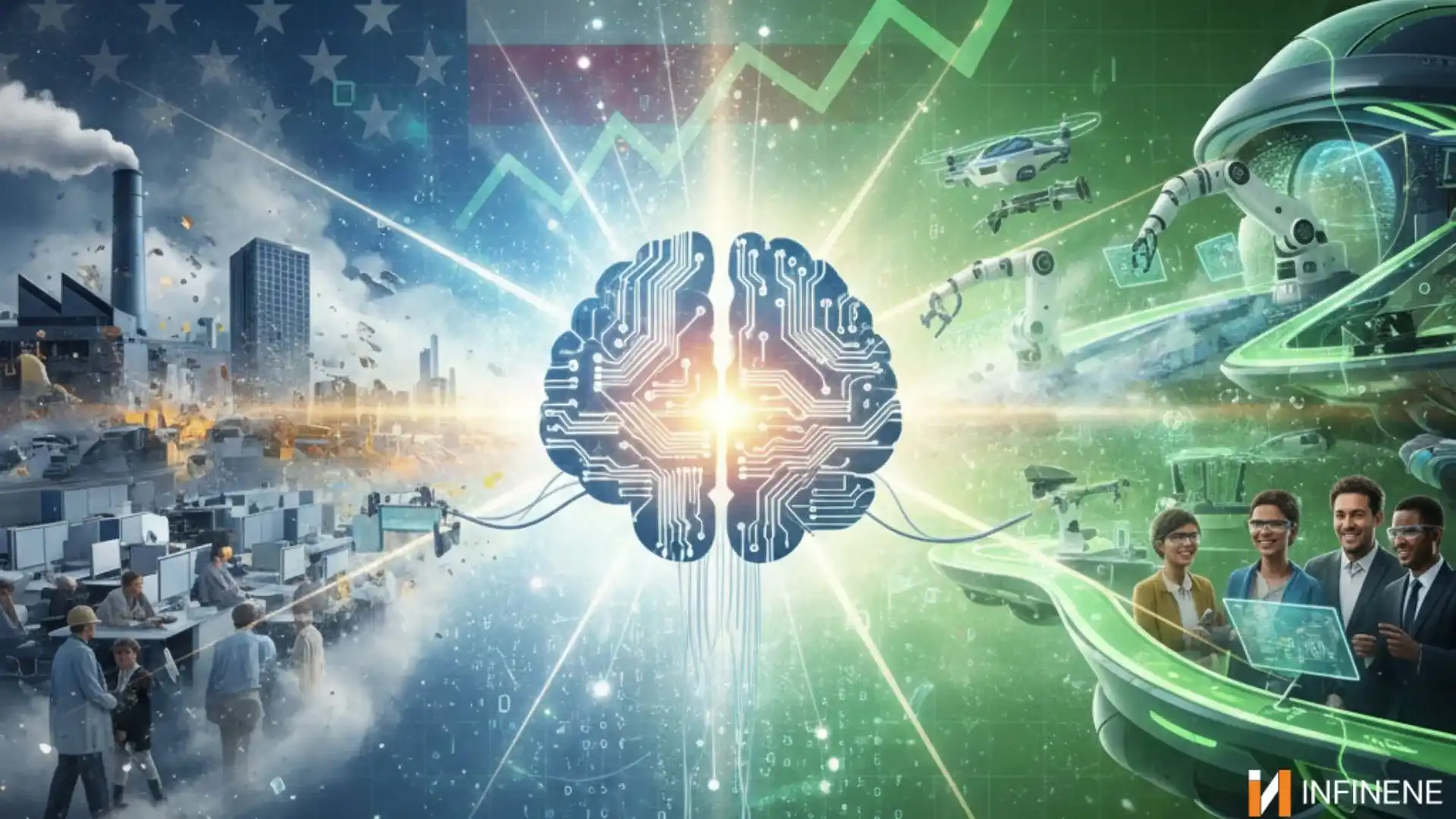
The AI job market US is undergoing seismic changes in 2026. AI has evolved beyond its original application in scientific research laboratories and specialized technology firms. It is now integrated in business operations to revolutionize all industries by streamlining administrative operations and upgrading specialized technical positions. The trends AI and jobs in the US are experiencing complete transformation for both workers and organizations. Intelligent algorithms have begun to take over routine tasks which used to require several hours of human labor for activities such as data entry and scheduling. This automation enables professionals to concentrate their efforts on activities which have a significant impact on their growth. The introduction of AI into the workplace has established new employment opportunities which did not exist before. New positions have emerged including AI trainers, prompt engineers and human-AI collaboration specialists.
Job seekers must learn about these changing trends. Understanding of modern trends affects employment opportunities. The old-school skills that were once the ticket to excel in your career have lost their effectiveness. Organizations now require employees who possess skills including technical proficiency in AI tools, data literacy and problem-solving abilities. HR leaders and policymakers face a similar challenge.
The current fast-paced job environment reveals that knowledge is the strongest advantage. Organizations can achieve success by determining their most affected positions, assessing upskilling needs and implementing the required changes. This blog demonstrates how artificial intelligence technology transforms employment patterns within the United States by identifying the most affected jobs and determining essential skills needed for future positions. Professionals and businesses who understand and adapt to these trends will achieve success.
The US economy in 2026 shows a combination of economic expansion and decreasing joblessness combined with technological advancements that is transforming workforce practices. The country struggles to recover from pandemic-related interruptions which are now being affected by inflation, new global trade patterns and current international political situations. Technology-driven changes have become the core element of the modern US labor market as they determine what tasks need people to be executed and which can be automated to save time.
The sectors of healthcare, financial technology and green technology powered by artificial intelligence see fast growth. immediate employment of personnel who possess particular artificial intelligence skills is the need of the hour. These industries require workers who can navigate complex systems and collaborate with AI tools to deliver innovative solutions. Automated systems now function as operational enhancements for manufacturing retail and logistics industries. AI enables these sectors to achieve cost savings and productivity improvements. The US labor market is undergoing a major transformation through emerging employment options and system-based automation methods.
US Bureau of Labor Statistics reports show that AI implementation produces productivity increases between 15 and 25 % for businesses. The increased performance allows workers to accomplish their tasks faster while their job responsibilities undergo complete transformation. AI systems now complete repeating tasks while workers focus on developing creative solutions, solving intricate issues and mastering new technologies. The impact of AI on employment is very clear. Professionals need to work together with AI systems to control advanced equipment and use machine-derived data for making business choices.
The AI workforce trends 2026 reveal a dual pattern. The first pattern shows that automation takes over repetitive work which leads to the elimination of particular standard employment positions. The second pattern shows that there is a rise in advanced job openings. Some of the fast-growing new fields are AI development, data analytics and human-AI collaboration. Job seekers need to learn these skills to beat the competitive job market. While the Professionals should upskill and focus on lifelong learning to meet the changing work requirements.
The US economy in 2026 presents itself as a fundamental transformation. AI functions both as a productivity accelerator and an employment development force that establishes a framework where people achieve success through their knowledge and ability to adapt.
The US labor market in 2026 is witnessing a significant transformation and AI is at the heart of this shift. The impact of AI on employment in 2026 is multi-dimensional. Major industries experience AI-driven task replacement. This trend generates new employment opportunities requiring advanced skills. Professionals who embrace technological fluency together with problem-solving and adaptability skills will achieve success. While organizations that implement AI through strategic methods will experience productivity gains and growth. The understanding of these trends is crucial because artificial intelligence now functions as an essential tool for future workforce development.
The financial sector is among the earliest adopters of AI in its processes. It is used to detect fraud, provide customer service through automation and conduct algorithmic trading. The process of automating entry-level clerical positions has now evolved to include traditional roles like loan processing and account management. The field of financial data analysis, AI auditing and regulatory compliance presents new career paths for professionals.
For instance, banks and finance companies hire AI compliance specialists to verify algorithm compliance with legal requirements. They also hire data analysts to study trends produced by automated systems. The Impact of AI on Employment demonstrates two outcomes. It removes certain job positions while creating opportunities for higher skilled employment.
implementation of AI has a visible impact on the healthcare industry. AI-based diagnostic tools provide accurate results through their ability to interpret medical imaging scans and identify preliminary disease indicators. They can also forecast patient health results. AI technology enables continuous patient surveillance. It also optimizes hospital operations through its ability to manage scheduling activities and billing procedures.
The healthcare industry currently experiences a decline in medical transcription and manual data entry positions. While AI-assisted radiologists, healthcare data scientists and digital health coordinators are increasingly becoming popular. AI implementation in hospitals leads to increased operational efficiency and decreased human error cases.
Artificial intelligence transforms production processes in manufacturing through robotic systems and ability to predict equipment failures. The industry increasingly depends on automated machine operations. Yet there is a growing need for personnel who can oversee robotic systems and interpret production information to resolve system malfunctions. Factory managers now depend on predictive analysis to avoid equipment failures while their technicians observe AI-powered machines. AI technology is demonstrating its capacity to execute repetitive functions successfully in every industry.
This sector is leading the AI-powered employment transformation. Companies are hiring machine learning engineers and AI specialists to create intelligent software and AI-powered solutions. The automation process eliminates basic programming and testing tasks. Teams can now use their time to develop new products and safeguard AI technologies against cybersecurity dangers.
Both startups and established tech companies are looking to hire professionals who can create artificial intelligence models and optimize their algorithms to enforce responsible AI development standards. The impact of AI on employment in this sector is particularly visible as traditional developer roles now evolve into AI-centric and innovation-driven positions.
AI technology is a cause of transformation in both the retail and e-commerce industries. The system uses chatbots to address common customer questions. Predictive analysis improves inventory management. While personalized recommendation systems drive increased sales. Automation creates challenges for cashiers and customer service representatives but businesses now require professionals who work as AI retail analysts and supply chain optimization specialists. The employment effects of AI technology extend beyond technology-based fields. Companies such as Amazon and Walmart now utilize AI solutions in their regular customer service operations.
There is a widespread perception among people that the whole work field are becoming extinct. This is not the entire truth.
The impact of AI on employment in the United States could not be that simply explained. It requires deeper understanding. AI technology eliminates specific job functions through its automation capabilities. employees now need to work on strategic tasks. Some of the job tasks that AI has currently replaced are as follows.
Data entry clerks - The manual process of entering data and organizing large volumes of data has now become automated through AI systems. They achieve greater accuracy and require less operational time.
Routine customer support agents - Virtual assistants and AI chatbots provide solutions to frequently asked questions. They manage user requests and direct complex problems to human representatives who handle sensitive customer situations.
Basic bookkeeping roles - Automated systems handle invoice processing and reconciliation. They produce standard financial reports which allows accountants to concentrate their efforts on analysis and strategic planning tasks.
Assembly line operators - The manufacturing process uses robots to handle repetitive tasks while humans manage system operation and process development.
Professional knowledge work - AI systems in legal and compliance examine contracts. They create standard reports and monitor regulations to detect anomalies. This enables professionals to spend their time on decision-making and interpretation work.
The point to be noted here is the impact of AI is task-specific rather than profession-wide. The entire job scope stays unchanged as only some tasks can be automated. Workers still need to develop their creative abilities and learning skills to make independent choices. People who adapt to AI tools and automated system management will achieve permanent job security.
With AI organizations experience enhanced efficiency and productivity because they can direct their human resources toward essential business operations. AI is only transforming the nature of work. The automation of repetitive tasks allows workers to become more flexible and better at creating new ideas.
The integration of AI has a very positive impact on the United States labor market. It has created many new employment positions. It transforms industry standards by automating existing work functions. In 2026, companies will use artificial intelligence systems to boost operational efficiency and enhance customer service. The following list shows new employment positions which will arise from artificial intelligence technology.
AI trainers and annotators - Professionals who create and annotate data for AI training purposes work to maintain accurate model learning and reliable system outputs.
Machine learning engineers - The Machine learning engineers design and build artificial intelligence systems which include predictive modeling and sophisticated neural network technologies.
AI ethicists and compliance officers - The role of AI ethicists and compliance officers involves creating responsible AI systems that meet ethical standards and legal requirements.
Data privacy managers - They create secure AI operations by protecting sensitive data and development of AI security protocols. They handle risks which arise from processing large amounts of data.
AI-enhanced customer experience - They create user interfaces and customer journeys through AI integration. They are responsible for improving user interaction and customer satisfaction.
Digital transformation specialists - They guide organizations through AI adoption by connecting technology with business strategy to achieve maximum organizational results.
These positions reflect a broader trend toward hybrid roles which require employees to possess both technical skills and industry expertise. Companies want professionals who can operate AI tools while understanding how to strategically apply these tools for solving practical business challenges. The healthcare AI specialist requires both data science competencies and patient care knowledge. While the fintech AI engineer needs algorithmic expertise and financial compliance understanding.
The rise of these positions demonstrates the positive side of AI in employment. The workforce is moving toward higher-skilled strategic work. Organizations now offer new positions in artificial intelligence development and user experience fields. AI technology reshapes existing employment while creating new jobs which benefits business growth throughout the United States economy.
Instead of competing against it, AI requires people to develop the skills needed for effective collaboration with automated systems. It enables workers to achieve their full potential rather than its automation capacity. Professionals need to develop technical and adaptive skills and digital skills to excel in their future work environment.
Technical skills - Technical skills remain foundational for many AI-related roles. Workers can operate AI systems through the understanding of machine learning and data analysis. Non-technical employees receive better support from technical teams when they know about basic AI functions and data processing methods.
Adaptive skills - Workers who possess critical thinking abilities and creativity skills together with emotional intelligence can use these skills to handle difficult situations. They can assess AI-generated data to find its most effective application. A marketing professional uses AI analytics to understand consumer behavior.
Digital literacy - Employees must acquire digital literacy skills to operate AI-powered software and understand cybersecurity basics for secure AI tool usage. All employees must understand how AI technology connects with their everyday work activities in project management and data reporting to gain a competitive edge.
Upskilling and reskilling - organizations should create essential methods to maintain a competitive edge. Online learning platforms and corporate training programs enable employees to develop new technical skills while building their capacity to adapt to different situations.
US companies are adopting more comprehensive workforce changes because the impact of AI on employment has become more pronounced. Traditional job design requires human workers to complete their tasks. but progressive organizations develop new work methods that enable human employees to work with intelligent systems. Organizations are shifting their focus from reducing expenses toward building internal capabilities.
The main AI workforce transformation initiatives for companies include the following elements:
Comprehensive upskilling programs - Businesses are developing internal training academies and working with online learning platforms to deliver certification programs that meet their needs in data analytics, AI tools and cloud computing. Many organizations choose to train their employees in new AI-enabled positions instead of terminating them.
Integration of AI tools into daily operations - AI tools find their application through direct integration into business processes which include automated reporting and predictive analytics. Companies use gradual exposure to enhance their employees' adaptation processes which results in better productivity.
Job redesign combining human and AI strengths - The new job profiles require employees to spend their time on strategic thinking and creative tasks. It needs their emotional intelligence skills while AI handles all repetitive and data-intensive work. Analysts now concentrate on understanding AI-generated information because it has become their primary task.
AI-driven HR analytics - Organizations use predictive analytics in their HR functions to predict future employee requirements and determine existing skill deficiencies.
Cross-functional digital teams - Companies create cross-functional digital teams that combine IT staff members with business executives and operational personnel to support their AI deployment projects.
The development of AI technology is disrupting employment in multiple sectors. This has led US government officials and business leaders to develop a system of rules that protects jobs while enabling new technological developments. The objective of this project is to achieve responsible AI deployment which protects workers and creates sustainable economic development. The current AI regulation discussions in the United States focus on three main areas of concern.
AI ethics and bias mitigation - Regulators are emphasizing transparency in algorithmic decision-making, particularly in hiring, lending, and healthcare. Companies must now conduct AI system audits to establish fair outcomes while preventing discrimination.
Data privacy and security - AI systems require large dataset access which necessitates stronger privacy and cybersecurity protocols to protect both personal and corporate data.
Incentives for AI-related training programs - Federal and state initiatives are increasing funding to support workforce development through community college partnerships and employer-based reskilling initiatives.
Labor protections for displaced workers - Policymakers are currently investigating labor protection options which include expanded unemployment benefits and transition assistance programs.
The impact of AI on job markets will shift from immediate disruptions to established work practices by 2030. The United States workforce will develop into a flexible working environment which combines human skills with artificial intelligence technologies. AI will act as a decision-support tool which helps workers build their productivity throughout the day.
The workforce development process will experience multiple long-term trends which will include the following elements.
The workforce will use a combined approach to decision-making through which AI systems will handle data analysis and forecasting. While employees will make ethical assessments and leadership decisions along with resolving intricate issues.
High-skilled employment sectors will experience substantial growth as the technology sector expands. The demand for advanced technical skills and interdisciplinary expertise will increase in the fields of technology and AI engineering.
All workers in different fields will need to master AI tools. It will become a mandatory skill that matches current computer literacy requirements.
People will need to develop their skills throughout their lives because micro-credential programs and employer training will replace their dependence on traditional degrees. People will establish their career paths through skills-based systems which provide flexible work options.
The need for standardized work procedures will decrease because organizations will value creative and strategic work activities.
Employees who possess both technical and industry knowledge of AI applications within healthcare and finance will maintain a competitive edge.
Organizations looking to lead in the AI-driven future can partner with InfineneTech to design practical workforce and business transformation strategies. InfineneTech helps US enterprises implement AI automation, upskilling frameworks, and intelligent operational systems that improve productivity and adaptability. Contact us to discover how your business can build a sustainable AI-powered competitive advantage.
Will AI replace
jobs in the US?
The implementation of AI technology currently
transforms specific job tasks but does not affect complete professional fields.
The technology mostly impacts workers who execute tasks that require little
thought while protecting positions that demand artistic thinking, emotional
understanding, and advanced problem-solving capabilities.
The most affected work areas include data entry, routine customer service, basic bookkeeping, and manual assembly tasks. The legal profession and contract review process together with accounting and reporting fields experience partial automation.
AI technology creates new employment opportunities through AI-driven roles. The process of automation removes basic work activities from the workplace while creating new jobs that need advanced abilities.
Organizations use employee reskilling, upskilling activities and daily AI tool implementation approaches. Employees receive training to work together with artificial intelligence technology while they sustain their productive and creative thinking capabilities.
The US workforce needs technical machine learning, AI tools and data analysis expertise together with critical thinking and problem-solving for success in their work.