


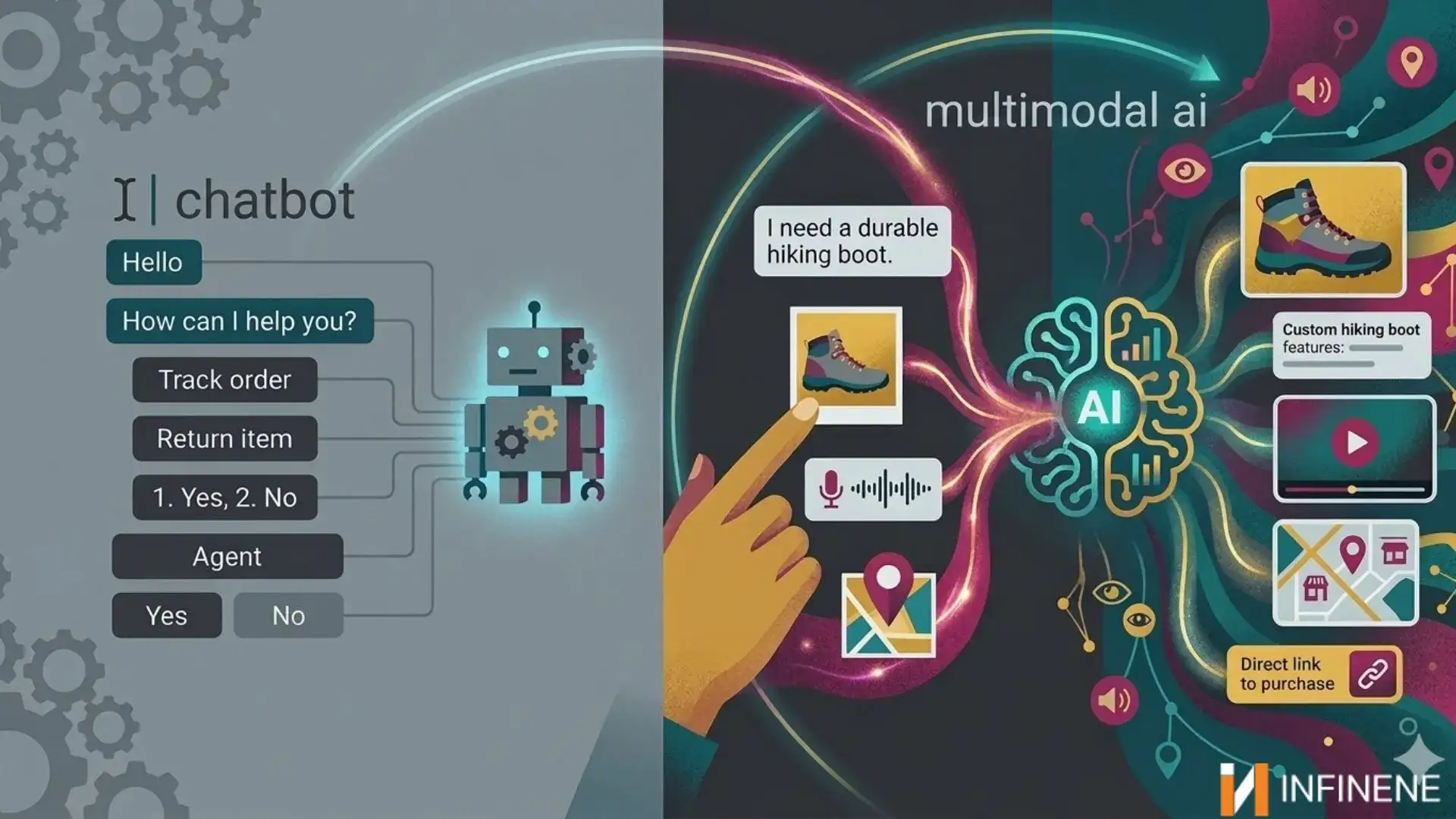
For the past decade, chatbots have been the top choice for businesses seeking customer service solutions. The system enabled businesses to handle customer inquiries at all times while delivering instant help, together with lower operational expenses. There was a time when people actually thought that these AI virtual assistants would completely take over human staff.
Traditional chatbots operate with limited functions and sometimes create frustrating user experiences. The system incorrectly interprets customer inquiries which forces customers to either repeat their requests or go through complicated automated systems. Beyond that, chatbots lack the ability to understand human communication which contains multiple contextual elements. They miss important information that human beings demonstrate through their body language and vocal expressions because they cannot process audio or video content.
The primary issue that chatbots face arises because their systems fail to comprehend customer requirements. It cannot detect a frustrated expression or properly answer ambiguous questions. This could lead to a situation that remains undetected and results in lost opportunities and lower customer trust. The operational challenges have increased for companies when they rely solely on chatbots for their business operations because the competitors are using advanced artificial intelligence systems that are capable of improving through continuous learning. The multimodal AI system processes multiple input types which include text, voice, visual content, and user behavior information, to provide businesses with full access to their customer data. This approach allows businesses to develop a proper understanding of customer preferences and deliver customized solutions.
The integration of multimodal AI systems has become critical for organizations that want to achieve market leadership. Let's explore more about this groundbreaking technology.
The Multimodal AI system represents the next phase of AI development because it exceeds the capabilities of traditional chatbots that could only process written text. Multimodal AI enables businesses to obtain a deeper understanding of customer preferences as it can process multiple input types at once. Whereas traditional NLP-driven bots need to analyze specific words for customer request comprehension. Multimodal AI technology changes customer interactions by creating proactive intelligent systems that deliver personalized experiences to customers.
Multimodal AI processes different forms of input.
It processes chat messages, email and social media interactions through text-based input.
The system uses voice input to detect emotional signals which include tone, pitch and even frustration.
It processes user-shared content through photos, screenshots and video clips.
The system collects user information through their browsing activities, clicking behavior and past engagements with content.
Through its data stream integrations, multimodal AI establishes system responses that include intent prediction and personalized solutions development.
A general customer request example involves two items including a blurry product image and their angry written-complaint. A traditional chatbot might reply with a generic, “Please describe the problem,” frustrating the customer further. Multimodal AI can handle this situation as follows.
The system uses image analysis to assess the extent of damage in the photographed object.
The system uses text analysis to identify emotional signals that show the level of customer frustration and their sense of urgency.
It uses automated solution selection to provide suggestions and it sends cases to human agents only when necessary.
The system predicts customer turnover and purchase abandonment rates which allows businesses to implement strategies for customer retention.
The result generates faster problem resolution which makes customers feel understood while businesses achieve greater customer satisfaction and loyalty.
Customers today expect artificial intelligence systems to manage their entire interactions rather than providing basic automated responses to their inquiries. Organizations that use multimodal AI technology achieve competitive benefits as they can better understand customer intentions while delivering superior experiences.
Chatbots were declared to be the future of customer service because they were designed to provide immediate answers while decreasing expenses and expanding service capacity without hiring additional staff. The year 2026 demonstrates that businesses that depend exclusively on chatbot technology face multiple challenges.
The biggest problem with traditional chatbots is that they often don’t understand what the customer truly wants. The message "I need help with my account" presents an easy challenge because it contains hidden meanings that require explanation. The customer needs to express which of the following three options: "I want a password reset" or "I want to dispute my bill" or "I want to troubleshoot my technical issue". Chatbots use context limitations to choose between two options, making random guesses or producing standard answers. This results in frustration and reduced customer satisfaction.
Humans naturally pick up on subtle emotional cues that exist beyond human speech including tone and urgency. A user who types angrily will receive the same standard response that the system uses to answer all users, regardless of their emotional state. Customers who feel their needs have not been understood will stop talking because they need their issues solved. Thus, damaging customer loyalty.
People today interact with businesses through several channels which include chat, email, phone calls, social media and mobile applications. Traditional chatbots function as independent systems because they lack the capability to share user information between different platforms. The AI system cannot recall prior user interactions after a customer enquires through email following a chat with a virtual assistant. Businesses lose essential context which creates a breakdown in their ability to manage customer interactions.
Chatbots cannot detect customer buying signals or customer dissatisfaction signs before it’s too late. A customer who wants to upgrade his account or who needs to complete his purchase should receive support at the right moment. The result leads to lost opportunities for upselling and cross-selling which ultimately results in lost business revenue.
Companies continue to use chatbots but their competitors who apply multimodal AI technology have already gained competitive advantages. The system establishes custom interfaces that help businesses acquire deep insights about customer intents and emotional states. Companies that refuse to acknowledge their operational constraints will suffer because they will lose clients while smarter AI systems acquire the revenue opportunities.
Also Read: How AI is Reshaping the US Job Market in 2026
The traditional chatbots operate 24/7 but their flawed operations cause problems for businesses and customers alike. They fail because they cannot process ambiguous questions, misjudge emotional signals and lack the capability to process information that exists outside of written text. Multimodal AI solves these limitations by combining multiple types of data, text voice images, video and behavioral signals to accurately capture what customers actually want. E-commerce, SaaS and service businesses reveal that organizations using this technology will achieve up to a 40 percent increase in their capacity to capture customer intent.
Multimodal AI systems understand hidden meanings that exist in textual material. The system processes human speech through text analysis which enables it to recognize stress, urgency and satisfaction during ongoing dialogues. The system analyzes text patterns to find hidden signs of customer dissatisfaction and intent while it tracks user behavior through repeated clicks and abandoned carts. It uses information from different sources to obtain a complete understanding of vague or incomplete queries and deliver better responses.
Many customer problems require visual solutions. The critical information that needs to be processed by chatbots exists in screenshots of error messages, product photos and video demonstrations. Multimodal AI identifies product defects through photo analysis and detects UI errors in screenshots. It also recognizes gestures, facial expressions and visual cues through video interactions. The integration of visual context enables businesses to solve issues rapidly while decreasing customer frustration and providing a better overall experience.
Multimodal AI uses historical data and current interactions together with different types of input to forecast customer behavior. The system can predict which items customers will buy and stop using. It also detects which issues need human support. The system enables the staff to take proactive measures to solve issues before they develop into major problems. This leads to increased customer retention and higher financial gains.
The system enables businesses to create personalized customer experiences through multimodal AI technology. The system creates human-like responses which show understanding of current situations by analyzing customer history together with emotional tone and visual elements and behavioral patterns. Customers no longer experience robotic, generic answers; they receive guidance and solutions that feel intuitive and relevant. The system provides businesses with a competitive advantage through hyper-personalization which boosts customer interest and strengthens their loyalty to the brand while increasing the number of customers who make purchases.
Business organizations create interactive customer experiences that include both predictable elements and customized solutions through multimodal AI technology. Businesses can better understand customer needs by tracking behavior that goes beyond spoken and written input.
The implementation of multimodal AI technology is a technological upgrade that is transforming business operations through its strategic significance. It enables businesses to develop their customer relationships through better understanding of user behavior across different channels.
Multimodal AI technology enables businesses to determine customer intent with exceptional precision. Its accuracy exceeds traditional chatbot systems as it enables organizations to analyze complete customer interaction data through voice inflections, visual elements and user conduct. Businesses can present the right product and solution to customers because they know the best time to make additional sales. A customer uploads a product defect image and the multimodal AI determines the issue while providing replacement and add-on service options. The outcome produces better conversion rates which result in increased cross-selling opportunities and higher customer satisfaction.
Multimodal AI technology demonstrates its value through its ability to enhance customer retention processes. Organizations can take action against customer loss because they can identify the user experience through their use of hesitant words and frustrated speech patterns. The system enables businesses to protect important client accounts while simultaneously developing better customer connections.
The return on investment of multimodal AI is multiple times the initial invested amount. The system operates at high capacity to resolve intricate questions while enabling human agents to dedicate their efforts toward critical tasks that depend on emotional skills and decision-making abilities. The system decreases staffing expenses while enhancing response efficiency. It also improves first-contact resolution rates and customer satisfaction scores.
The businesses using multimodal AI systems achieve better customer understanding than their competitors who depend on traditional chatbot systems. Any business can establish itself as a market leader through its ongoing process of developing customer experience innovations which gives a competitive benefit. Multimodal AI gives additional value to businesses who want to succeed in the current competitive environment through its ability to boost revenues while decreasing customer turnover and boosting operational efficiency.
Also Read: 6 Practical Steps to Attract High-Value B2B Clients
Multimodal AI implementation is a strategic approach to enhance understanding of customer needs and user engagement. The successful implementation process requires organizations to execute their project planning activities with precision while also maintaining core business functions. The following framework describes how to implement multimodal AI systems for successful operation.
Businesses need to identify all points of customer contact with their brand. Customers use multiple channels to communicate with businesses because they prefer to start conversations through website chat and then continue via phone support and social media messaging. Some people might interact through your mobile application while others may access your services through a self-service portal.
The AI system will capture all data inputs and contextual information when you identify all customer interaction points. It uses multiple channels to understand customer interactions between different touchpoints throughout the complete customer experience. The AI requires complete customer interaction data to establish customer intent and create complete customer interaction visibility.
The next step after establishing the customer journey requires your organization to implement system integration. Multimodal AI becomes more effective when it works together with the Customer Relationship Management system. The system uses CRM data to provide information about previous customer interactions, which includes their buying history, support requests and loyalty program participation.
The integration of AI insights with CRM data creates a unified database. The AI system enables personalized customer interactions by predicting customer needs and recommending solutions while keeping a consistent experience throughout all interactions. This approach transforms AI from a tool that reacts to events into a business advantage that predicts future developments.
The abilities of multimodal artificial intelligence systems depend on their training data quality. The system requires training with multiple datasets to achieve successful performance across text, voice and visual content. It needs to learn how customers use different ways to express their needs through various spoken and written contact methods. It needs to process different visual content including different types of images and different levels of visual quality. The system has to learn different dialects, accents and different ways of talking. Your AI system develops better real-world understanding through training with diverse data. It requires training data which includes both end-user cases and requests that standard chat systems fail to recognize.
Your work isn't done after deployment. You need to keep track of the data at all times. The organization should monitor key performance indicators which include customer intent, understanding precision, time needed for problem solving, customer experience ratings and sales conversion rates. The ongoing analysis process enables your AI system to adapt to changing customer demands through improved accuracy and operational efficiency.
The correct implementation of multimodal artificial intelligence systems leads to businesses achieving measurable results. Multimodal AI deployment enables organizations to achieve
15 to 40% better intent detection.
10 to 25% decrease in customer abandonment.
10 to 20% increase in customer spending.
Faster problem solving and lower operating expenses.
The results show up within a few months. Businesses that adopt multimodal AI technology gain a competitive advantage because they convert customer interactions into a business development tool while their rivals continue using standard chat systems for customer support.
Also Read: How Offshore AI Integration is Helping US Startups Beat Silicon Valley Giants
The advancement of artificial intelligence will continue beyond its present capacity to process multiple forms of data. The current trends create completely novel ways for businesses to interact with their customers. The implementation of generative AI enables companies to develop personalized email messages that deliver customized solutions while creating new content from particular client interactions. The predictive analytics system allows businesses to forecast customer demands before they even know it. Thus, enabling them to provide appropriate solutions at optimal moments. The combination of AI with human teams creates a system that provides benefits in both ways. AI improves productivity while humans deliver emotional understanding and decision-making abilities.
The use of traditional chatbots is outdated now. It risks losing customers to advanced competitors and revenue losses through misunderstood customer intents. The early adopters of multimodal artificial intelligence gain better customer insights. The human workforce will not disappear because businesses will work together with artificial intelligence systems to improve their ability to understand consumer needs while delivering superior customer service and maintaining their market advantage. Multimodal artificial intelligence has already reached its present state of development and will continue to exist as the new standard for business growth.
Ready to take your customer support to the next level? Contact us today to explore how multimodal AI can transform your business and deliver personalized experiences your customers will love. Our experts at InfineneTech are here to guide you from strategy to implementation—let’s unlock your AI advantage together.