


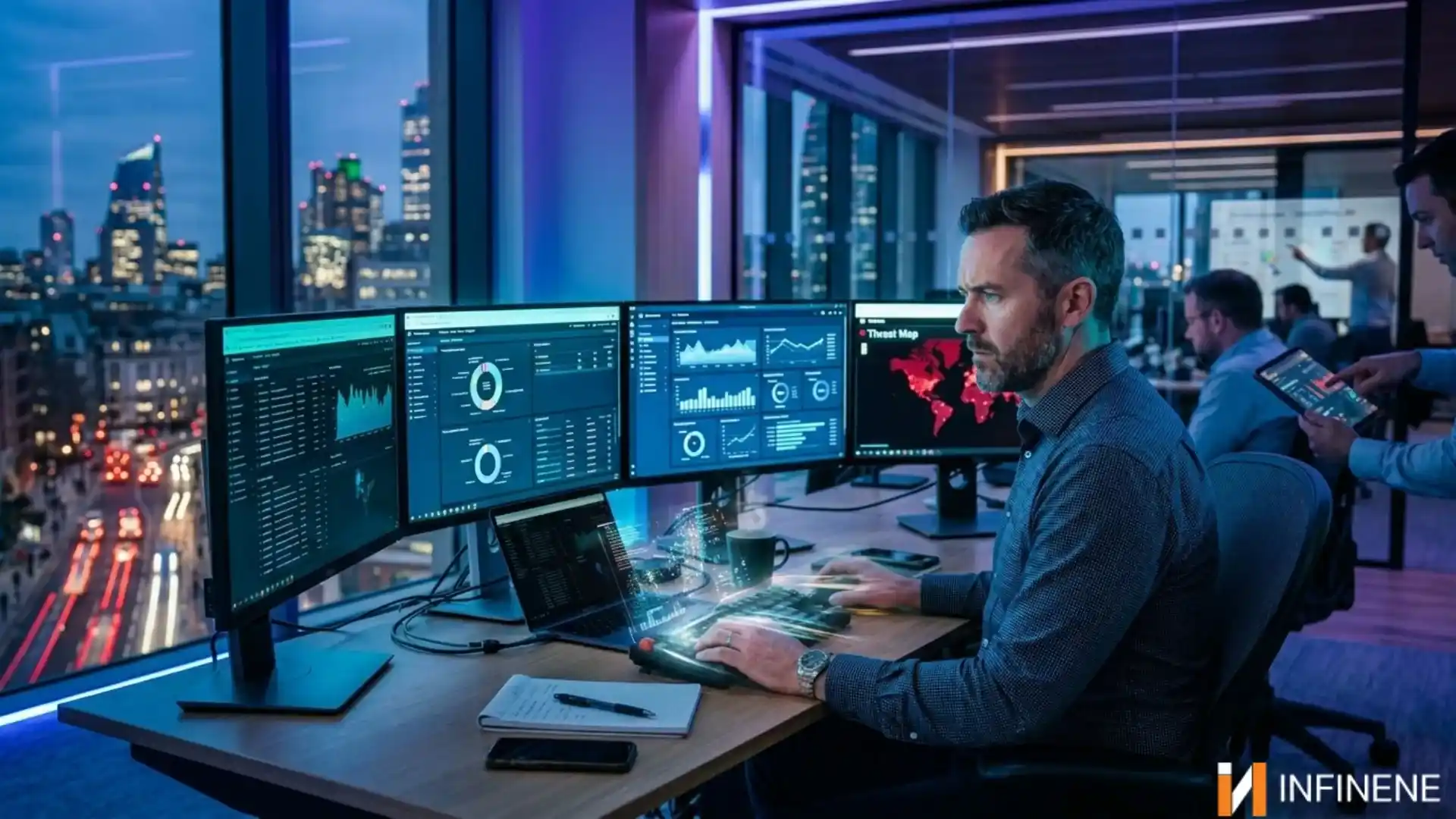
Technology is evolving faster than ever. Businesses are feeling that extra pressure to keep their systems secure, reduce downtime, and also deal with the whole increasing IT complexity thing. Old-school IT support models don’t quite keep pace with what’s happening lately. So, many organizations begin to seek more clever, more proactive styles of support, as opposed to merely reacting to whatever pops up.
This is basically where AI-powered Managed IT Services are getting big and changing the game.
AI-powered managed IT services combine predictive monitoring, automated help desk support, and intelligent cybersecurity to help US businesses reduce downtime, lower IT costs, and stay ahead of threats. As AI reshapes managed IT support in 2026, companies gain faster issue resolution and stronger data protection without expanding in-house teams.
With Artificial Intelligence, Managed Service Providers (MSPs) can predict potential issues before they even happen, automate those repetitive tasks, and also make cybersecurity stronger in a more consistent way. They can even deliver faster support experiences. It sounds simple, but it actually makes a big difference. So, businesses often end up cutting operational costs, boosting productivity, and getting more attention on growth, not just on technology problems that keep showing up.
In this article, we’ll kinda dig into how AI is reshaping managed IT services, the benefits it brings, and what business leaders should really think about when they adopt AI-driven IT operations, basically.
AI powered managed IT services mix classic IT helpdesk-style support with smarter artificial intelligence tools. So, they can watch over your systems in a more proactive way. They monitor stuff, then analyze it, and finally try to optimize the whole IT setup, not just patch problems after.
What makes them different from traditional IT support is that traditional teams usually only respond once something has already broken or gone wrong. AI enabled systems, on the other hand, can spot repeating patterns, catch odd behavior, and even foresee possible failures before they start interfering with daily business operations. That usually leads to a more efficient IT environment, but also more resilient and less reactive, in general. These services often include:
AI-driven network monitoring.
Automated help desk support.
Predictive maintenance.
Intelligent cybersecurity.
IT process automation.
Performance analytics.
Capacity planning.
A few different factors are pushing the adoption of AI powered IT support, it’s not one single reason.
Cybersecurity threats are rising, not only in how often they appear but also in the sophistication level they bring. So, businesses are looking for faster threat detection and response abilities because traditional monitoring just can’t keep up in many cases.
Quite a lot of companies can’t really recruit or keep enough skilled IT professionals. That’s where AI becomes a bridge. It automates the routine stuff and frees up the IT people to work on more valuable and more nuanced tasks instead of spending time on repetitive tasks.
Modern tech environments have gotten way more intricate than before. Companies now seem to rely on cloud platforms, remote work setups, SaaS tools, and hybrid infrastructures all at the same time, without really thinking too much about it. In practice, this means there’s more to juggle and AI helps manage that complexity with a bit more steadiness.
People now want better support. They don't expect just reactive firefighting now. Now the executives expect IT teams to keep things from going sideways, not just show up right after it breaks. It feels like this is a big shift from what we used to believe.
One of the major benefits of AI is that it can easily sift through huge amounts of operational data. It can spot warning signs earlier than you'd expect. It can often catch subtle changes in real time instead of waiting until there’s a clear failure or some sort of obvious break. For example, AI systems may detect:
Server Performance Degradation.
Network Bottlenecks.
Storage Capacity Problems.
Hardware Failures.
Application Performance Anomalies.
This kind of forward leaning method helps businesses steer clear of expensive downtime and those annoying service interruptions too.
Traditional monitoring tools mostly stick to fixed rules and alerts. You kind of know what to expect from them. With AI powered monitoring systems, they keep learning from how the network behaves, so they can spot odd or rare patterns that suggest things like Security breaches
Unauthorized Access Attempts.
System Malfunctions.
Performance Troubles.
In the end, this helps IT teams react faster and with more precision instead of waiting for the same old signals.
AI powered virtual assistants and chatbots are reshaping IT support desks these days. They can
Answer the usual tech questions.
Help with password resets.
Route support tickets.
Give troubleshooting guidance in real time.
They can take care of routine requests automatically.
As a result, the first reaction time gets faster and employee satisfaction goes up pretty noticeably.
Cybersecurity is one of the most valuable uses of AI in managed IT services. In practice AI systems can detect suspicious behavior patterns and also identify malware signatures. They can also monitor login activities more steadily. They can analyze user behavior too and flag potential insider threats before it turns serious.
Unlike traditional security tools, AI keeps learning on the fly. It tends to adapt as new threats show up. It reshapes its approach in real time when threats appear.
Businesses sometimes have a hard time guessing what technology will be needed later on or when exactly. With AI, though, you can look at old records and see usage patterns. Then do a forecasting that’s more or less on target for:
Bandwidth needs.
What storage will take up.
How many cloud resources are being chewed through.
Which kinds of infrastructure upgrades are likely coming next.
In practice this helps with tighter budgeting and calmer resource allocation, so teams are not constantly reacting too late.
When AI spots and addresses issues before they turn into something critical, it helps minimize interruptions. So, business continuity stays steadier.
AI-powered diagnostics speed up troubleshooting. That usually means support replies come back quicker which matters a lot when people are stuck.
With nonstop monitoring and smarter threat detection, businesses can bolster their security posture. They can turn more into a proactive stance instead of just being reactive.
Automation can reduce repetitive manual chores and boost efficiency in a pretty direct way. It also helps organizations to get more value out of their technology spending not just once, but consistently over time.
If fewer technical hiccups happen, employees spend less time waiting for assistance. They spend more time actually doing their jobs.
AI-generated insights give business leaders useful signals for smarter technology planning. So strategy doesn’t feel like guesswork.
Feature |
Traditional IT Support |
AI-Powered Managed IT Services |
|
Monitoring |
Reactive |
Predictive |
|
Problem Detection |
Manual |
Automated |
|
Support Response |
Human-Driven |
AI-Assisted |
|
Cybersecurity |
Rule-Based |
Behavior-Based |
|
Downtime Prevention |
Limited |
Proactive |
|
Scalability |
Moderate |
High |
AI helps healthcare organizations in a bunch of ways like, monitoring critical systems, shoring up patient data security, and even smoothing out compliance management.
Financial institutions tend to use AI for stuff such as detecting fraud, watching transactions closely, and boosting cybersecurity in real time.
In manufacturing, teams leverage AI toward predictive maintenance, network monitoring, and operational efficiency. It helps keep things running more steadily.
Retail businesses usually rely on AI to support e-commerce infrastructure, improve customer experiences, and monitor payment systems with a bit more vigilance.
Technology companies benefit from AI through cloud optimization, application monitoring, and automated support workflows. So, customers get help faster without as much friction.
Even though AI brings a lot of benefits, it’s smart for organizations to look at a few things first before they jump in. There are some practical concerns that get overlooked when people focus only on speed or convenience.
Data privacy matters a lot. Any AI solution has to match the right privacy rules and also stick to security standards that are already in place.
AI should work alongside IT professionals, not as a full replacement. The human side is still crucial for strategic planning and also for those thorny situations where judgment counts.
Integration needs can be a whole project of their own. Companies might have to tweak existing workflows and update infrastructure to get the best results, as the system just underperforms in real use.
Even if AI can lower expenses over time, businesses still have to account for deployment costs, plus training expenses, and the time it takes to get teams ready.
The future of managed IT services is getting more and more pushed by intelligent automation. You can almost feel it. Some of the emerging currents are a bit of everything at once, such as self-healing IT systems, but also autonomous network management. and then AI-driven security operations centers (SOCs), which basically run security work with less manual babysitting.
You also get predictive infrastructure management, plus those more advanced AIOps platforms, and the point is to make sure that problems are noticed before they become a big, loud thing. Businesses that really lean into this kind of refinement tend to end up in a more solid position so they can push day to day operational efficiency further, and then shore up their cybersecurity defenses, too. That way, they’re better set to keep backing sustained growth, even when the overall environment keeps shifting, or kinda behaving unpredictably.
As technology environments start getting more complex, businesses really need smarter and sort of smoother ways to manage and secure their IT operations too. Organizations that decide to use AI-powered managed IT services usually see a bunch of direct wins, like:
Less Downtime.
Quicker Issue Resolution.
Stronger Cyber Protection.
Lower Operational Costs.
Better Day to Day Business Productivity.
At InfineneTech, we assist companies with modernizing their IT operations through proactive monitoring, intelligent automation, cybersecurity solutions, plus AI-driven managed IT services. So, whether you’re aiming to boost system reliability, reinforce security controls, or optimize IT spending, our team can help you build a future-ready technology approach.
See how AI powered, managed IT services can help your business cut costs, give better speed and stability, and keep a step ahead as the whole world gets more digital every year or two.
AI powered managed IT services are basically IT help that uses artificial intelligence to take care of things in the background. Like, it can automate monitoring, spot problems earlier, help harden cybersecurity, and generally make IT support workflows feel more responsive… less stuck, you know.
It can support predictive maintenance (so issues show up before they turn into incidents), handle automated ticket resolution, do smarter monitoring, and help identify threats faster. In the end it usually means better efficiency and less downtime, even if the team stays small.
No. It doesn’t fully replace people. Instead, AI helps what IT teams can do by handling repetitive chores and passing along useful, actionable insights. But the human side is still crucial for the decision-making part, the right context, and those weird edge cases where AI just doesn’t always catch it exactly right.
Yes. Smaller companies can often get noticeable value from better security, lower support costs, and smoother day to day IT operations by using AI powered managed services. It’s kind of like getting stronger coverage without needing a huge staff.
In healthcare, financial services, manufacturing, retail, professional services, and technology companies, there are often big gains from AI powered IT management, “helpful automation” in practice.
Your competitors aren't waiting — and neither should you. Get a Free IT assessment and see how AI-driven managed IT services can cut your downtime, lower costs, and keep your business running at full speed.