


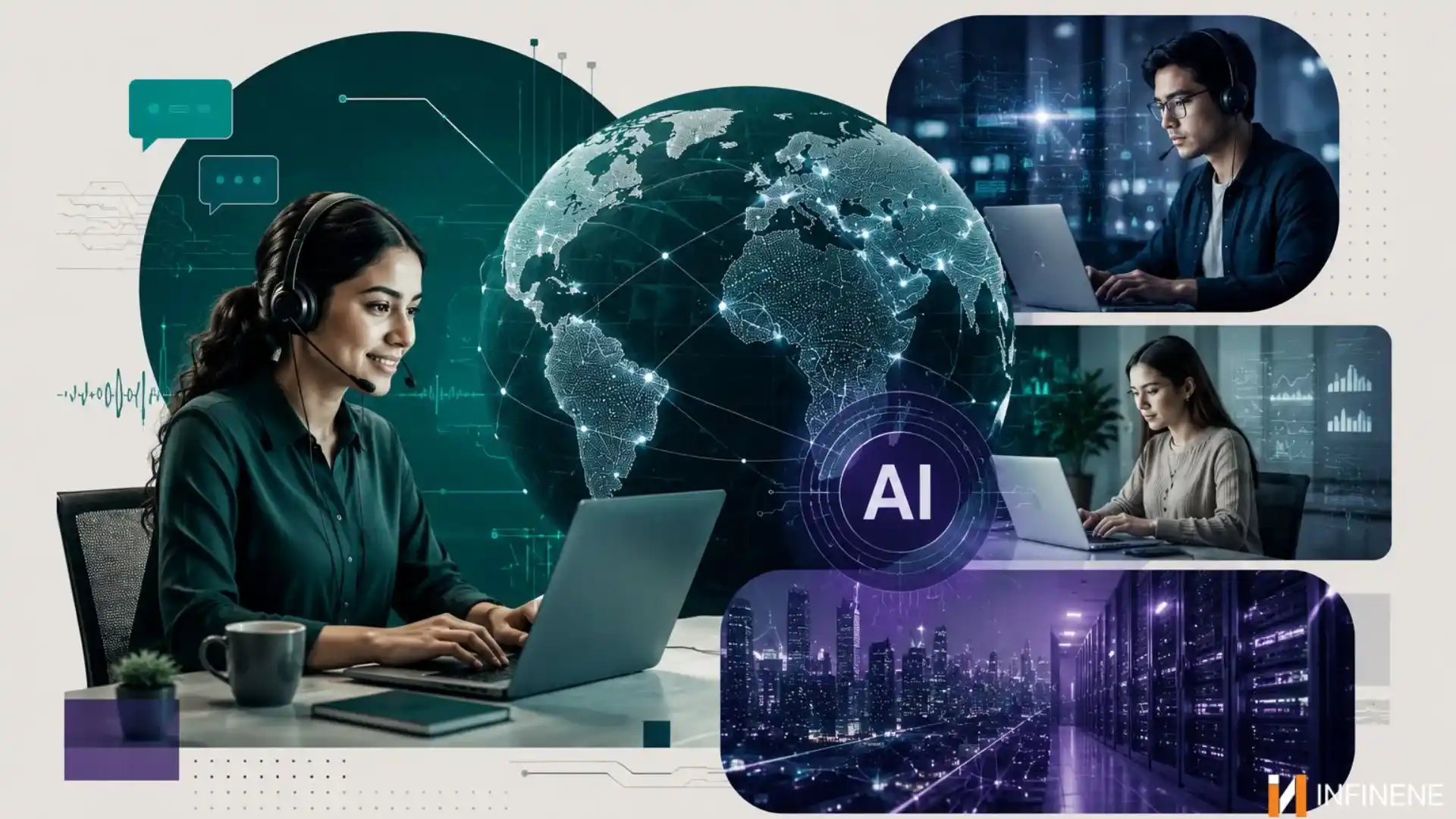
Global outsourcing is entering a new era. For decades, companies saw outsourcing mostly as a cost cutting move. Businesses used to outsource customer support, data entry, administrative tasks, and the back-office stuff to trim expenses and push efficiency. Even if this route did deliver value, the outsourcing sector is now going through a major change.
The major driver of this change is the blend of smart Business Process Outsourcing (BPO) along with artificial intelligence. It's not just one of those small regular tweaks. It’s more like a whole different direction for global outsourcing.
Now organizations are not really hunting for outsourcing providers to just handle their day-to-day tasks. They want partners that can help them run things faster, grow without losing control, enhance customer interactions, and land smarter business calls. This pressure has really pushed the adoption of AI in outsourcing. So now you see a hybrid approach where tech and human know-how are working side by side in kind of like a co-pilot situation.
Let's explore the major remote workforce trends to understand this revolution. Across the United States, this movement is creating fresh opportunities to boost productivity while keeping flexibility in an even more competitive market.
Traditional outsourcing has long been a useful approach for companies that want to lower their operational costs and keep operations running smoothly. In that more usual model, firms hand over particular business functions like customer support, payroll administration, technical assistance, appointment scheduling, and a bunch of other clerical work to outside service providers. Sometimes it’s like the whole thing just sort of keeps moving, even when the internal team is a bit lighter. It has worked, mostly for streamlining operations. But this approach relied on human-driven routines that can feel slow and tricky to scale up when demand jumps.
Now, the outsourcing scene is shifting mainly because of the rise of smart Business Process Outsourcing (BPO). Instead of sticking to the older idea of delivering manpower, smart BPO mixes experienced specialists with modern technologies. So, the service output becomes more efficient and intelligent. Most contemporary outsourcing providers are not only offering “people” anymore. They also weave in artificial intelligence, workflow automation, and predictive abilities into day-to-day operations.
With that tech enabled approach, outsourced teams can handle tasks with better speed and improved accuracy. Like in customer service situations, AI powered systems can automatically sort support tickets, interpret a customer mood, and then sometimes suggest a next move before a human agent even steps in. This usually drops response times, and honestly it makes the whole customer experience feel more effective.
And the benefits don’t really stop there. Smart BPO can help businesses make wiser choices through real-time visibility, automate repetitive steps, and adjust more quickly when market needs shift. As companies keep pushing for stronger efficiency and a more scalable delivery model, the mix of human know-how plus intelligent technology is showing up more often these days, even when people don’t notice it at first.
The rising use of AI in outsourcing is changing the operational efficiency of businesses and how organizations manage people. And just to be clear, organizations are not jumping in to simply trade human workers out. It’s more like they’re adjusting workflows and responsibilities in a more indirect way. What’s happening is that they’re using tech to push productivity up, ease operational bottlenecks, and build better customer experiences. So that trained professionals can stay with more high value tasks instead of the dull stuff.
Today, companies are generating huge amounts of data from customer conversations, transactions, plus all sorts of internal processes. Trying to handle that info by hand is getting harder and harder. So, AI-enabled solutions are showing up more and more in outsourcing operations. As one of the fastest-growing trends in business process outsourcing, AI is helping companies do more with fewer resources, while keeping quality steady and consistent. A few of the main drivers behind the rapid growth of AI in outsourcing include:
AI can sort through and interpret really big volumes of information in seconds. It trims down the time that’s usually needed for day-to-day routines.
Administrative work such as data entry, planning calendars, invoice processing, and document handling can be managed by AI, which makes outside teams able to focus more on strategic responsibilities instead of the tedious stuff.
AI systems lower the chances of mistakes in repeat workflows, which helps businesses maintain operational consistency at a higher level overall.
AI-powered chatbots and other “intelligent support systems” can take care of the simple customer questions, sort the incoming requests, and then route the harder cases to human agents in a more efficient kind of way.
With advanced analytics tools, organizations can spot unusual patterns, anticipate upcoming trends, and also assemble actionable reports. So, the teams can make decisions that feel actually informed.
AI helps outsourcing providers deal with heavier workloads without needing staffing to grow in the same ratio. So, scaling up becomes more cost effective, less painful and more predictable.
Automated systems support more streamlined processes, improve task prioritization, and boost overall output, day after day.
The future of outsourcing is being carved out by technology and strategic partnerships. from the growing adoption of AI in outsourcing to the way remote workforce trends keep evolving, organizations are rethinking what they expect from outsourcing. Businesses that really lean into emerging business process outsourcing trends are likely to be better placed to boost efficiency and push growth in this competitive digital economy.
Modern businesses need more speed, accuracy, and overall efficiency. Outsourcing providers are starting to braid artificial intelligence automation and data analytics into how they operate, not only on paper but day to day. By using these tools, the repetitive tasks get handled more smoothly, errors come up a lot less often, and employees can lean into real time intel. And then, altogether, it ends up lifting productivity. This tech-forward style of outsourcing also lets businesses scale operations without juggling internal resources too much.
Organizations aren’t just judging outsourcing partnerships by cost savings anymore. What they want now is more measurable contributions to business growth and daily performance. Companies tend to look for providers who can push productivity forward, improve the customer experience in a sharper way, and raise operational efficiency. Because of this turn toward outcome-driven outsourcing, service providers are basically asked to act like strategic partners, not just an outside vendor. In other words, it’s less about delivering services and more about delivering results.
More people are asking for Specialized talent, like not just generic skills. For instance, some firms want digital marketing specialists, others care about customer experience management, or technology support. In many cases, they are looking for outsourcing partners who can bring specific niche insight. It helps organizations tap into advanced ability without dealing with the usual price tag and headache of hiring full-time.
The whole outsourcing future is getting pulled toward a mixed teamwork where humans work alongside AI tools. It feels more like collaboration than replacement. Instead of swapping people out, intelligent tech is often speeding up how teams operate by taking on routine chores, sifting through huge data sets, and giving clearer assistance for decision making. Still, human expertise is not going anywhere. creativity, real problem-solving, and especially customer relationship management need a human touch. So, this pairing of people and AI is becoming one of the more important shifts in modern outsourcing, not just a side note.
That flexible remote workforce trend is slowly changing the way business’s structure outsourcing, and honestly, it feels like everyone’s moving a little at once. More companies are leaning on distributed teams, virtual assistants, and wider global talent networks to fit those shifting operational needs. With these adaptable staffing models, they can tap into a broader talent base, keep overhead lower, and make scaling seem more manageable, even when demand gets weird. And as remote work keeps evolving, organizations are seeing new pathways to build agile operations that are also sturdier when something unexpected happens, like a sudden delay or a supply hiccup.
Remote workforce trends are changing fast, like really fast. What started out as a necessity during global disruptions turned into a long-term play for many organizations. The remote workforce trends are reshaping the whole team setup across borders, not just where people are.
More and more organizations are starting to lean into this hybrid vibe, mixing in-office people, remote professionals, and a pool of outsourced specialists to shape workforce structures that feel kind of more adaptable, like “ready to pivot” instead of rigid. With that setup, collaboration can feel a bit smoother, and yet you still get access to global know-how, plus closer to 24/7 output, not just on paper but in practice.
Modern remote operations kind of ride on cloud platforms, AI-enabled communication tools, and project management systems. With all these things, it’s easier to coordinate scattered teams, watch over outputs, and keep the tasks running smoothly. Because of that, business process outsourcing trends are now more and more leaning toward digital-first approaches.
AI in outsourcing is growing fast, since artificial intelligence is getting embedded into everyday operations. AI helps remote groups stay productive and organized in a steady way. It also strengthens coordination between in-house staff, remote workers, and outsourced teams.
The rise of virtual assistant services in the US is tightly connected to the overall expansion of remote work. Virtual assistants now kind of take care of the administrative duties, customer messages and data handling, plus scheduling, usually with a bit of help from AI tools. That combo lets companies grow their operations in a more efficient way without piling on too much internal workload.
Looking ahead, the future of AI in outsourcing is heading toward deeper, more end-to-end automation, and stronger decision support, even if it still feels a little futuristic. But AI won’t really replace human workers, not the way people sometimes picture it. Instead, it acts like a collaborative layer that quietly boosts output and helps lift service quality. In practice, outsourcing providers will use AI to handle the repetitive bits, sniff out these subtle, hidden inefficiencies and then fine tune the workflows. Meanwhile, humans will still be in the driver's seat for the strategy side, those little spikes of creativity, and the stewardship of relationships. Firms that move early and adopt these changes faster often end up with more flexibility, better operational efficiency, and a durable competitive advantage in the digital economy.
At InfineneTech, we help companies tap into the strength of smart outsourcing by pairing skilled professionals with modern AI fueled workflows. Depending on what you’re looking for, our crew is ready to help you push for more efficiency and steady growth over time. Be it like virtual assistant services, customer support, or maybe broader business solutions.
Work with us, and see how smart BPO along with AI can help keep your business one step ahead in the shifting global marketplace.