


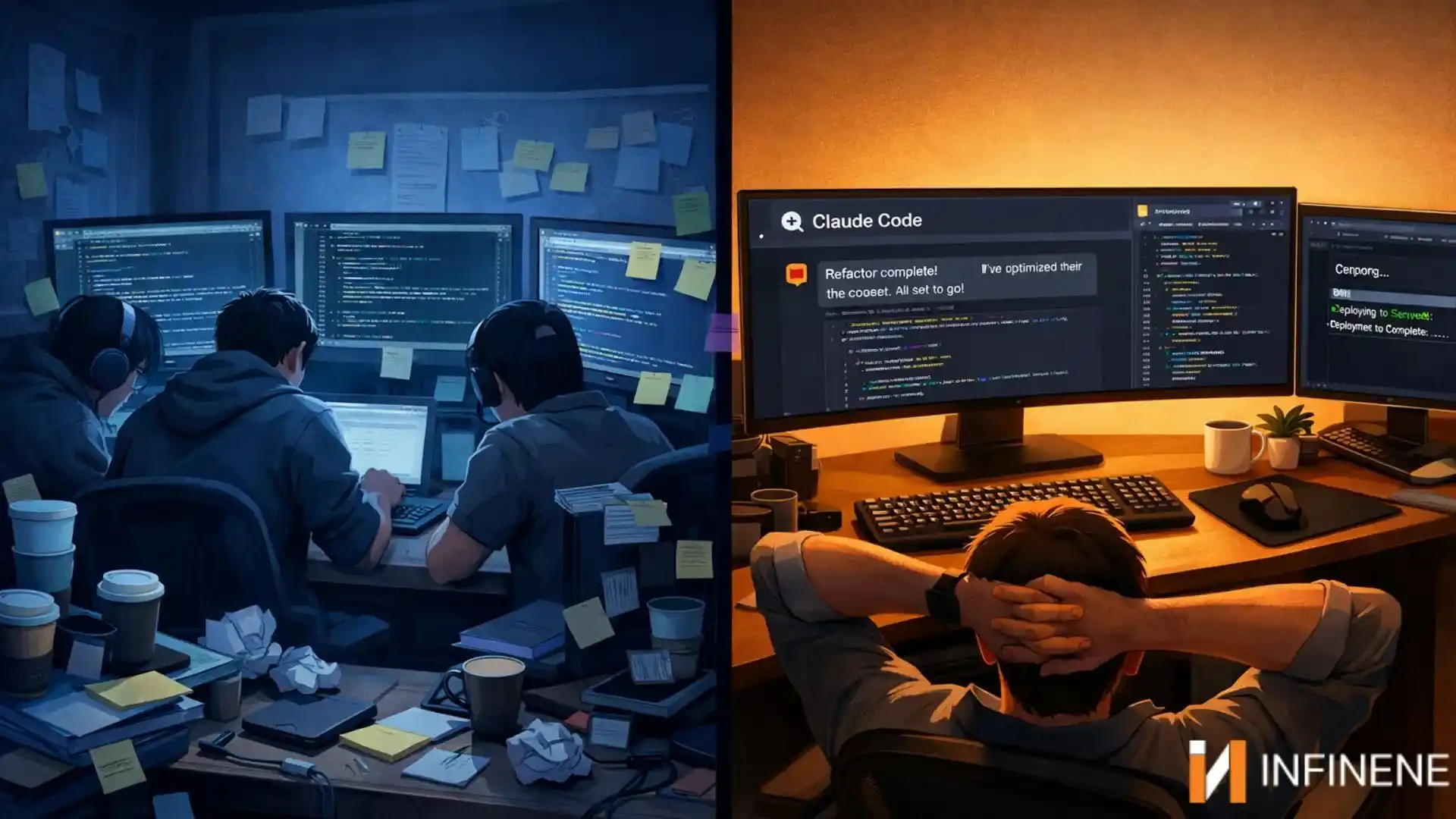
Last spring, a startup CTO in Austin posted something on LinkedIn that made the tech community genuinely uncomfortable. He'd just let go of two junior developers — not because of budget cuts, not because of poor performance — but because a single mid-level engineer using Cursor and Claude Code was outproducing the entire three-person team. He wasn't bragging. He seemed almost apologetic about it. The post got 4,000 likes anyway.
That story isn't an outlier anymore. It's a pattern. And if you're a business owner evaluating your dev team, a CTO rethinking your hiring pipeline, or a developer trying to figure out where you stand in 2026, vibe coding jobs — and what they're doing to the traditional software labor market — deserve your full attention right now.
Credit goes to Andrej Karpathy, former Tesla AI director and OpenAI co-founder, who coined the term in early 2025. His framing was deliberately casual: vibe coding, he explained, is when you describe what you want in plain language and let an AI generate the actual code. You're not writing functions. You're not debugging logic line by line. You're expressing intent — and the model handles implementation.
That shift sounds subtle. It isn't.
Traditional coding required developers to think in syntax, in logic structures, in the specific grammar of a programming language. Vibe coding vs traditional coding isn't just a workflow difference — it's a fundamentally different cognitive model. You're closer to an architect giving direction than a carpenter swinging a hammer.
What does it look like in practice? A non-developer founder — say, someone running a boutique consulting firm — can open Bolt.new or Replit, describe the internal dashboard they need ("show me this week's client hours by project, let me filter by team member, export to CSV"), and have a working prototype in under an hour. No developer hired. No agency engaged. No technical co-founder needed.
That's not hypothetical. That's Tuesday morning for a growing number of small business owners in 2026.
Karpathy himself admitted he barely looks at the code anymore. He vibes, he said. The code mostly works. And when it doesn't, he describes the bug and lets the AI fix it. Vibe coding explained simply: it's software development with natural language as the primary interface.
Nobody wants to say it plainly, so let's just say it: the junior developer job market is in serious trouble.
Entry-level software engineering job postings dropped by roughly 26% between 2022 and 2024, according to analysis from Revelio Labs. That was before the current wave of AI coding tools hit critical mass. The CS graduate unemployment rate in the US climbed to around 6.2% in early 2025 — a figure that would've been unthinkable five years ago, when companies were practically bidding wars over fresh comp-sci graduates.
The economic logic driving this is brutally simple. GitHub Copilot costs about $19 per month per developer seat. A junior developer in a US tech hub earns $75,000 to $95,000 per year — plus benefits, onboarding costs, and the management overhead of bringing someone up to speed. The productivity math, for many tasks junior developers used to handle, no longer favors the human.
GitHub Copilot replacing developers entirely? Not quite — but GitHub Copilot replacing the parts of development junior devs spent most of their time on? That's already happening. Boilerplate code, basic API integrations, CRUD operations, documentation, unit tests — these were the training ground for junior developers. They're now largely automated.
"The uncomfortable truth: AI isn't eliminating the developer role. It's eliminating the first three years of the developer career path."
Cursor is doing to mid-level productivity what GitHub Copilot started with autocomplete, but going several steps further — full file edits, multi-file context, reasoning about your entire codebase. Claude Code operates at an even higher level of abstraction, handling complex refactoring tasks that would have taken a senior engineer half a day. When you combine these tools with a competent senior developer, the output-per-person ratio shifts dramatically.
Entry-level developer jobs disappearing isn't the full story, though. Because something else is being created in the gap — and it's worth paying attention to.
Here's where the narrative gets more interesting.
The same forces compressing junior developer hiring are generating entirely new categories of work — roles that didn't have names 18 months ago and are now attracting serious salaries.
2022 Junior Developer: Spent 60-70% of time writing boilerplate, debugging syntax errors, building CRUD functionality, and waiting for code reviews. Mostly an executor of technical specs handed down from seniors.
The New "AI-Native" Role: Someone who can define the architecture, write precise prompts that encode business logic, orchestrate multiple AI agents across a codebase, evaluate and correct AI output, and translate between what the business needs and what the model produces. Equal parts technical editor, systems thinker, and product manager.
These roles go by different names: AI orchestration engineer, prompt architect, AI-native product builder. The pay reflects how new and scarce the skills are.
AI prompt engineer salary in the US ranges from about $130,000 to $200,000 annually at mid-to-senior levels, with some specialized AI orchestration roles at major tech firms hitting $250,000 or above, according to data from Levels.fyi and LinkedIn Salary. That's not a junior dev salary. That's senior territory — and the field is nascent enough that people are arriving from surprising directions.
We've also seen an explosion of non-developer vibe coding — founders, product managers, designers, and operations lead who are building real tools without engineering backgrounds. As we've written about before in our coverage of AI reshaping the US job market, this democratization of software creation is one of the most underappreciated economic shifts of this decade. People who can think clearly about systems and express requirements precisely are suddenly competitive in a market that used to require years of technical training.
"Insider note: I've talked to three non-technical founders in the last six months who shipped actual SaaS products — paid users, real revenue — using nothing but Bolt.new, some Claude prompting, and a lot of iteration. None of them wrote a line of code. Two of them are now hiring developers to help them scale what they built. The floor has dropped; the ceiling hasn't."
The future of software development jobs isn't fewer jobs. It's jobs that require entirely different entry points.
The tools themselves are worth understanding — not as a checklist, but because which tool someone uses tells you a lot about what they're trying to do and who they are.
Cursor is the power user's IDE of 2026. It's built for developers who want to stay in a professional coding environment while getting serious AI assistance — full codebase context, multi-file edits, and reasoning that goes beyond autocomplete. The cursor vs GitHub Copilot debate among working developers usually lands here: Copilot is great for autocomplete and inline suggestions, but Cursor's ability to understand and modify an entire project is on a different level. If you're a software engineer who wants to 10x your output without changing your workflow dramatically, Cursor is the tool.
GitHub Copilot remains the most widely deployed AI coding tool in enterprise environments — partly because of GitHub's existing footprint, partly because the enterprise tier integrates with existing security and compliance frameworks. It's the safe, scalable choice for large engineering teams.
Claude Code operates more like an autonomous collaborator than an assistant. You can give it a complex task — "refactor this authentication module to support OAuth" — and it reasons through the problem, writes the changes, and explains what it did. It's particularly strong on tasks that require understanding context across a large codebase. For experienced developers working on substantive engineering problems, it's become a serious part of the toolkit.
Bolt.new and Replit serve a different audience entirely. These are the vibe coding platforms for non-developers — the AI app builder no code crowd, business operators who need a working tool without hiring an engineer. Bolt.new vs Replit comes down to use case: Bolt is faster for greenfield web apps from a prompt, while Replit offers more flexibility and a development environment for users who want to tinker further. Both are genuinely capable of producing deployable software.
Lovable sits in a similar space — optimized for building user-facing apps quickly, with a particular strength in UI generation. For founders who want to validate a product concept with a real prototype before investing in a development team, it's become a go-to first step.
These are the AI coding tools for developers 2026 that anyone hiring, building, or planning a tech team needs to understand.
Yes. Full stop. But not for the reasons people used to give.
The "learn to code" advice used to mean: master a language, get a job, write software professionally. That specific path — junior developer at a tech company, working your way up through code reviews and JIRA tickets — is genuinely harder to access than it was five years ago. If you're expecting that exact trajectory, recalibrate.
But here's what's actually true: understanding how software works, how systems connect, how to think logically about requirements and edge cases — that understanding is more valuable in 2026 than it's ever been, because it makes you dramatically better at working with AI tools. The people getting the most out of Cursor, Claude Code, and Bolt.new aren't people who don't know how to code. They're people who understand code well enough to evaluate what the AI produces, catch its mistakes, and push it in the right direction.
Is coding still worth learning in 2026? Absolutely — just reframe why. You're not learning to replace AI. You're learning to direct it intelligently.
For developers: double down on systems thinking, architecture, and the ability to work with AI tools fluently. The developers who are thriving right now aren't the ones resisting AI — they're the ones who've essentially turned themselves into AI orchestration engineers, using these tools to do the work of three people while taking on more complex and higher-value problems.
For non-developers: a basic understanding of how web applications work, what APIs are, and how databases store data will make you a substantially better vibe coder. You don't need a computer science degree. You need enough mental model to have a real conversation with your AI tools — and catch it when it goes sideways.
AI developer skills 2026 are about fluency, not mastery. The goal is being dangerous enough to get real things built.
The "should I hire developers or use AI" question is real, and the honest answer is: it depends on what you're building, and at what stage.
For early-stage exploration — validating an idea, building an internal tool, prototyping a product — AI-first makes sense. Bolt.new or Replit can get you a working MVP in days. For companies that need custom software development at serious scale, with security requirements, complex business logic, and long-term maintainability, human developers still win. Not instead of AI tools, but alongside them.
The middle ground is where most US businesses actually live. A software development cost reduction AI strategy for this group usually looks like: fewer total headcount, higher seniority bar, AI tools embedded in the workflow from day one. One strong AI-native developer — someone who can use Cursor, Claude Code, and knows when to reach for each — can do what a team of three did two years ago.
Staff augmentation is evolving too. The smartest approach to outsource software development vs AI 2026 isn't a binary — it's building a flexible team structure where AI tools handle volume and human expertise handles judgment. Offshore and nearshore developers who are fluent in AI tools are significantly more valuable than those who aren't, at every price point.
For CTOs evaluating their teams: the question isn't whether to use AI coding tools — it's whether your current team knows how to use them effectively. That skills gap is real, and it's widening.
If you're at the point of rethinking your entire development approach — build vs. buy, hire vs. augment, in-house vs. custom software development partner — it's worth having a real conversation about what your specific needs actually require. An AI-ready development team looks different than a traditional one, and the cost structure is meaningfully different too.
Ten years from now, the developers who navigated this transition well won't be the ones who fought hardest against AI tools. They'll be the ones who figured out, early, that the skill worth having was knowing how to think — how to break down a problem, evaluate a solution, and push the work toward something genuinely good. The tools change. That skill doesn't.
The vibe coding jobs question isn't really about coding at all. It's about who gets to build things in a world where building got dramatically easier.
Vibe coding is a style of software development coined by Andrej Karpathy where the developer — or non-developer — describes what they want in natural language and lets an AI model generate the code. Instead of writing syntax directly, users express intent. The AI handles implementation. It's made software development accessible to people without traditional engineering backgrounds and dramatically accelerated output for those who do have them.
Not entirely, but AI is significantly compressing entry-level developer hiring. Tasks that junior developers spent most of their time on — boilerplate code, basic integrations, documentation, unit tests — are now largely automated by tools like GitHub Copilot and Cursor. The path into software development careers hasn't disappeared, but it's changed. Junior developers who learn to work fluently alongside AI tools will have substantially better outcomes than those who don't.
AI prompt engineer and AI orchestration roles in the US currently pay between $130,000 and $200,000 annually at mid-to-senior levels, with specialized roles at major tech companies reaching $250,000 or more. The field is new enough that salaries vary widely based on company size, industry, and the specific technical depth required. These roles attract both experienced developers transitioning into AI-native work and non-technical specialists with strong domain expertise.
The right tool depends on your role and goals. Cursor is the leading choice for professional developers who want deep codebase context and multi-file AI editing within a familiar IDE. GitHub Copilot remains dominant in enterprise environments for its integration and compliance features. Claude Code handles complex autonomous tasks well. Bolt.new and Replit are the go-to platforms for non-developers building real products without writing code directly. Most experienced developers in 2026 are using at least two of these in combination.