


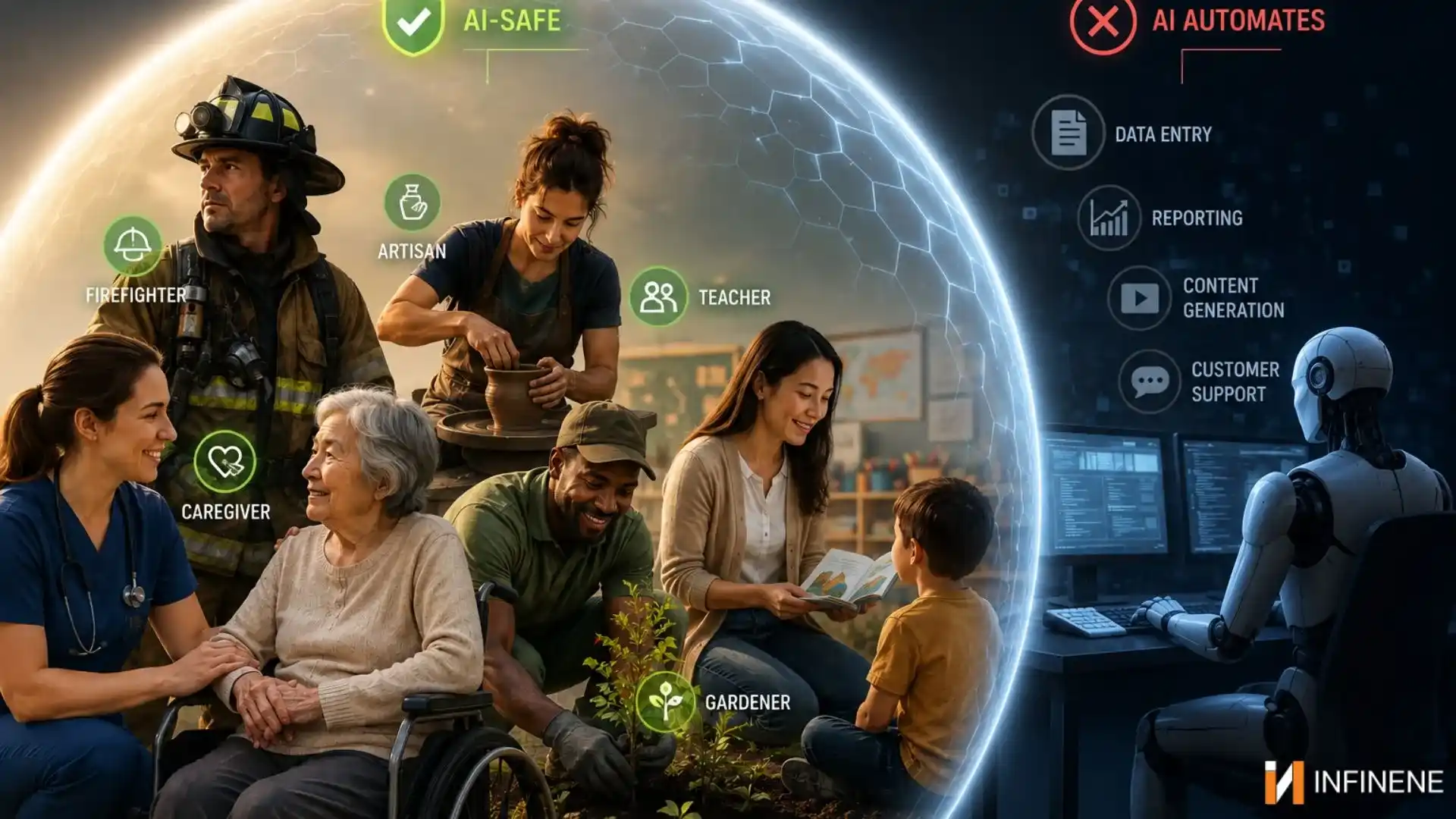
A customer support chatbot handles 5,000 conversations overnight. An AI tool designs a logo in under 30 seconds. A software assistant writes code faster than junior developers. An automated system screens thousands of resumes in a matter of minutes.
These are not just predictions. It is the modern American workplace.
For the first time in years, people are not just asking how to get a job. They are actually more concerned about the fact whether their career will still exist in the next five years. And honestly, that concern is valid.
AI technology is rapidly replacing the tasks that are repetitive and predictable. The entire business world is transforming to implement automated systems. Organizations now focus on hiring employees who possess the ability to work with artificial intelligence technology. Automation creates widespread job loss throughout various industries. But it is to be noted that AI is not replacing human value. It is just replacing repeatable tasks. Understanding this difference changes everything. The fields that require human connection, strategic thinking, creative abilities, leadership skills and complex decision-making are more effective professional paths. In fact, in some industries, the integration of AI produces a greater need for skilled workers instead of decreasing the human workforce. Let's explore jobs safe from AI in 2026 and which skills will matter most in the future workforce.
AI does not impact all jobs equally. The core reason some jobs are more vulnerable is not the job title itself but the nature of the tasks. The more a role is structured, the more AI will find it easy to duplicate. But if the job involves human involvement, it maintains protection against artificial intelligence taking over the job.
Repetitive and Rule-Based Work - AI can accomplish tasks that follow fixed rules at a faster speed while making fewer mistakes. The positions that require basic data-driven decision-making are more prone to being replaced by AI.
Data-Heavy and Digitally Structured Roles - AI thrives on data. Positions that deal with large amounts of structured digital information are highly exposed. For example, roles in basic accounting, customer service chat handling, or administrative scheduling rely heavily on systems that AI can now process directly. AI can analyze, organize, and respond with minimal human intervention in such roles.
Predictable Decision Patterns - Some professions depend on decision-making on established patterns. The AI systems can be trained on historical data to make corresponding decisions. The current applications of this technology include loan approval processes and fundamental technical support services. The requirement for human participation decreases as the ability to forecast results using historical information improves.
Limited Human Interaction and Creativity - Jobs that demand minimal empathy and imaginative thinking face more risk of automation. AI technology cannot yet duplicate human emotional comprehension or moral decision-making. That's why fields of healthcare delivery and strategic leadership work continue to resist automation.
The jobs safe from AI in 2026 are defined by the nature of the work. Artificial intelligence creates changes in work environments but still requires human workers for operational purposes. The technology creates demand for human workers in tasks that machines cannot perform. The future workforce will consist of professionals who possess the ability to integrate human intelligence with artificial intelligence tools. The following section presents an extensive analysis of the most secure professions against artificial intelligence disruption that remain in demand.
The field of cybersecurity has become one of the most rapidly expanding professional areas during the AI development era. The introduction of AI technology has resulted in both increased cyber threats and more complicated attacks which require cybersecurity professionals to gain advanced skills.
AI has the ability to examine systems and identify unusual activities to detect possible security risks. However, it lacks the necessary strategic abilities to comprehend attacker actions and predict new security threats while handling ongoing cybersecurity operations.
Security experts in the field of cybersecurity perform more than just security alert monitoring. The team develops security measures to defend their systems against attacks while they investigate security breaches and conduct ethical hacking assessments to track down attack methods. This job requires skills that AI technology cannot duplicate including creative thinking and instinctive judgment together with professional knowledge.
There is an ongoing requirement for SOC analysts, cloud security engineers, penetration testing specialists and incident response professionals throughout the United States. Human-operated cyber defense systems have become essential as organizations increase the implementation of digital technologies.
The healthcare industry depends on human workers for its proper operations. The AI system has achieved major advancements in medical testing for diseases, medical image evaluation and treatment development support. The fundamental human relationship which exists in healthcare cannot be replaced by artificial intelligence technology.
Medical professionals such as doctors, nurses and therapists do more than just treat medical conditions. They need to establish connections with patients while delivering psychological assistance and studying detailed patient medical background information. They make medical choices that involve both legal and emotional considerations.
Healthcare professionals use their emotional abilities to provide help. Artificial intelligence lacks the capability to perform this task. Emergency physicians create medical solutions that must work when they face emergency medical situations that lack complete data. The healthcare profession will maintain its demand for human labor because registered nurses, physical therapists, mental health counselors and emergency physicians must work together with patients for years ahead.
The upcoming technological developments will not affect the job security of skilled workers. Electricians, plumbers, HVAC technicians, mechanics and construction workers handle jobs in work environments that undergo permanent modifications.
Physical abilities serve as the essential requirement for trade work. Workers at job sites need to perform continuous assessments. They must handle challenges in their particular work environment which includes safety risks and operational needs. The process becomes extremely difficult because of its unpredictable nature which makes automation unfeasible.
AI and robotics still face limitations because they cannot execute precise actions in environments where they do not have control. These fields keep their operations running because of the need for human expertise and skilled manual work. The US currently faces employment deficits across these occupations which boosts both job stability and income prospects for certified professionals.
There has been an exciting development in the year 2026 in the realm of artificial intelligence. This technology is replacing many jobs while simultaneously creating new employment opportunities. Professionals who can develop, operate, and control artificial intelligence systems can find new career opportunities. The modern workforce requires organizations to employ AI engineers, machine learning specialists, data scientists, prompt engineers, and AI ethics experts. The experts train artificial intelligence systems that work to enhance system efficiency while achieving equitable results and preventing detrimental consequences.
Companies require human workers to control artificial intelligence technologies as automated systems continue to create errors. They exhibit inherent data biases and they operate without any form of responsibility. Human supervision guarantees that artificial intelligence systems maintain safety, precision, and compliance with business objectives. AI technology has created more work opportunities for highly skilled professionals because it does not eliminate their jobs.
The assumption that AI would take over creative fields turned out to be incorrect because the outcome of using AI in these fields made things more complex. AI produces content at high speed but its output lacks both original thought and emotional depth along with cultural understanding. Creative professionals achieve their highest effectiveness through strategic planning abilities and storytelling skills.
The industry depends on creative directors, brand strategists, filmmakers and content creators who work together to build personal brands. Creators use human creativity to develop emotional ties with their audience which results in successful story development. Authentic replication of these elements remains challenging for AI to achieve. Artists use AI as a creativity tool which helps them develop new artistic concepts.
Leadership positions maintain protection from automation because these roles require individuals to assume accountability while maintaining their ability to understand and control their emotional reactions during challenging decision-making situations. In many instances, leaders need to resolve conflicts among team members with different backgrounds while they work to motivate their teams and create a vision for the future. The responsibilities require trust from people who work together with others through social interactions that artificial intelligence systems cannot yet duplicate.
The role of executives and managers and team leaders will maintain its importance for organizational development throughout 2026 and subsequent years. AI provides insights, forecasts and performance data yet it lacks the ability to take responsibility for decisions that impact people and whole organizations.
Human participation remains necessary in education because technology has not yet replaced human emotions. AI provides rapid information delivery. But education requires more than basic knowledge dissemination.
Teachers and trainers deliver support to students through their role as motivators, emotional helpers, discipline enforcers and guides for academic and personal development. Educators use their knowledge of student behavior to create learning environments that help students develop self-confidence and experience educational progress.
Human relationships need to exist as a primary element in this field because they hold special importance in early childhood education, career guidance and leadership development programs. The educational system depends on teachers who serve as its essential workers.
Also Read: How AI is Reshaping the US Job Market in 2026
Humans still dominate in roles that require understanding context, detecting emotional states, creating artistic work and dealing with unpredictable situations. AI may enhance productivity and support decision-making but human experience determines the fields that machines cannot dominate. AI functions as a tool within these areas. But it fails to provide complete operational capacity.
Some Tasks Require Emotional Intelligence - Healthcare, counseling, teaching and caregiving roles depend on empathy and trust as fundamental requirements. AI lacks true comprehension of human experiences and the development of genuine emotional relationships.
Complex Decision-Making in Uncertain Situations - People perform better when they deal with incomplete information and contradictory evidence than machines do. Senior executives in leadership positions make decisions based on their knowledge when there are no established guidelines and past practices. Professionals in these settings use their intuition and professional knowledge to make choices.
Creative and Original Thinking - Human creativity involves breaking established patterns and developing fresh concepts. Human originality and vision continue to drive art in the fields of filmmaking, literature, design, branding and product development.
Real-World, Hands-On Professions - The process of automating jobs becomes challenging for positions that involve working in physical spaces and dealing with unpredictable circumstances. The skilled trades of electricians, plumbers, construction workers and technicians require workers to solve problems that occur in actual work environments.
Relationship-Based Work - Some professions rely on building trustful connections. In sales, consulting and leadership positions, professionals need to understand people while detecting hidden social signals to establish trust.
The discussion around jobs safe from AI in 2026 is not a comparison between humans and machines. It is a deeper question. It is about the skills that remain uniquely human in an increasingly automated world. In 2026, career safety is not about avoiding technology. It is about learning how to work with it. The professionals who are most secure in their careers are not the ones resisting AI. but the ones who understand how to use it as a tool to improve their performance and productivity. The future workforce is increasingly defined by a combination of human strengths and technical capability. Employees who possess domain knowledge and problem-solving skills together with AI expertise, have become the most important assets for contemporary businesses.
This shift is already visible across the United States. More individuals are actively investing in future-focused skills. The need for continuous learning has become essential in the present time. Workplace requirements have changed because of automation and intelligent systems to the point that workers must now acquire new skills beyond what they needed five years ago. The capacity to learn new skills and to use fresh tools is emerging as the most important factor that determines an individual's success in a professional career.