


You have likely searched “what does PESO stand for in marketing” on Google. You then see a stack of pages that say almost the same idea. Acronyms. Four parts. A simple picture. Nothing wild. But that still does not explain why this model lasted more than ten years. Many other marketing frameworks did not make it.
PESO means Paid, Earned, Shared, and Owned media. It stayed relevant because it was not tied to one tool or one site. When the PESO model was first used, TikTok was not even a thing. Neither did AI powered search. The model still works anyway, because it's not about where people find your brand. It's about how trust actually gets built. That's why marketers, PR people, and more recently, a lot of IT and tech companies keep coming back to it. Below, we'll go through what PESO actually means, where the term came from, what each of the four PESO marketing channels does well and where it falls short, and how you'd actually put this to work if you're running marketing for a real company on a real budget.
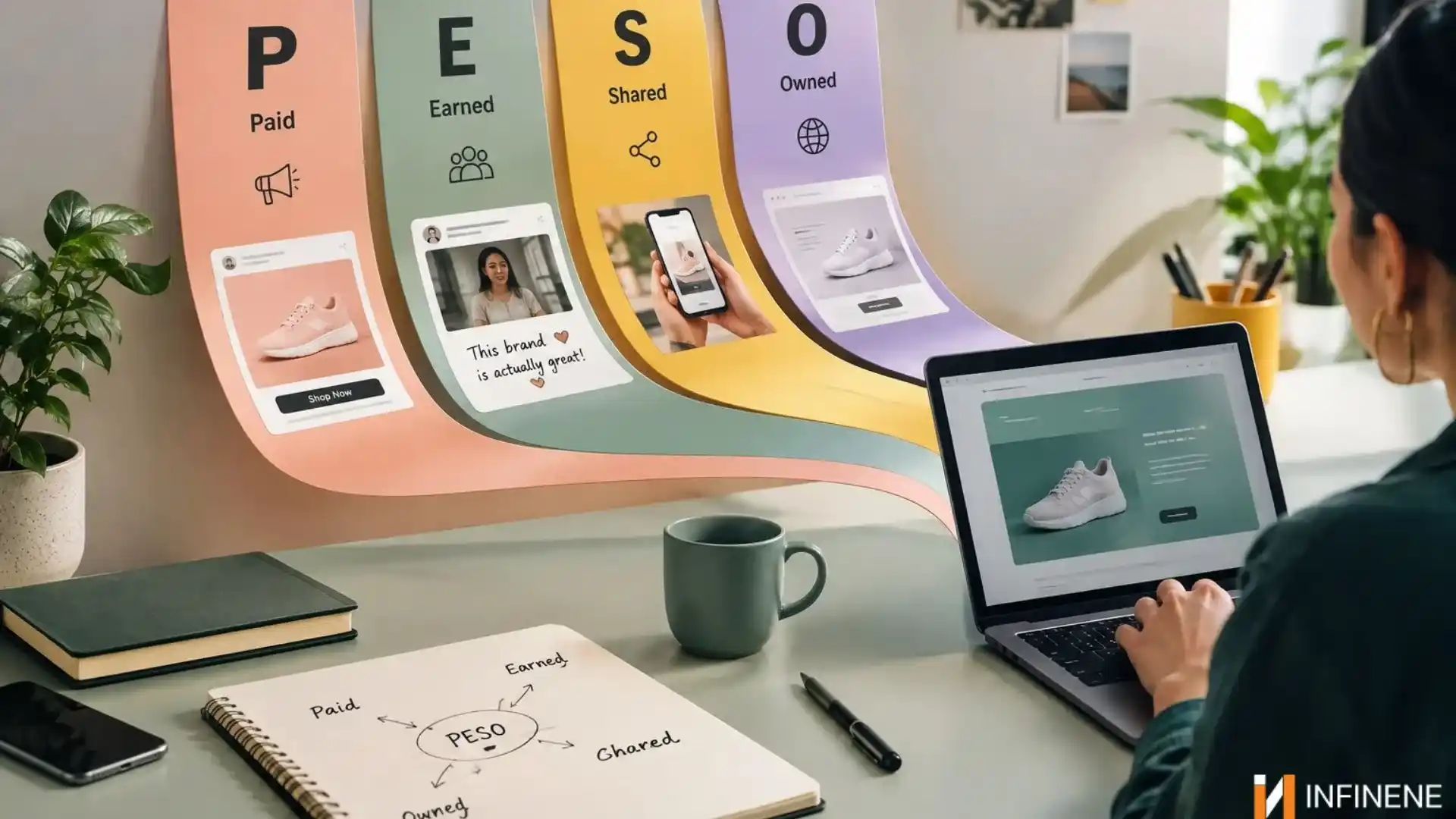
PESO stands for Paid, Earned, Shared, and Owned media. Those four groups cover most marketing channels.
Paid media: Advertising and sponsored placements you pay for.
Earned media: Coverage and mentions you don't pay for directly.
Shared media: Social media and community driven content.
Owned media: Channels your brand fully controls, like your website.
None of this work as well by themselves as they do together, and that's really the whole point of peso marketing. A press mention gets shared on LinkedIn. That drives people to a landing page. You put a small ad budget behind it to push it further. Four channels, one story, told four different ways.
For IT and tech companies this matters more than people think. Buyers in this space do a lot of homework before they'll book a call. They look at the founder’s LinkedIn. They read one case study. They check reviews. They might notice a webinar too. If your brand shows up in only one spot, it can feel light and incomplete. If it shows up consistently across all four, it starts to look like a company worth trusting with a five or six figure contract.
Gini Dietrich founded Spin Sucks. She later created the PESO model. In 2014, she put the model into her book called the same thing. Her agency, Arment Dietrich, had actually been using this approach with clients for a few years before that. It still had no name then. The acronym was not new, though.
In May 2010, Don Bartholomew, a person who tracks PR results, came up with the term PESO. He described it like a model right away, covering paid, earned, shared, and owned media. Dietrich later built on that idea. In June 2013, she posted a cloverleaf diagram on the Spin Sucks blog. The diagram showed how the four parts overlaps. By early 2014, people were using the model’s name, and a book and a steady crowd had formed around it.
Things have shifted a lot since then. What started as a way to describe four PESO media types has turned into something closer to an operating system, at least in how its creator talks about it now. The idea is that each channel should make the next one stronger instead of running on its own island.
Why has it lasted this long? Mostly because it was never tied to a platform. Platforms come and go. Facebook, MySpace, Vine, whatever comes next. Paid, earned, shared, and owned as categories don't really change. That's the whole reason PESO media is still taught in PR programs and even has its own certification through Syracuse's Newhouse School.
Paid media is anything you pay for placement on. Google Ads, LinkedIn and Meta ads, sponsored content, display ads, paid influencer deals, even traditional print or TV.
The good part is speed and control. Choose who will see it. Decide the spending limit and go live right away. That works well if you are testing a new idea or pushing into a new market quickly.
The bad part is trust. People know an ad when they see one, and tech buyers especially have gotten pretty numb to them. So, in the PESO model, paid media isn't supposed to carry the whole load. Its job is to push something that already has credibility further, a strong case study, a good review, a piece of press coverage. Spend your ad budget amplifying trust you already earned rather than trying to buy trust from scratch. It goes a lot further that way.
Earned media is the attention you get without paying. It can include press coverage or analyst notes. Podcast guest spots, word of mouth, customer reviews, and awards also help in generating Earned media. People tend to trust it more than the other types. The reason is simple. Another person is speaking, not your brand. When an analyst or a satisfied customer backs your product, it feels more real than a sales message. In IT, this usually looks like a G2 review or getting quoted as a source in an article about enterprise tech.
The downside is you can't force it. Nobody can guarantee a journalist will write about them, and you definitely can't control what an unsolicited review says. It takes actual relationships and actual expertise, and it's slow. But it's worth the wait, because nothing else on this list builds belief quite the same way.
Shared media is social media and anything meant to be passed around, discussed, argued about. LinkedIn posts, Reddit threads, Slack communities, comments, shares, employee posts.
This is not the same as owned media. You can publish the post, but you do not fully own the site. You also do not decide how much others will react to it. The reach comes from the community choosing to spread it, not from you pushing it out.
For B2B and IT brands, this has quietly become one of the strongest trust builders on the list. On LinkedIn, an engineer post that shares something real can go farther than a typical ad. When the message is useful, people in the technical space tend to pass it along. It feels like someone is talking with you, not pitching you.
Owned media is everything you fully control. Your website, your blog, your email list, case studies, whitepapers, podcasts you host, your documentation, your app if you have one.
This is the foundation the other three channels point back to. A press mention links to your site. A shared post drives traffic to your blog. A paid ad clicks through to a landing page. If your owned media isn't solid, all that traffic has nowhere good to land, and you've basically wasted the attention you worked to get.
The upside is permanence. Nobody can change an algorithm and wipe out your blog traffic overnight the way they might with a social feed. This is not the same as owned media. You can publish the post, but you do not fully own the site. You also do not decide how much others will react to it.
Small IT and tech companies love to pick one channel and go all in. Ads only. Or LinkedIn only. Or just blogging and hoping SEO carries the whole business eventually. I get why that sounds hard. Money is limited, and trying to handle four tasks at the same time is a lot.
The trouble is every channel has a hole in it, and a different channel usually plugs that hole.
Paid gets attention fast, but nobody trusts an ad on its own.
Earned builds trust, but it's slow and you can't fully control the timing.
Shared builds community, but posts fade fast and you're at the mercy of an algorithm.
Owned builds long term authority, but it takes a while to get an audience finding it.
Put them together and something changes. A case study on your site gets picked up by a trade publication. You share that write up on LinkedIn. Next, add a modest ad budget. Send it to the right people. The message will land on that same prospect four separate times. Each time it comes with a different kind of proof. This beat hitting them just once through one channel.
This also happens to line up well with how search works now. Google and the newer AI search tools reward brands that show consistent signals of authority across the web, not just one perfectly optimized page. Backlinks from real coverage, engagement on social, a well-built site, legitimate ad visibility. PESO isn't just a PR framework anymore. It's basically aligned with how discoverability works in 2026.
Knowing the theory is one thing. Actually, running peso marketing on a real budget, with a small team, is a different problem. Here's roughly how we'd approach it.
Start with owned media. Before you spend a dollar on ads, make sure your website and blog are actually worth sending people to. Everything else eventually points back here.
Find your realistic earned media opportunities. You don't need the New York Times. A trade publication, a niche podcast, a review site, or a customer willing to give you a quote all count. For IT companies specifically, that's often a technical case study or a contributed article in a developer focused outlet.
Show up consistently on shared media. Pick one or two platforms your actual buyers use. For B2B and IT, that's usually LinkedIn. Post regularly instead of in bursts. People notice consistency more than volume.
Let paid media amplify the strategy. Instead of writing fresh ad copy from scratch, put money on content that's already proven itself. A blog post that's ranking. A press hit. A social post that got real traction.
Connect the channels instead of running them separately. This is where most teams drop the ball. A press mention should get shared. A social post that does well should become a blog article. A blog post that ranks should get a small paid push. Each piece should feed the next one.
Track the whole picture. Since this is meant to work as one system, only watching ad clicks or only watching organic traffic gives you half a picture. Look at how earned coverage affects branded search. Look at how shared content drives traffic to your site. Look at how paid amplification changes conversion on content that already had credibility going for it.
Most of the companies we work with have long sales cycles and technical buyers who are naturally skeptical of vendor claims. Which makes PESO a pretty natural fit, since it mirrors exactly how those buyers already evaluate a company before they'll take a sales call.
Say we're working with a B2B SaaS company or a managed IT provider launching a new cybersecurity product. Here's roughly how the four channels would play out.
Owned media would mean building a resource hub on their site, an in-depth blog post breaking down the actual problem the product solves, and a downloadable checklist to capture leads.
Earned media would mean pitching that angle to relevant cybersecurity publications and trying to get the company's own engineers quoted as experts in bigger stories about the security landscape.
Shared media would mean turning that same blog post into a LinkedIn post written by the founder or lead engineer, tied to a real problem their team has actually run into, so it sparks conversation instead of getting scrolled past.
Paid media would mean waiting to see which piece gets the most traction, then putting a modest ad budget behind that specific piece, aimed at IT decision makers, instead of spreading a small budget thin across everything at once.
None of that is four separate marketing projects. It's one story showing up in a prospect's inbox, their LinkedIn feed, a Google search, and a publication they already trust. For a buyer who's naturally cautious, seeing the same message reinforced across four different PESO marketing channels does a lot more work than one polished ad ever could. We run this same approach across pretty much every client, no matter what part of tech they're in. Pick a channel and it's a tactic. Connect all four and it's actually a strategy.
In marketing, what is PESO? It means paid, earned, shared, and owned media. These four parts work well as a set, not by themselves. When they all show up, people tend to trust the message more. The model has lasted this long because it was never chasing a trend or a platform. It's built around how people actually decide whether to trust a brand.
For IT and tech companies especially, where buyers take their time and check everything twice, PESO gives you an actual roadmap. Build a solid owned media base, earn credibility through outside coverage, get real conversation going on shared channels, and use paid media to push what's already working instead of trying to do all the heavy lifting itself. If you'd rather build a connected marketing strategy around paid, earned, shared, and owned media instead of running the same disconnected campaigns everyone else runs, that's the kind of work we do at InfineneTech.com.
PESO stands for Paid, Earned, Shared, and Owned media. There are four groups inside an integrated marketing and communications plan. Paid media means ads you pay for. Earned media is coverage and mentions from a third party. Shared media is social and community driven content. Owned media is any channel your brand fully controls, like your website.
Gini Dietrich, who founded Spin Sucks, came up with the PESO model. She laid it out in her 2014 PR book titled PESO. The term was around earlier, though. PR measurement specialist Don Bartholomew is credited with naming the acronym PESO for paid, earned, shared, and owned media. He did this in May 2010. Dietrich later built it into the framework the industry actually uses today.
Honestly, both. It started in public relations as a way to organize media work, but it's been adopted well beyond PR at this point. Paid, earned, shared, and owned media apply just as much to content marketing, social strategy, and demand generation as they do to press outreach. These days it makes more sense to call it an integrated marketing framework than a PR only tool.