


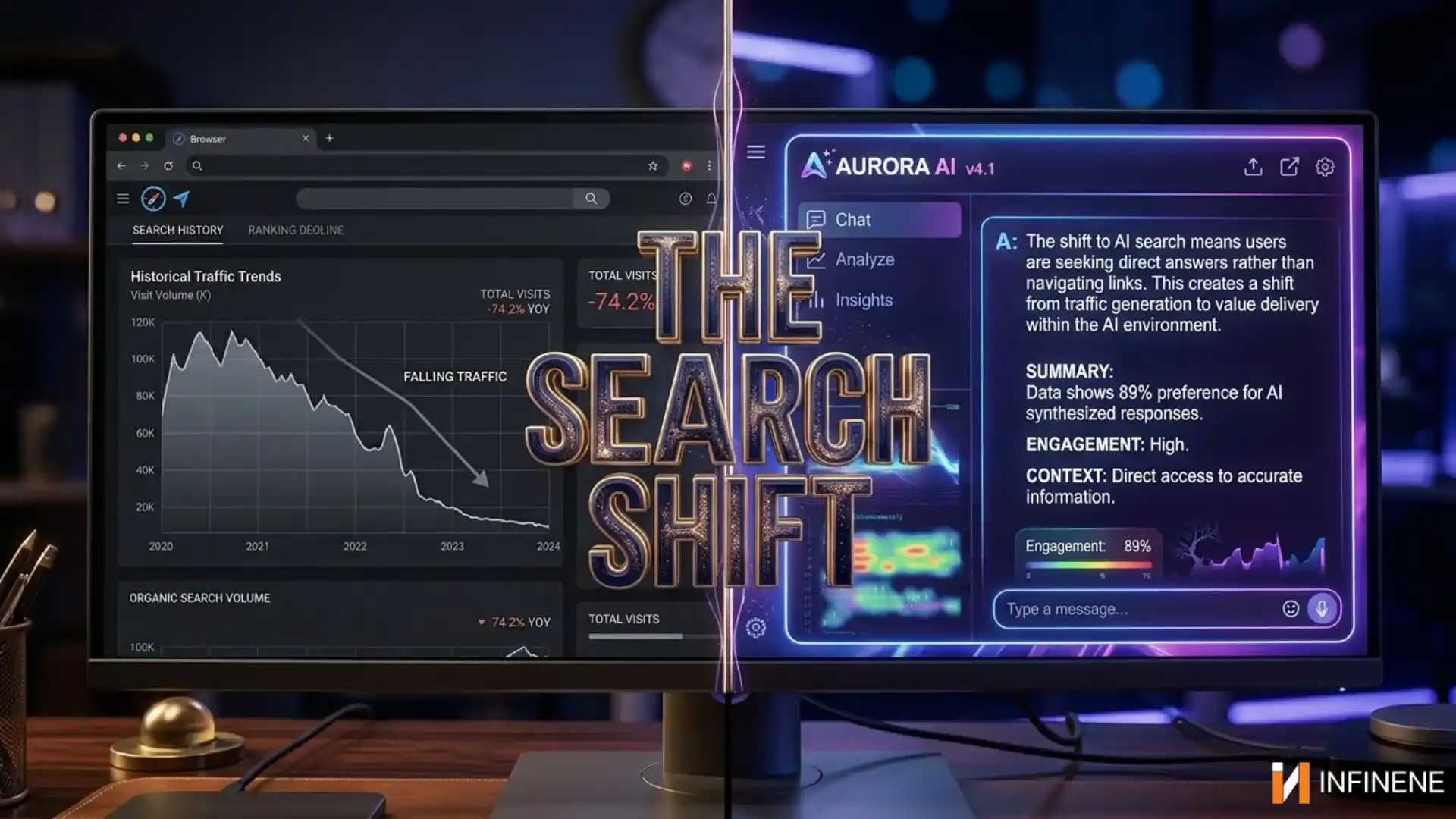
“Google's AI Overviews are quietly eating your clicks. Perplexity and ChatGPT are answering your customers' questions without ever sending them to your site. And most companies have no idea it's happening — until the analytics do.”
Let's be direct about something: the SEO playbook most US businesses are still running was written for a world that no longer exists.
Not because search is dead. It isn't. But the contract between search engines and publishers — the one where Google sends you traffic in exchange for good content — is being rewritten in real time. And almost nobody is reading the new terms.
Google's AI Overviews now appear on the majority of informational searches in the US. Perplexity has crossed 15 million daily active users. ChatGPT search is handling tens of millions of queries a week. And every single one of those interactions has the same structural problem for your business: the answer is delivered without a click.
This isn't a blip. It's a shift in how America looks things up. And if your revenue relies on organic search traffic — even a little — you need to understand what's changed, why it happened this fast, and what AI search optimization actually means in practice.
For two decades, the SEO value proposition was clean: rank high, get clicked, convert visitors into customers. The whole industry was built on that chain of cause and effect.
Zero-click search behavior blew that up.
According to SparkToro and SimilarWeb data, more than 58% of Google searches in the US ended without a single click in 2025. Featured snippets, knowledge panels, local packs, and now AI Overviews — Google has become extraordinarily good at keeping users inside its own ecosystem. The irony? The better your content, the more likely Google is to summarize it and never send you the traffic.
Think about what that means for a business that spent $200,000 on content marketing last year.
"You're essentially feeding the machine that's eating your lunch. The content you write to rank is now the content Google uses to answer questions without you."
This is the brutal economics of zero-click search. It's not hypothetical — you can see it in virtually every analytics dashboard right now. Impressions are flat or up. Clicks are down. Sessions per impression have collapsed. The funnel isn't broken, exactly. It's been bypassed.
Google began rolling out AI Overviews to all US users in mid-2024, and by early 2026, they're appearing on the vast majority of informational and commercial-research queries. These aren't just featured snippets with a fresh coat of paint. AI Overviews synthesize multiple sources, present a structured answer, and — critically — compress the user's need to click anywhere.
BrightEdge tracked a 30% average organic traffic decline for pages that previously ranked in positions 1–3 for queries now covered by AI Overviews. For health, finance, legal, and how-to content, the drops are steeper. Some publishers have reported 40–60% reductions in clicks on their top-performing pages.
The losers here aren't just small blogs. Major media companies, established SaaS firms, and e-commerce brands are all watching organic acquisition costs climb while free traffic evaporates. The playbook that generated leads for $4 a visit is now generating leads for $11 — and that's before factoring in the content investment itself.
Here's where it gets strategically interesting. Google's AI Overviews do cite sources — they just cite them in a way that rarely generates meaningful clicks. But being cited matters enormously for brand authority, and more importantly, it matters for how AI search engines in general decide what to trust.
The pattern that's emerging across AI search platforms — Google, Perplexity, ChatGPT's web browsing — is that they systematically favor:
Primary research, original data, and proprietary statistics.
Bylined content with credentialed authors and institutional affiliations.
Long-form editorial that demonstrates genuine domain expertise.
Structured content with clear definitions, comparisons, and factual anchors.
Sites with strong E-E-A-T signals — experience, expertise, authoritativeness, trustworthiness.
Content that other authoritative sources link to and quote.
This is the first real-world expression of what generative engine optimization means as a discipline. It's not about keyword density or backlink counts. It's about whether an AI model trusts your content enough to pull from it when constructing an answer.
Generative engine optimization — GEO — is a real practice now, not a thought experiment. But most of what's being published about it is either too vague to act on or so technical it loses the business context entirely.
The core idea is simple: traditional SEO optimized for human readers and Google's crawler. GEO optimizes for AI systems that read your content and decide whether it's worth including in a generated answer.
Those are different audiences with different criteria.
A Google crawler wanted to see semantic keyword coverage, internal linking, and page speed. An AI language model wants to see factual density, clear claims, citations, and structured prose it can quote without distortion. The writing style matters in a different way. The specificity of your claims matters more than it ever did. Vague, hedged marketing copy — the kind that sounds good but says nothing — gets ignored or paraphrased into meaninglessness.
"GEO isn't about tricking an AI. It's about giving it something worth saying."
Think about how Perplexity answers a question like "What's the best CRM for small law firms?" It synthesizes answers from sources it considers authoritative. If your SaaS company has published a rigorous, data-backed comparison of CRM solutions for legal practices — with real case studies, specific feature comparisons, and pricing context — you have a chance to be cited. If you published a fluffy "top 10 list" that reads like it was written in 20 minutes, you don't.
This is what AI search optimization actually demands: subject matter depth, editorial standards, and the kind of intellectual rigor that's always been the hallmark of great journalism and research. SEO just never required it before. Now it does.
The shift from keyword queries to conversational queries is probably the most underappreciated change. When someone types into ChatGPT, they don't write the way they used to Google. They explain their situation. They add context. They ask for a recommendation, not a list of links.
That changes everything about what good content looks like. Your "best project management software" roundup ranked for that keyword in 2023. But the 2026 query is "I'm a 12-person agency managing multiple client accounts with freelancers — what project management tool should we actually use?" That's a different question. It demands a different kind of answer.
And right now, most content on the web isn't built to answer it.
Not every industry is being hit the same way. The sectors absorbing the hardest blows in organic traffic since AI search scaled up:
What's surviving better? Local businesses with genuine geographic signals. E-commerce with unique product inventory. Brands with strong direct traffic and email lists. And — crucially — companies that have invested in the kind of original research and proprietary data that AI systems can't synthesize from elsewhere.
That last category is the most important lesson from 2025.
This is the part most articles dance around. Here's what the evidence actually shows is working for businesses navigating AI search in 2026.
Surveys, proprietary studies, internal benchmarks, customer research — anything that can be cited as a primary source. AI engines weight original data heavily. If Perplexity is constructing an answer about conversion rates in e-commerce, it will cite whoever published the most credible, specific numbers. Be that source.
This means: clear topic sentences, concise definitions, numbered processes, comparison frameworks with explicit criteria, and strong factual anchors in every paragraph. AI language models are essentially looking for passages they can lift without misrepresenting the original. Make those passages obvious.
E-E-A-T has never mattered more. But it's not about gaming a checklist — it's about having real credentials, real bylines, and real institutional signals that AI systems can trace. Anonymous content, AI-generated pages, and low-attribution posts are being systemically deprioritized. Put real experts on the page. Link to their credentials. Make the authorship impossible to question.
There's a category of search intent that AI cannot fulfill: the intent to do something, not just know something. High-purchase-intent queries, local service searches, personalized consultations, product demos, free trials — these still require a human interaction. Build content that serves the bottom of the funnel, not just the top.
When ChatGPT recommends tools or services, it often does so without a hyperlink. But it mentions brand names. If your brand appears frequently in AI-generated answers — even without a click — you're building recognition in a channel that's reaching millions of Americans who will eventually search for you by name. That's a new form of SEO value that most analytics tools aren't measuring yet.
Search your key queries in ChatGPT, Perplexity, and Google with AI Overviews on. Is your brand cited? If not, you have a GEO gap.
One proprietary data study can generate AI citations across hundreds of queries. It's the highest-leverage content investment you can make right now.
Bylined experts with verifiable credentials outperform anonymous content in every AI ranking signal. This is non-negotiable in 2026.
Clicks are an incomplete metric now. Track branded search volume, direct traffic growth, AI mention frequency, and revenue attribution by channel.
Email lists and direct communities don't care about AI Overviews. The businesses surviving search disruption all have strong first-party audiences.
Find the queries where AI gives weak or generic answers. Those are your best opportunities for driving actual clicks from search right now.
AI search optimization — sometimes called generative engine optimization or GEO — is the practice of structuring your content so that AI-powered search systems like Google AI Overviews, Perplexity, and ChatGPT are more likely to cite you in their generated answers. It matters because AI engines now handle a significant portion of US search queries, and appearing in AI-generated responses has become as important as ranking on page one of traditional Google results.
Losses vary significantly by industry, but the data is not reassuring. BrightEdge tracked roughly a 30% average organic traffic decline for pages previously ranking in positions 1–3 after Google AI Overviews began appearing on those queries. In content-heavy verticals like health, finance, and education, some publishers have reported 40–60% drops on their highest-traffic pages. Zero-click behavior now affects more than 58% of all Google searches in the US.
Traditional SEO optimized content for Google's crawler and human readers — think keyword placement, backlink acquisition, and technical performance signals. Generative engine optimization focuses on making your content trustworthy and useful enough for AI language models to cite when constructing answers. GEO prioritizes factual density, original data, clear source attribution, and expert authorship over keyword frequency or link counts.
Google AI Overviews appear above organic results for a growing share of US searches, which pushes traditional blue links further down the page. Even when a page is cited in an AI Overview, click-through rates are dramatically lower than for traditional rank-1 results — because the AI summary often satisfies the user's intent before they reach the links. Pages that previously dominated position 1 have seen their effective CTR collapse in queries now covered by AI Overviews.
Content that performs well in AI search environments tends to be primary-source, data-backed, and written by credentialed experts. Original research, detailed how-to content with step-by-step structure, comparison frameworks with explicit criteria, and editorial content with strong factual anchors all tend to be cited more frequently. Thin, generic, or heavily promotional content is systematically underweighted by AI systems.
The most important AI search trends to watch in 2026 include: the rise of conversational query formats that demand contextual answers rather than keyword matches; the growth of AI-native search interfaces like Perplexity and ChatGPT that compete directly with Google for informational intent; the expansion of zero-click behavior to commercial and comparison queries that previously drove significant traffic; and the emergence of brand mention frequency — not just backlinks — as a meaningful signal of authority in AI-generated answers.
Our team helps US businesses close the gap between where they rank and where AI systems actually pull answers from. From GEO audits to content restructuring — we handle the strategy so you don't have to figure it out alone.