


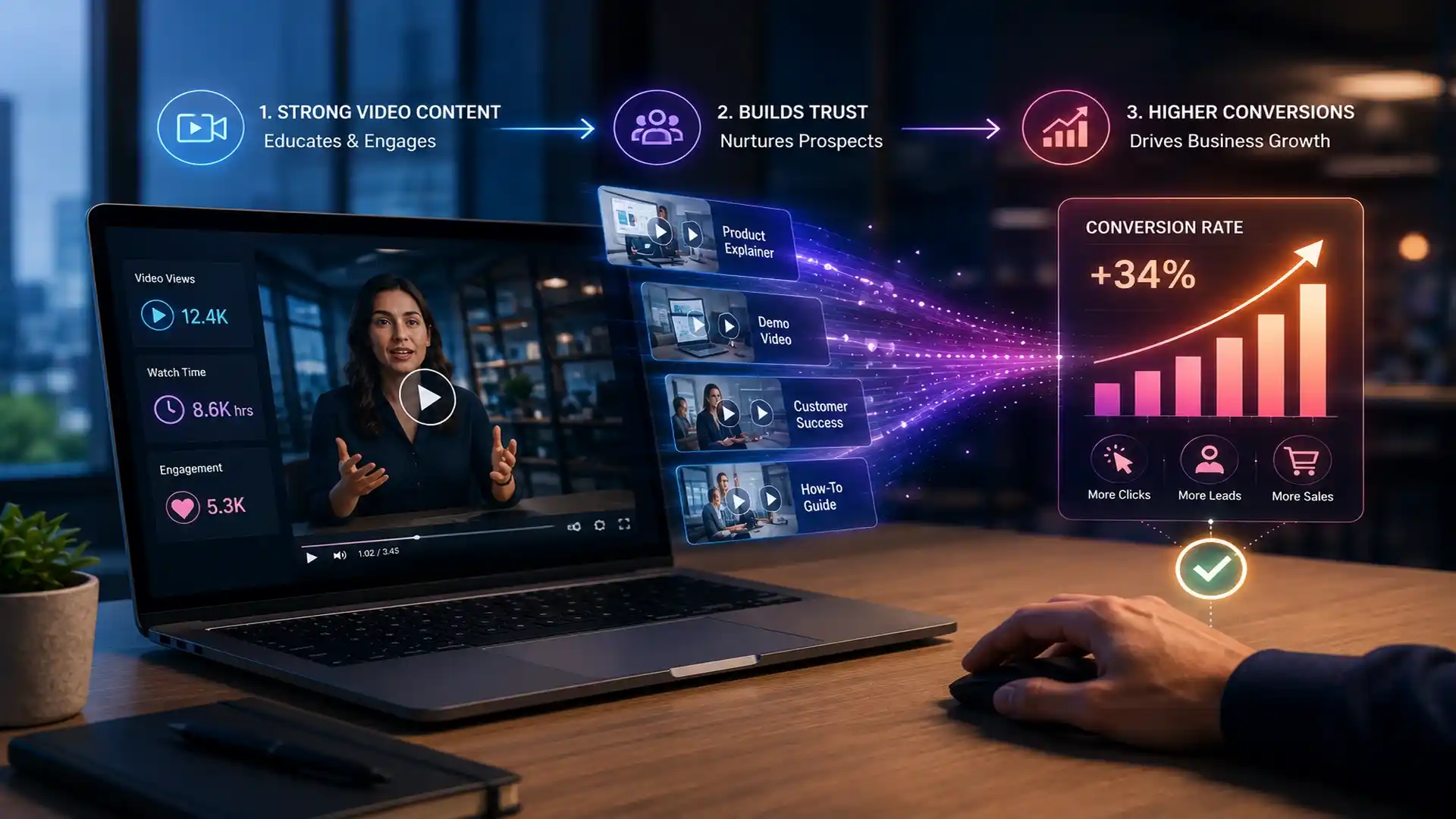
Most SaaS marketing teams already know they should be doing more with video. But only a few of them actually know why it works. Or how to prove it to a CFO who wants results. That difference matters more than it used to. Buyers researching software today are impatient. They are skeptical about sales copy. At the same time, they’re drowning in near identical landing pages. All of them claim the same thing, “streamline workflows”, “unlock growth,” and so on. Video content marketing cuts through all that noise in a way that plain text can’t quite do. The data backing that claim has become hard to ignore. This isn't about producing flashy content for its own sake. It's about using video with intent. To explain complex products faster. To build trust with buyers who've never spoken to a salesperson. To shorten the gap between "interesting" and "I'll buy this." For SaaS and tech companies especially, where the products are kind of invisible until someone actually logs in, that little gap is actually where deals are won or lost, depending on how fast and how well you convince them.
Software is a strange thing to sell. Unlike a physical product, there's nothing to hold or try on. A prospective buyer can't walk into a store and see what they're getting. That abstraction is exactly why video content marketing has become such a disproportionately powerful tool for this sector.
A demo video or a short explainer does something a spec sheet never can. It makes the abstract concrete. It shows the interface, the workflow, the "aha" moment a user has when a feature finally clicks. For a category where the core objection is often "I don't fully understand what this does or how it fits into my day," video answers that question in a way word on a page struggle to.
There's also a trust problem unique to tech and SaaS buying. Enterprise software purchases increasingly happen without a single call to a salesperson. Buyers research independently. They compare tools. They often make shortlist decisions before anyone from the vendor's team even knows they exist. In that self-serve research phase, video is frequently the only "human" touchpoint a prospect gets. A founder explaining the product's origin story, a customer describing how the tool solved a real problem, a product lead walking through a dashboard. All of it does the work a sales rep would have done in an earlier era of B2B buying. None of this means video is a silver bullet. A video that’s made a bit wrong or packed with jargon can mess things up just as much as a bad landing page. The companies getting actual conversion growth are the ones viewing video as a real communication tool. It shouldn’t just be a checkbox on a content calendar.
There's also a category-specific dynamic worth acknowledging. Tech and SaaS buyers tend to be more skeptical of marketing claims than buyers in almost any other sector. A lot of them have been burned by software that didn’t do what the sales page promised. Like, the video makes it harder to overstate a product’s capabilities. Because a viewer can see exactly what the interface looks like as well as how a feature actually behaves. That transparency cuts both ways too. It shows a weak product just as clearly as it showcases a strong one. But if a company is confident in what they’ve built, it becomes an edge that the competitors don’t really get. Especially those who rely purely on words and screenshots.
A lot of SaaS companies approach video marketing the same way as they do blog content. Produce it, publish it, hope it performs. That's not a strategy. And it rarely moves conversion metrics in any measurable way. A more effective video marketing strategy starts by figuring out what video types do for each stage in the buyer journey. It’s like you don’t just post stuff. You place it right where it can actually help someone decide.
At the top of the funnel, short videos with high context usually do best. They are from thirty to ninety seconds. They are not sales pitches exactly. They are more like a quick nudge. Built to clarify an issue the audience already knows but maybe only in a vague way. These videos are delivered in a format that works on LinkedIn, YouTube Shorts, or even a paid social placement. The goal here isn't conversion. It's earning enough attention that a prospect clicks through to learn more.
In the middle of the funnel, video has to do the heavy lifting. This is where product demos and use-cases along with comparison content live. A prospect who's already aware of the problem and is now evaluating solutions wants to see the product in action. He doesn't want to read a bullet-pointed features page. Companies that place a genuinely useful demo video above the fold on a product page routinely see it outperform static screenshots for time on page and, more importantly, for demo requests.
Near the bottom of the funnel, customer testimonials and case study videos carry disproportionate weight. Software buyers, especially in B2B, are making a decision that reflects on their own judgment internally. Hearing a peer, someone in a similar role, at a similar company, describe a specific, measurable outcome does more to reduce purchase anxiety than another round of feature comparisons.
The strongest video marketing strategy also accounts for where the video lives. A demo embedded directly on a pricing page needs to answer objections fast, ideally under two minutes. The same content repurposed for YouTube can run longer. Because the audience there has opted in to learn, not just to buy.
The theory behind the video is easy to accept. The harder part, for a lot of marketing teams, is connecting it to the metrics finance actually cares about. Sign-up rate. Demo-to-close rate. Cost per acquisition. SaaS video marketing tends to move conversion in three fairly consistent ways.
It increases the likelihood a visitor takes the next step. Landing pages that have an embedded product video usually get stronger engagement than pages that don’t. The video also keeps a visitor on the page long enough so they can actually reach the call to action that they may have skipped otherwise. If someone watches even about thirty seconds of a demo, they’ve basically prequalified themselves. That means the follow up email or retargeting ad hits differently for them, compared with a person who bounced in like five seconds and was gone.
It shortens sales cycles. When a prospect has already watched a clear product walkthrough before a first sales call, that call moves faster. The rep isn't spending the first ten minutes on the basics. They’re answering specific questions from someone who already gets what the product does. The sales teams at SaaS companies that lean into video consistently say the first calls are shorter. But also, more productive. That compounds across a pipeline into a meaningfully shorter average sales cycle.
It reduces churn risk before a customer ever signs up. Onboarding and product education videos set expectations accurately, even if it sounds small. A prospect who converts because a slick ad overstated the product is still a prospect who churns in month two or something like that. A prospect who converts after watching an honest and detailed demo already knows what they're getting. That means the customers video marketing brings in tend to be a better long-term fit.
None of this requires Hollywood production values. The highest-converting SaaS demo videos are basically screen recordings with a clear voiceover and good editing. Buyers care about clarity and honesty, not just a polished look.
There's a second-order effect worth mentioning too. Video content marketing, in general, makes the whole ecosystem around it work better. If you drop a demo video right on a product page, it can increase the average time visitors spend there. That usually reads as relevance to search engines which then helps organic rankings for that specific page over time. Likewise, a well-crafted explainer posted on social platforms often gets more shares and comments compared with a still image or a single graphic. So, you can expand discoverability naturally without any extra advertising spend. None of this shows up on a "conversion rate" line directly. But it compounds into lower acquisition costs across the funnel which is ultimately the same outcome finance teams are looking for when they ask marketing to justify budget.
It’s also worth noting how video performs differently across acquisition channels. Paid social ads that open with a product demo in the first three seconds routinely beat static image ads on click through rate. And, it’s not subtle at all. The format itself signals "this is worth stopping for" in a feed built for scrolling past things quickly. Email campaigns that include a video thumbnail tend to see a lift in click-through rate. That’s because a play-button graphic reads as more clickable than a plain hyperlink. None of these are dramatic, single-variable wins. They're incremental gains that, stacked across a funnel, add up to a noticeably more efficient acquisition motion.
For every SaaS brand using video well, there's another treating it as an afterthought. The mistakes tend to repeat across the industry.
The most common one is leading with the company, instead of the problem. A video that opens with "We’re thrilled to introduce our revolutionary platform" loses viewers in the first five seconds. Because it hasn’t given them a reason to care yet. The videos that actually hold attention open with the problem the viewer is already experiencing. Then place the product as the answer, not the other way around.
The second mistake is length mismatch. A ten-minute-deep dive video on a homepage will kill conversion rate. The reason is, people are still there just deciding if they even want to spend the time at all. And that same ten-minute video could do brilliantly lower down in the funnel. If it’s sent straight to a warm lead who has already asked for more detail. Matching the video length to what the viewer actually wants is one of the simplest levers in video content marketing, and also one of the most ignored.
The third is skipping captions and mobile optimization. A significant share of B2B buyers now do their initial research on a phone, often with sound off. A video that kind of depends entirely on audio to make its point is already losing a meaningful chunk of its potential audience before it even gets a real chance to convert them. And then, it’s not just that. A lot of companies pump out video, and then never really look at what happens after someone watches. If you don't track watch-through rate, the click-through from video to landing page, or the eventual conversion, you basically can’t tell whether the video is driving revenue or it’s just stacking views.
It’s that simple. Treat video analytics with the same kind of seriousness you’d use for email or paid ads. That’s what separates teams that actually get better at their video marketing strategy year after year from teams that keep guessing.
Getting one good video out the door is achievable for almost any SaaS team. Building a repeatable program, one that keeps producing content that moves conversion metrics, is a different challenge. It's where most companies stall out. The businesses that do this well usually start small and humble rather than trying to be ambitious and broad. A single, well produced demo video can teach a team more than a dozen scattered videos that get published with no clear purpose.
From there, scaling often turns into building a repeatable production process. A template for demo videos. A standard format for customer testimonials. A lightweight system for turning webinars or sales calls into short-form clips. This is also where a lot of tech companies find efficiency by repurposing. A single customer interview can become a testimonial video, several social clips, and supporting quotes for a case study page, all from one recording session.
It's also worth being honest about who owns this. Video content marketing that lives entirely with an outside agency, disconnected from the product and sales teams, tends to feel generic. The SaaS companies that seem to produce the most effective video are usually the ones where marketing works tightly with product and customer success. The people who get the product the best are also the ones who figure out which features truly handle a customer's issue and which bits of the pitch land in real conversations. Sometimes it feels like the best messaging isn’t only written. It’s rehearsed using what customers say day to day.
One question comes up in almost every conversation about scaling a video content marketing program. How much should this cost, and who should be doing it?
There's no single right answer. But there is a pattern that SaaS video marketing get meaningful conversion lift from video without overspending. A lot of teams start with a hybrid model rather than going all in on outsourcing or fully building in-house. Usually it’s a lean internal setup, like one person who has editing know how and product context. They do most of the demo videos, screen recordings and those social snippets. Because everything has to ship quickly and they already know the product roadmap. Then the higher-stakes stuff, like a flagship brand film or a polished customer testimonial reel that’s headed for a homepage or a sales deck, gets passed to a production partner. That partner brings the more premium gear and a more refined edit process, but only for a smaller number of pieces.
This split matters because the two kinds of video aren’t really the same job, and they don’t even move on the same schedules or cadence. A product update might need an explainer video within days of shipping, which an agency relationship simply can't turn around fast enough. A cornerstone brand video, on the other hand, might only need a refresh once a year, which makes a larger one-off production budget easier to justify.
Budget talk also goes smoother when the video is framed not as some flat content-production line item. But in terms of the metrics, it’s expected to nudge. For example, a demo video tied to a particular landing page can be checked against that page’s current conversion rate. So, marketing gets a clean before-and-after and then can return to leadership with it. That kind of framing tends to unlock further investment far more reliably than a general pitch about video being "important for brand."
SaaS video marketing isn't a trend that companies can afford to treat as optional anymore. It's become one of the more reliable levers available for improving conversion rates in a buying environment that's grown more self-directed and more skeptical of traditional sales messaging. The companies seeing real results aren't necessarily the ones with the biggest production budgets. They're the ones treating video as a tool to answer real buyer questions, placed deliberately at the right stage of the funnel, and measured with the same discipline as any other marketing channel.
For US-based SaaS and tech marketers trying to set up a plan for the year ahead, the real opportunity isn't whether to invest in video. It’s more about whether that investment is steered by a clean video marketing strategy, built around buyer intent and fairly honest product representation, plus consistent measurement. Or if it’s just more content tacked on to an already crowded feed. In other words, it’s not just spent here or spend there. It’s about having a direction that actually holds up when results start showing up. Get that right, and video stops being a line item on a content calendar. It becomes one of the clearest paths a SaaS or tech business has to turning attention into pipeline, and pipeline into revenue.