


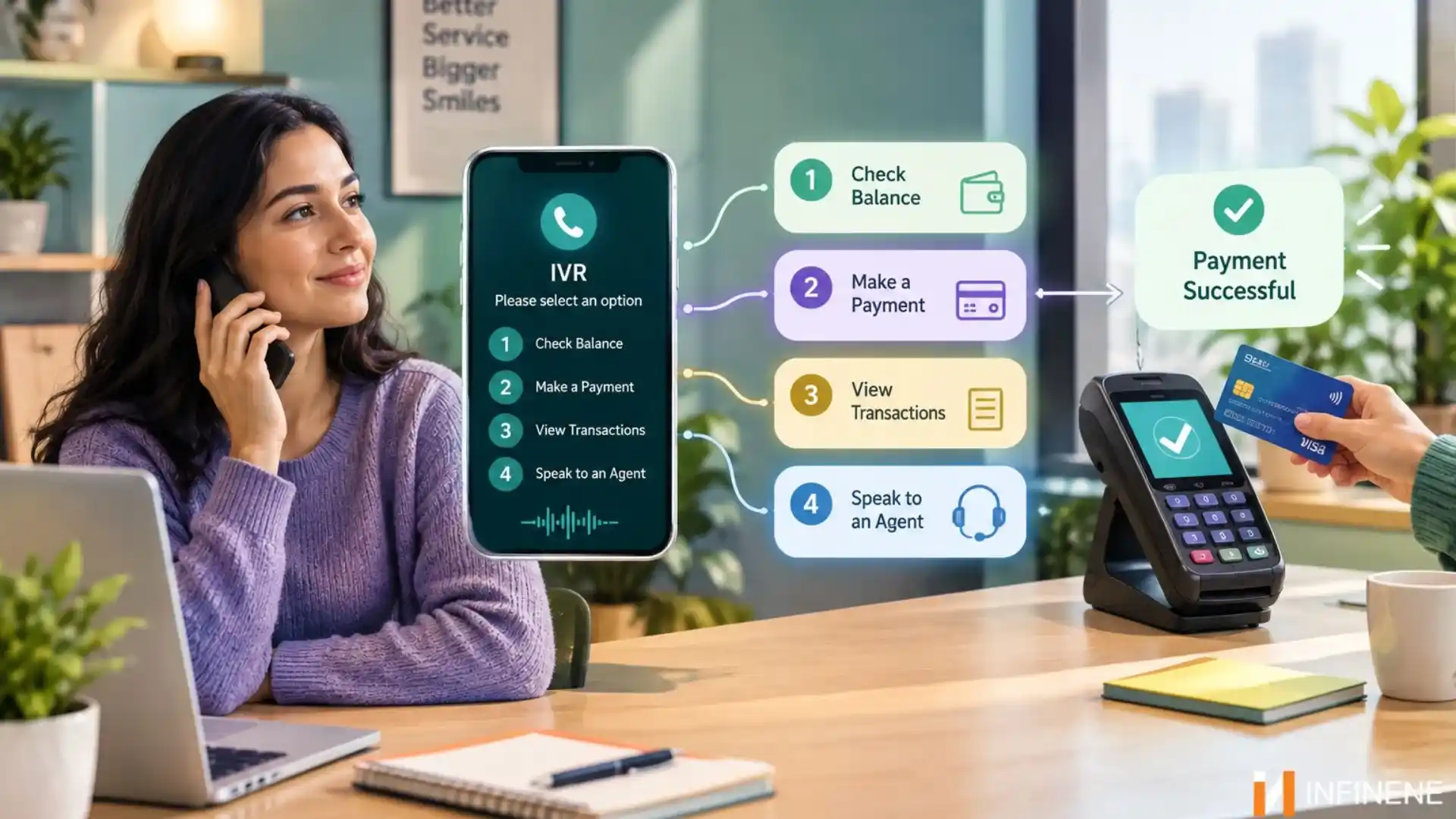
Phone based payments have not gone away. They have just gotten smarter. Instead of reading a card number out loud to an agent, most callers now complete the transaction themselves through an automated system. That system is IVR payment processing. It has become the default way businesses collect phone payments securely, around the clock, and without tying up agent time.
This guide breaks down what IVR payment is, how IVR payment processing works behind the scenes, what "PCI compliant" actually means for a phone payment, and how to compare IVR payment solutions for your own IVR contact center. Along the way, we will cover IVR credit card processing, the IVR software features worth paying for, and the questions most people ask before they roll out an IVR payment system.
IVR means Interactive Voice Response. It is a setup where a phone system handles a caller by using prerecorded voice prompts. The caller also taps keys on the keypad to choose options. In this way, calls do not always need to go right to a live agent. When someone calls a business line, IVR is what plays the menu. It asks the caller to press one for billing or press two for support. It can also listen to what someone says and route the call based on that.
IVR has been used in call centers for a very long time. In the beginning, these systems mostly sent calls to the right place. They also helped with basic account checks. Back then, if someone asked what does IVR stands for, the usual answer was simple. It was an automated phone menu. Now things look different. Modern IVR tools can recognize speech. They can also handle natural language, so callers do not have to use strict prompts. It also links with CRMs, data stores, and payment tools. Because of that, the system can do an end-to-end task. It is no longer only about choosing a menu option.
An IVR payment means using an Interactive Voice Response system so a person can complete a payment call. The caller does this by phone only, with no real-time agent on the line. The caller types the payment info on the keypad. This can include the card number, the CVV and other details. In some setups, the caller can also say the digits out loud. Then the system listens and records what is said.
Once the customer enters that information, it goes straight to a payment gateway for processing. It skips the agent entirely. That is really the whole appeal of IVR payment. The payment is done between the caller and the computer voice system. Because of that, staff do not view or listen to the card information. This method is used by many kinds of companies. You can see it in utilities, healthcare, insurance, shops, and finance firms. They use it for common needs like one off bill pay, cash or account deposits, and monthly subscription charges.
IVR payment processing follows a fairly predictable sequence from the moment the phone rings to the moment the receipt goes out. It usually looks something like this.
The customer calls the payment number. The caller dials a dedicated payment line, or a live agent transfers them there partway through a support call.
IVR identifies the customer's account. The system asks for an account number and other details to confirm who is calling. It then pulls up the right record.
The customer selects the payment option. Voice prompts walk the caller through what they want to pay, whether that is a full balance, a partial payment, or a saved card on file.
IVR requests payment or card information. The caller enters card or bank details using the keypad tones, known as DTMF, or by speaking them.
Payment data is securely processed. The system encrypts the information right away and sends it to a payment gateway or processor for authorization. It never touches the agent's screen and it never gets recorded on the call.
The customer receives confirmation. The system reads back a confirmation number and can follow up with a text message or email receipt.
For a returning customer with a saved payment method, this entire IVR payment processing flow can finish in under a minute. That speed is a big reason IVR payment processing has become the standard way to collect recurring bills.
Security is the whole reason businesses route card payments through IVR instead of an agent. It is worth understanding exactly what happens to the data and what counts as truly compliant.
With an IVR payment, the customer begins by entering their details. They might type the info, or they might speak it. The exact steps can change based on how the business set up the system. Most providers let customers use more than one option. That way, people can choose the method that feels simplest.
When a caller uses a DTMF keypad, they tap the number keys on their phone. The system then listens to the tones that come from those taps. This is the usual way to handle credit card actions in an IVR flow. It tends to work even if the caller speaks with a different accent, the line has some background sound, or the caller uses a different language.
Voice input is newer. Phone speech systems let a person say their card number. They can also answer yes or no to verify the details. Some people think it feels quicker and more like a real conversation. Still, it takes strong language understanding so it does not miss anything. That is harder when someone has an unusual accent. It is also tough when the room is loud or the audio is noisy.
When a customer enters or says a card number, the system encrypts it right away. After that, it commonly gets tokenized. That step replaces the real card number with a random sequence of characters. This sequence is known as a token. That token has no value to anyone who might intercept it. It can still be used to process future charges, but the actual card number lives only in a secure, PCI compliant vault. It never sits inside the IVR contact center's own systems.
A well-built IVR payment system does more than encrypt data. It suppresses or hides the DTMF sounds. As a result, people cannot hear them clearly, so they cannot piece together the card number from the audio. This matters most on agent assisted calls, where a live agent stays on the line while the customer enters payment details. Masking is what lets that agent stay connected for support without ever being exposed to the actual card data, and without it ending up on the call recording either. The fewer people and systems that ever touch raw card data, the smaller the target for fraud.
PCI DSS lays out the basic rules for anyone who works with payment card data. This standard covers more than storage. It also calls for encryption while data moves and while it is saved. Access to card data must be limited to approved staff. You also have to use and maintain firewalls. On top of that, you need to run checks to find weaknesses on a set schedule. For a call center, a PCI compliant IVR payment service is often easier to use. It can be simpler than trying to pull your whole setup into PCI scope by yourself.
If you use a company that already meets PCI DSS rules, you take a lot of the compliance work off your team. The audit becomes smaller for your own call center. You also reduce the chance of a pricey security incident. Customers tend to feel safer too, because their card details are managed with care like a bank or a well-known retail business would do.
Not every setup for IVR payment looks the same. Most fall into a handful of categories, and many businesses end up using more than one.
The customer calls in to pay a bill or make a purchase. This is the most common type of IVR payment for utilities, subscriptions, and retail.
The system calls the customer, maybe for a payment reminder or an overdue balance, and lets them pay right there on that same call using the same prompts.
The person takes care of the whole transaction by themself. They double check their account, then they complete the payment. No calls, no back and forth, no one else involved.
A live agent talks the customer through the call, but hands off the actual payment entry to the IVR payment system. That keeps the agent available for support while keeping card data completely out of their hands.
When you start comparing IVR payment solutions, a handful of features separate a genuinely useful platform from a bare bone one.
Automated payment collection for both onetime charges and recurring billing, without extra setup work each time.
DTMF and voice input support so customers can choose whichever method they find easiest.
Secure card data handling, including DTMF masking, as a standard feature rather than an add on.
Tokenization so saved payment methods stay safe for future use.
CRM and contact center integration so account and payment data sync automatically instead of living in two separate systems.
Payment gateway integration that works smoothly with the processors you already use.
Call recording controls that pause or mask recordings the instant sensitive data entry begins.
Reporting and analytics that show payment volume, success rates, and the reasons behind failed transactions.
Scalability, since your IVR software needs to keep up during call volume spikes without dropping transactions.
Good IVR software checks all of these boxes at once, not just one or two.
Adding IVR payment processing to a contact center tends to pay off in a few clear ways.
24/7 payment availability so customers are not stuck paying only during business hours, which tends to cut down on late payments.
Reduced agent workload because routine payment calls no longer need a human on the line.
Faster payment processing, since a self-service transaction moves quicker than a manual, agent led call.
Lower operational costs because fewer agent minutes go into each transaction.
Improved customer convenience, since customers can move at their own pace and pick keypad or voice input.
Secure handling of payment information because it bypasses agents and call recordings completely.
Integration with contact center systems, so payment activity flows directly into CRM and reporting tools without extra manual work.
A few things matter most when you are weighing different vendors. Evaluate each option against the following.
Security and PCI compliance. Confirm the provider is actually PCI DSS validated, not just compliant by their own claim.
Payment gateway integrations. Make sure the solution works with the processor you already use.
CRM and contact center compatibility. The system needs to sync cleanly with the platforms your team relies on every day.
Scalability. The solution has to handle both normal daily volume and seasonal spikes without issues.
Reporting and analytics. Visibility into completed, failed, and abandoned transactions helps you catch problems early.
Total cost. Factor in setup fees, per transaction fees, and any ongoing platform fees.
Businesses running IVR-enabled contact center solutions are usually in a better position to fold payment collection into their existing customer service workflows instead of bolting on a separate system later. Automation is reshaping contact centers well beyond payments too. You can read more about how AI is reshaping IVR contact center economics if you want the bigger picture. If you are still deciding, it may be smart to ask for support with setting up IVR payments. Work with a group that has done this before, not a first-time team. They can help you put the steps in place.
IVR means Interactive Voice Response. It is a setup where callers can speak to a company system and also press keys to choose options. With this, a business does not have to use a live agent for every single call.
IVR payment is when you finish a payment by phone using an Interactive Voice Response system. Instead of saying your details to a person, you enter them by touch tones or by voice.
It will work if the payments go through a PCI DSS compliant provider. The card details are encrypted and turned into tokens. Then they are kept out of agent screens and call recordings, using steps such as DTMF masking.
The person inputs card details on the keypad or speaks them out loud. Right after that, the system locks the data with encryption and also turns it into tokens. Then it routes the token data to the payment gateway so the payment can be checked. The support staff and the recorded calls do not get access to the actual card data.
A live agent must take the payment details by hand or listen as the customer reads them out. With IVR, the customer types the info into a protected system. That lowers call handling time and helps keep staff from being around card details.
Yeah. Many IVR payment systems link with call center tools, CRMs, and payment processors. Because of that, customer data, payment activity, and call notes remain aligned.