


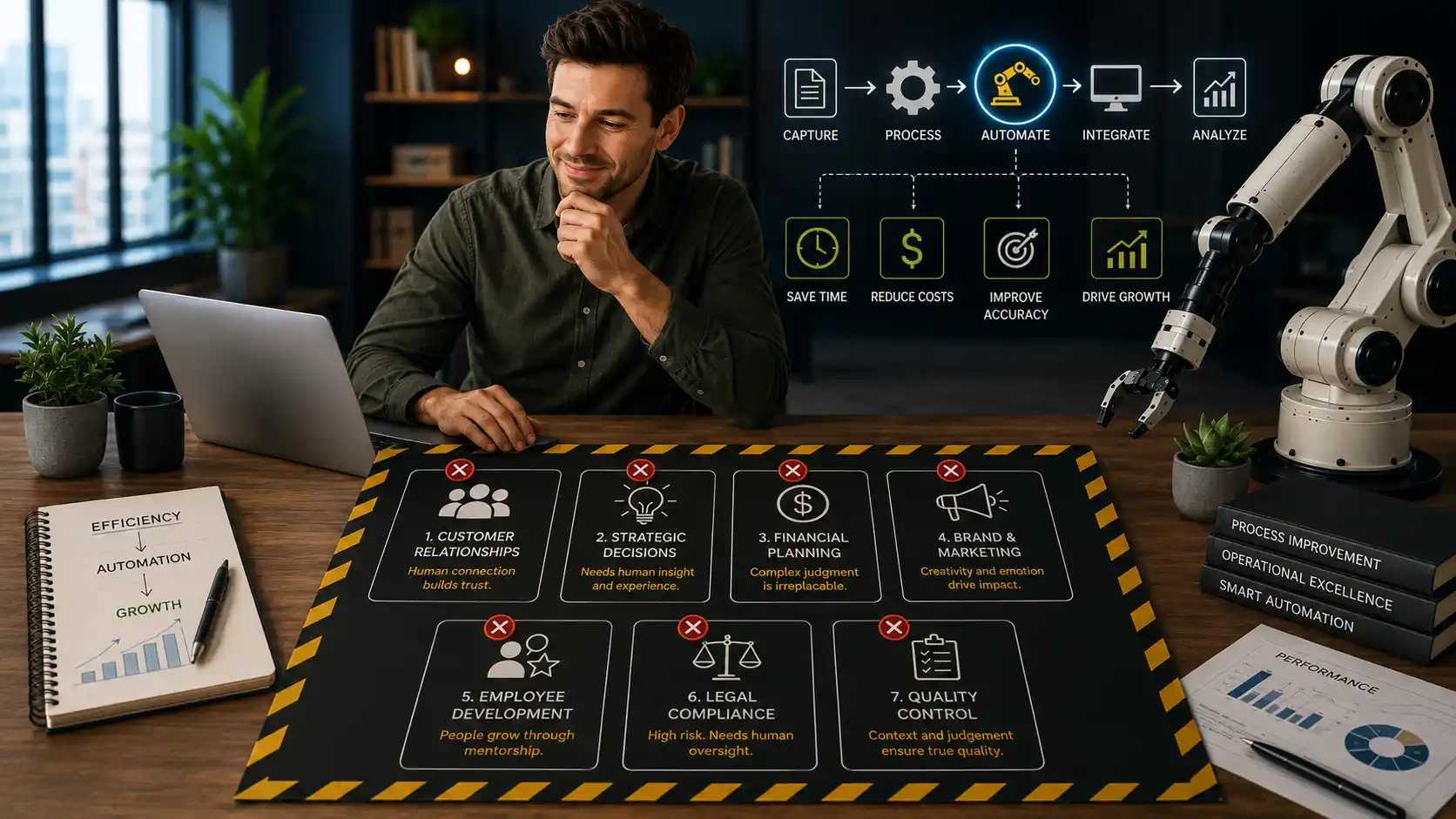
Every B2B leader these days is chasing the same promise. They want faster operations, fewer errors, and a workforce to do "higher-value work." Business process automation is the answer that’s being asked for to fix just about every operational pain point in corporate America. And honestly that instinct is right most of the time. But here's the bit nobody wants to say out loud at the vendor demo. Not every process deserves to be automated first.Some processes are too delicate, or too little understood, to be left to the algorithm on day one. If you automate the wrong thing early, you not only waste a software license, you bake broken logic into your operation. Then spend the next eighteen months un-learning those bad habits in your system.
I've seen enough automation roll-outs go awry to know the pattern. A company orders business process automation tools with gusto but a company only tames chaos instead of eradicating chaos. The problem is not the tools. The sequencing is. So, before you open that RFP for the shiniest AI process automation platform on the market, let's talk about the processes you should leave alone. At least for now.
Automating everything at once feels very attractive. Competitors are doing it. The software is cheap. The ROI slides in every sales deck look identical. But business process automation isn't a single decision. It's a portfolio of decisions. Each decision comes with different risk profiles.
Well-documented and stable processes are the best candidates for early automation successes. These include reconciliations like invoice reconciliations and data migrations from one system to another or simply status updates. These “low hanging fruit” quickly build confidence in automation within the organization. These processes generate quick wins to justify further investment. The processes below are the opposite. They are either too undefined or regulated to be in line. Automating them early does not just risk failure. It risks credibility. And once a business unit has been burned by a bad automation rollout, getting buy-in for the next one gets a lot harder.
Customer complaints are rarely as simple as they look on a support ticket. A complaint about a shipment may actually be a complaint about a damaged relationship with the customer. A complaint could be a pricing dispute or a sign that a big account is about to churn. Human agents pick up on the history and the context. A rules engine simply can't infer these from a form submission.
Automating escalation handling early can create two kinds of failures. One failure is that the system sends everything into a decision tree, which makes customers who are already upset even more angry. The other failure is that the system gives conversations to a chatbot. In B2B relationships, a single account might be worth six or seven figures annually. So, this can become a very expensive mistake. This does not mean that escalations are out of the question forever. Artificial intelligence process automation can really make a difference here. It can be used to summarize case history for agents or to point out changes in sentiment. Completely automating the resolution part should happen much later. Once you truly understand all the situations your team deals with then you can go for it.
Procurement teams really like automation for purchase order approvals and the usual reordering stuff. And sure, it makes sense. But negotiation, especially with strategic vendors or long-run partners, is sort of a different thing entirely. Negotiation involves give and take that no correct dataset can truly capture. Negotiation includes relationship history, that unspoken leverage, the exact timing and all the organizational politics on both sides of the table. Automating the back-and-forth workflow around negotiation can be smart. Automating the actual judgment part though… not so much. Not without very thick guardrails and active human oversight.
Some companies jumped the gun by pushing AI process automation straight into contract negotiation, and then they end up stuck with terms that are just not favorable. The system usually gets tuned for one narrow measure, and it quietly forgets the more qualitative pieces that actually matter.
This warrants a separate caution. Automating these tasks creates concerns of operational inefficiency and legal/ethical issues. Automating resume screening and/or scheduling interviews is business process automation. Automating the onboarding process, i.e., completing the new hire’s paperwork, is also business process automation. Actual hiring decisions are not. Automated hiring tools have a well-documented history of encoding bias. Sometimes invisibly. It is usually based on training data that reflects a company's past hiring patterns rather than its future goals. Regulatory changes are happening in the U.S. too. A few states and cities have put rules in place about using hiring tools. These rules often require companies to perform audits or share details about how business process automation tools work. When you examine automation tools for HR, focus on the aspects. We should not let automation tools decide who should be hired or promoted. Automation tools can help with tasks, like sorting applications or setting up interview schedules. People must stay in charge of the hiring and promotion choices. People bring experience, fairness and sound judgment that automation tools cannot match. Keep automation tools in a role not in a judging role.
Pricing feels like it should be automatable. After all, it's just numbers, right? In practice, pricing decisions for new products or services include a lot of considerations. It comes from a blend of market research, competitive positioning, and gut instinct from people who've been reading the market for years. Dynamic pricing automation works beautifully for established products with predictable demand curves. It doesn't work nearly as well for a new B2B offering where historical data is lacking and demand elasticity is uncertain. Automating pricing too early can lead to a suboptimal pricing structure.
A better approach is to let a human pricing team handle the first several quarters. They can then incorporate their pricing expertise to create rules based on the data they collect. Once rules are in place, AI process automation can be very useful to ensure processes remain aligned. It dynamically adjusts price bands based on demand signals that you have actually verified.
When something goes wrong, speed matters. But so does judgment. This is exactly the sort of process where automation instincts can backfire. A badly phrased automated reply during a crisis can really flip the script. It can turn something that was manageable into a full-blown reputational disaster. I've seen companies automate social media response workflows that fired off tone-deaf templated replies during an active crisis. Just because the system didn’t catch the distinction between a normal gripe and a five-alarm situation. The backlash from an automated misstep in a delicate moment tends to spark way more attention than the original difficulty ever would.
Automate the monitoring and alerting layer here. It includes sentiment analysis and routing urgent issues to the right team fast. But keep actual public-facing responses in human hands until your crisis playbook has been stress-tested many times over.
Before you start making a process automatic you need to understand how it works. This means looking at every step and being clear about what happens when things don't go the way they should. If a process still uses guessing or requires a lot of cases it needs more attention before it can be automated. In a lot of situations, the issue isn't the program. The issue is that the process wasn't properly explained in the place.
They come from companies automating a process nobody had mapped properly. This results in an automation layer that reproduces undocumented inefficiencies at high speed. This is arguably worse than the manual version. Now the inefficiency is invisible and it’s running 24/7 non-stop. Before you even look at business process automation tools for a given workflow, you have to do the unglamorous work first. Map the whole process end to end. Interview the people who actually run it. Pin down every exception case. Only after you get real clarity should automation enter the conversation. Otherwise, you’re just copying the clutter into a faster engine. This single discipline separates successful rollouts from expensive failures more reliably than any platform choice.
Compliance-adjacent processes are a bag when it comes to automation readiness. Some parts work well with automation. Things like document retention logging audit trails and standard reporting to regulators are rule-based and repeatable. That makes them perfect for automation. You can set up a system to handle these without human oversight.
When it comes to decisions that require real judgment. Especially around unclear or gray areas in regulations. Automation isn’t ready yet. Think about it: deciding if a transaction should be flagged for activity reporting. Whether a clause in a contract could cause regulatory issues in a specific state. Trying to make sense of a new rule that hasn’t been tested in court. These are not yes-or-no situations.
US businesses already deal with a patchwork of state regulations. These rules change often. AI business process automation tools, no matter how advanced, are trained on data and existing rules. They don’t handle situations well. If a regulation changes and hasn’t been added to the AI’s training it won’t know how to respond. Trying to automate these judgment- tasks too soon can lead to big problems. Regulatory fines, legal issues, reputational damage. These mistakes don’t go away. They stick around.
That’s why it’s important to keep compliance professionals involved in any decision that needs interpretation. Let them handle the parts where judgment is needed. Use automation, for the rule-based steps that support their work. Like gathering data logging records or generating reports. That way the technology helps. Doesn’t replace the human expertise that’s still essential.
If these seven areas are off the table for now, where should you actually start? I think the answer is wherever the process is repetitive and well documented. Low risk tasks in case something goes slightly wrong. Starting points, for most US B2B companies typically include:
Invoice processing and accounts payable matching, where rules are clear and errors are easily caught before payment.
Data synchronization between systems. CRM to ERP and marketing platform to sales pipeline, where the logic's clear and the volume makes doing it by hand truly exhausting.
Reporting and dashboard creation. This lets analysts skip the boring repeat data pulls.
Internal ticket routing and triage. Where sending things to the place slows things down but doesn’t usually cause big problems.
Standard onboarding paperwork. Separate from the hiring decision itself.
These processes build momentum. They demonstrate ROI quickly. They're forgiving of early mistakes and they give your team hands-on experience with chosen business process automation tools.
The companies that get the most value out of business process automation aren't the ones that automate the fastest. They're the ones that sequence it deliberately. They start with safe, well-understood, high-volume work. They use those early wins to build internal trust and expertise. And they hold back on the processes that require judgment, relationship context, or regulatory nuance until they've built the organizational maturity and often the human-in-the-loop safeguards to handle them responsibly.
AI process automation is only going to get more capable over the next few years, and eventually some of the processes on this list may become reasonable automation candidates too. But "eventually" is doing a lot of work in that sentence. Rushing ahead of your organization's actual readiness doesn't make you an early adopter. It just makes you the cautionary tale in someone else's conference talk. Take the win on your invoice matching. Automate your data entry. Build confidence with your team and with your customers. Then when you are ready to take on the messier, more human processes you will do it with the judgment and the guardrails that they actually deserve.