



Blog Details
HomeBlog Details
5 Security Risks of AI Tools in Small Business Workflows
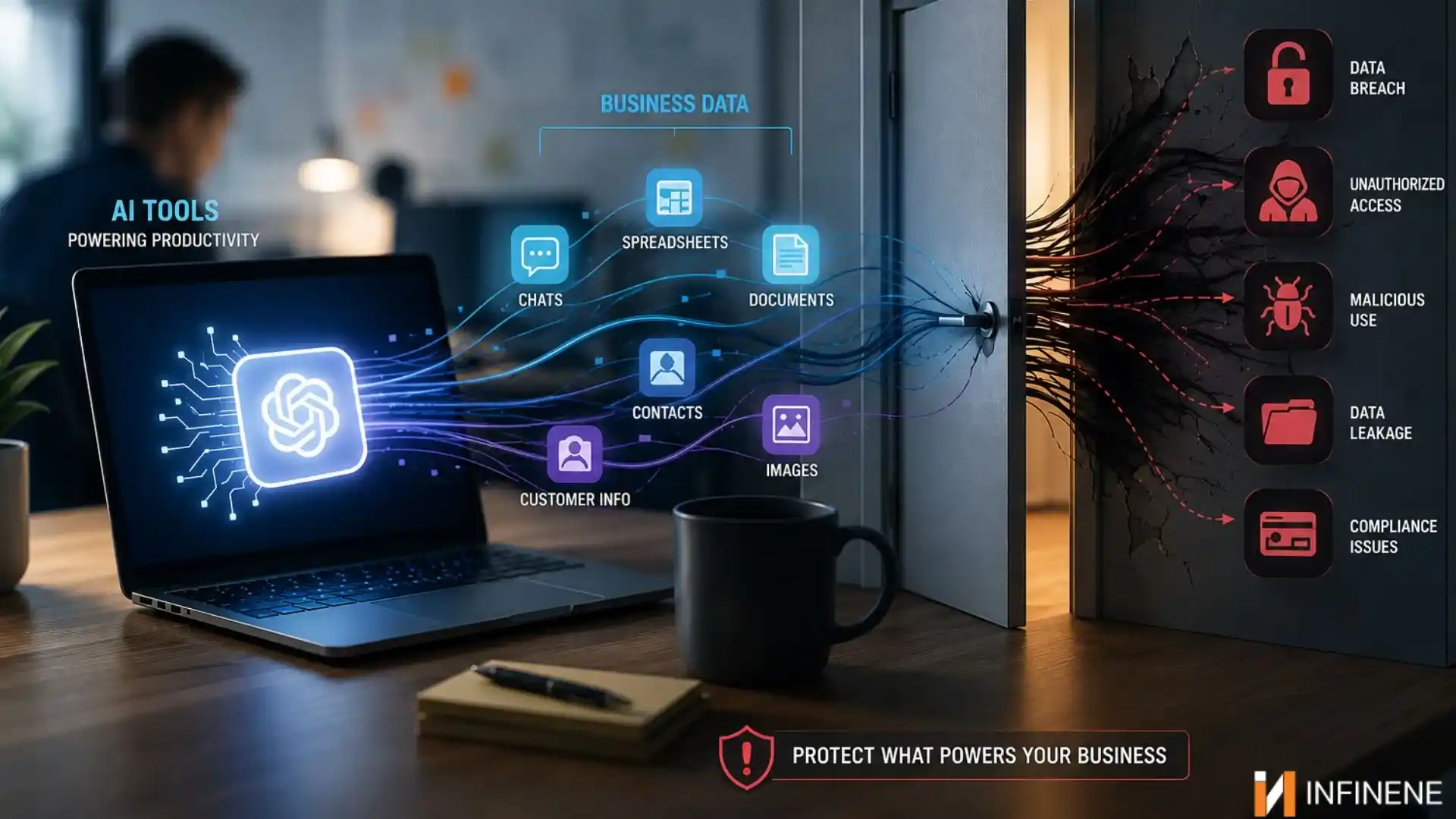
In any small business, you’ll find AI doing the work nobody really mentions in the all-hands meetings these days. Someone in accounts is pasting invoice data into a chatbot just to double-check the totals. Meanwhile, a marketing coordinator is dropping customer lists into a writing tool to personalize emails. A developer is also running proprietary code through an AI assistant, supposedly to catch bugs faster. But none of it was officially sanctioned. None of it went through IT at all. And honestly, almost none of it was meant to play out like this. So, that’s the quieter reality behind small business AI adoption in 2026. The tools showed up quicker than the guardrails did. And that gap, between adoption and governance, is exactly where the AI security risks are hiding.
It's tempting to treat this as an enterprise problem. But it isn't. Small businesses are, in many ways, more exposed. They have smaller IT teams, fewer formal policies, and employees who are more likely to reach for whatever free tool solves the problem in front of them. The risks of using AI in business don't scale down just because the company does. This piece breaks down five specific ways AI tools are creating security exposure inside small business workflows right now, and what's actually worth doing about each one.
Security Risks of AI Tools in Small Businesses
Before getting into the risks themselves, it's worth understanding just how fast this shift happened. According to recent industry research, more than 80% of workers globally now use AI tools in their jobs/. Many of them are used without their employer's knowledge or approval. In the US specifically, close to half of workers use AI at work without telling anyone. Among small businesses with 11 to 50 employees, roughly a quarter report active shadow AI in the workplace. Employees use the tools that are one browser tab away and require no budget approval or waiting. The productivity upside is real. So is the exposure it creates.
Risk 1: Shadow AI and the Tools Nobody Approved
The single biggest security risk facing small businesses right now is the AI tools already running inside the company that leadership doesn't know about. Shadow AI refers to any AI tool, chatbot, browser extension, or embedded feature that employees use without formal IT approval or oversight. It's the AI equivalent of "shadow IT," the decades-old problem of employees signing up for unauthorized software, except AI tools are stickier, faster to adopt, and touch far more sensitive data than a random project management app ever did. The scale of this is genuinely striking. Nearly all organizations have employees using AI tools that were never vetted or approved. Only a small fraction of companies say they can actually detect all the shadow AI activity happening inside their own operations. That's not a minor visibility gap; it's most of the picture missing entirely.
For a small business, this plays out in mundane ways. None of them thinks they're doing anything risky. But every one of these interactions is a small data exit point. Collectively, they add up to a business that has effectively lost track of where its sensitive information is going. The fix isn't a blanket ban, which tends to just push usage further underground. It's visibility first: understanding what tools are actually in use, then building a short list of approved alternatives that meet real security standards. Companies that offer sanctioned tools alongside clear usage guidance see meaningful drops in unauthorized use. Employees generally aren't trying to evade policy. They just haven't been given a paid option that's as convenient as the free one.
Risk 2: Data Leakage Through Everyday AI Use
This is one of the most underappreciated security risks of AI tools in the workplace. It doesn't look like a breach. There's no dramatic hack or locked files. It's an employee pasting a customer's Social Security number into a chatbot to format a form letter. It's a contractor uploading a client's financial statements to get a quick summary. It's a support agent copying a customer's full account history into an AI tool to draft a better response.
Once that information leaves the company's systems and enters a third-party AI platform, the business loses control over it. Depending on the tool's terms of service, that data might be stored indefinitely, used to further train the underlying model, or accessible to the vendor's own staff for "quality review." Few employees read the terms of service for the free AI tool they signed up for on a Tuesday afternoon to save ten minutes on a task.
The financial stakes here aren't hypothetical. Industry breach-cost research consistently shows that incidents involving unmonitored or unauthorized AI tool usage carry higher costs than average breaches meaningfully, in part because they're harder to detect and take longer to contain. And a significant share of shadow AI-related incidents involves exposure of personally identifiable information or intellectual property. Small businesses are particularly vulnerable here because they often handle sensitive data without the dedicated data classification systems larger enterprises use to flag what's sensitive in the first place. If you have not mapped out what counts as sensitive data, you can't build a rule around keeping it out of AI tools.
Risk 3: AI-Powered Phishing and Social Engineering
AI tools have made social engineering a lot more effective, and small businesses kinda end up being prime targets because they usually don’t have the layered defenses that bigger companies use to spot these attempts. Nowadays, attackers even lean on generative AI to craft phishing emails that look grammatically flawless, sound contextually specific, and are often tailored, using information they scrape from a company’s own website, from LinkedIn profiles or even from older data leaks.
The old method of spelling mistakes and awkward phrasing has largely stopped working. AI-generated phishing emails often read like they were written by some pretty competent colleague, because in a weird way they kind of were. A few attackers are even going further, using voice-cloning software that can copy a CEO’s or a vendor’s voice during a phone call, then asking for something like an urgent wire transfer or a password reset. It feels like a straight evolution of business email compromise methods, but now everything is amplified by tools that make impersonation cheap and convincing, at scale.
For a small business without a dedicated security operations team, these attacks are especially dangerous because there's often only one or two people responsible for approving payments or resetting credentials. A single convincing message is all it takes to get through. Defending against this requires layering in verification steps that don't rely purely on how legitimate a message sounds or looks: callback verification on a known phone number for any financial request, multi-person approval on wire transfers above a set threshold, and ongoing employee awareness training that specifically covers AI-generated phishing, not just the legacy red flags from five years ago.
Risk 4: Third-Party AI Vendor and Supply Chain Risk
Every AI tool a business adopts, whether officially or through the shadow IT back door, is also a new vendor relationship. A new link in the supply chain that a company's overall security posture now depends on. This is a subtle but important piece of the broader risks of AI automation for small businesses. When a company automates a workflow using a third-party AI platform, it's not just adopting a feature. It’s basically trusting that the vendor’s own security practices, its subcontractors, its storage rules, and its incident response steps will all hold up. Then, if that vendor gets breached, or if there’s a weakness in its infrastructure, that risk slides straight back into the small business that built a workflow around it.
Most small businesses don’t really have a formal vendor risk evaluation process for software in general, let alone for the whole wave of AI tools employees have started using on their own. Usually there’s not even a real checklist asking things like whether a given AI vendor is SOC 2 compliant, where its servers are located, what its data retention language actually says, or whether it relies on customer data to train newer models by default.
This is more serious with AI tools than with standard software because AI platforms often pull in far more contextual data than a typical SaaS product. A project management tool mostly needs your task list. But an AI assistant tucked into your workflow might need access to your email or customer records in order to be genuinely useful. So, when there’s a security gap at that vendor, the impact area is way wider than you’d expect. Before putting any AI tool inside a business process, it’s worth tossing a short set of questions their way:
Does the vendor publish a clear data retention and deletion policy?
Is customer data used for model training? Can that be declined or opted out?
What certifications or audits back up their security claims, in writing?
Who has access to the data on their end?
These aren't exotic questions. They're the same due diligence any vendor should face, just applied consistently to a category of tools that too often skips the process entirely.
Risk 5: Weak or Missing AI Usage Policies
The final risk is the absence of a framework to manage all four of the risks above. Most small businesses simply don't have a written AI usage policy. That gap is a security risk. Without clear guidance, employees are left to make individual judgment calls. Some will make reasonable choices. Others won't. This is where best practices for AI tool security actually start to matter in a concrete way, rather than as an abstract compliance checkbox. A workable AI policy for a small business doesn't need to be a fifty-page document. It needs to cover a handful of practical points:
A short list of approved AI tools, chosen because they meet baseline security and data-handling standards, so employees have a legitimate, convenient alternative to whatever free tool they'd otherwise find on their own.
Clear rules on what data can never be entered into an AI tool. Customer financial information or login credentials and anything covered by a client confidentiality agreement.
A simple process for evaluating new AI tools before they get adopted team-wide. So, a new tool doesn't quietly become critical infrastructure without ever passing a basic security check.
Regular, plain-language training that keeps pace with how the threat landscape is changing.
A designated point of contact. So, employees have somewhere to go instead of guessing.
None of this requires an enterprise security budget. It requires someone in the business actually sitting down and making these decisions deliberately, rather than letting AI adoption happen by default, tool by tool, department by department.
A Practical Starting Checklist
For a small business owner or office manager reading this and wondering where to actually begin, it helps to break the work into a rough sequence rather than trying to tackle everything at once. Security programs at larger companies are built in stages, and there's no reason a small business can't take the same approach at a smaller scale.
Start with discovery. Before writing a single policy, spend a couple of weeks simply asking staff, informally, what AI tools they're already using and for what. This alone tends to surface a surprising amount of shadow AI activity that leadership had no idea existed. Since employees are often more forthcoming when they don't feel like they're confessing to something. A short, anonymous survey works well here.
Triage by data sensitivity, not by tool popularity. Not every AI tool carries the same level of risk. A grammar checker that only ever sees marketing copy is a very different exposure than a chatbot being used to summarize customer contracts. Rank the tools already in use by what kind of data they touch, and focus the first round of policy and vendor vetting on the ones handling anything sensitive.
Pick just a few approved tools and explain why. People at work are way more likely to keep using an approved AI tool if they get the reasoning behind it, instead of being told a rule with no real context. A quick explanation helps a lot more for actual buy-in than quietly going around the process later.
Put verification steps around financial and credential requests. Given how convincing AI-generated phishing and impersonation attempts have become, this is worth treating as non-negotiable, rather than something you kind of hope for. Any request to move money, swap out banking details, or initiate a password reset should require a second channel of confirmation, even if the first message looks perfectly legit, and no matter how carefully it’s framed looks
Revisit the policy on a schedule. AI tools and the threats are changing quickly enough that a policy written this year may need real updates within six to twelve months. Treating it as a recurring calendar thing, not a one-time gig, keeps the business from quietly drifting back into the same blind spots.
None of these steps requires a large security budget or a dedicated hire. They require consistency and a willingness to treat AI tools as what they actually are: powerful, genuinely useful pieces of business infrastructure that deserve the same scrutiny as any other system handling the company's most sensitive information.
Related Reads
- AI Hackers Took Over an Entire Company in 72 Hours — Is Your Business Next?
- Deepfake Scams Just Cost a Company $25 Million — Here's How US Businesses Are Fighting Back
- AI Agent Login Security - Your AI Agents Now Have Your Passwords
- Software Flaws Are the Leading Cause of Data Breaches Now - Verizon Report