


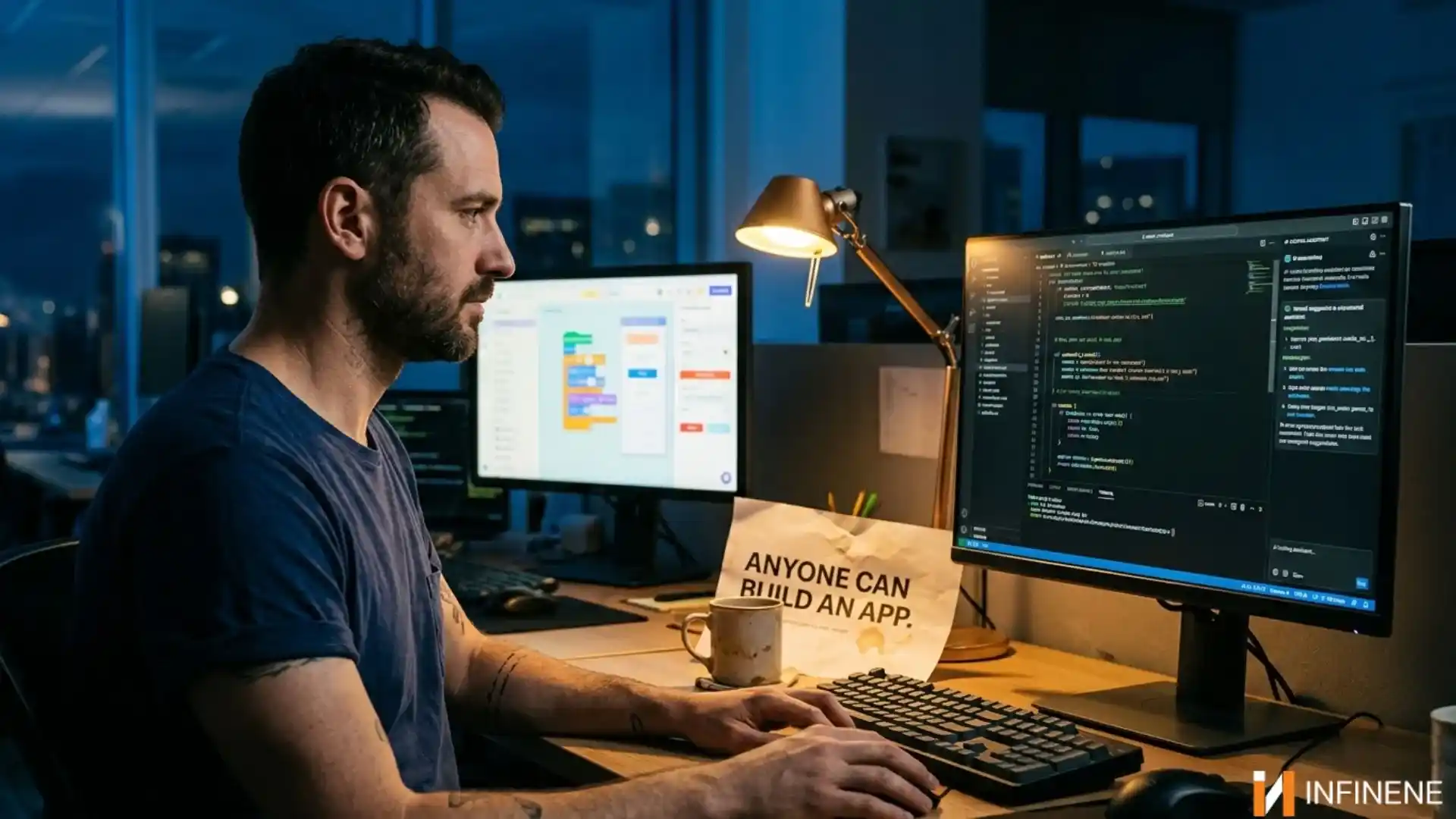
A no-code app looks great in a demo. Drag a button, wire a workflow, ship something in an afternoon. Nobody shows you the app eighteen months later, when it's handling 40,000 records instead of 400 and the whole thing grinds to a crawl. That gap between the pitch and the aftermath is the entire story of custom software development vs no-code, and most vendors would rather you not think about it until you're already locked in.
The no-code industry sold a promise that sounded almost too good to check: anyone, technical or not, could build production software without writing a line of code. Venture money poured into Bubble, Adalo, Glide, and a dozen imitators on that exact pitch. It wasn't a lie in the sense of outright fraud. It was a lie in the way "no assembly required" furniture is a lie. Something gets assembled. It's just not you doing it, and it's usually held together with fewer screws than you'd like.
The original pitch had three parts: speed, accessibility, and cost savings. Founders could skip hiring developers. Marketing teams could build their own internal tools. A single person with a Saturday afternoon could launch a functioning product. For a narrow slice of use cases, that promise held up fine.
But "no-code platform" quietly became shorthand for something the marketing never quite said outright: a permanent ceiling disguised as a starting point. The demos always showed the easy 80%. Nobody demos what happens when a client wants a custom approval workflow with branching logic based on three different user roles, or when you need to pull live inventory data from a legacy ERP system that doesn't have a clean API. That's where the platform stops being a shortcut and starts being a cage.
I've watched founders proudly show off a Bubble app that handled their first 200 customers beautifully, then quietly spend four months and $60,000 rebuilding it in React and Node because the platform choked once real usage kicked in. Nobody put that number in the original pitch deck. The rebuild always costs more than starting with custom development would have, because now you're paying for migration on top of new development, and you're doing it under pressure with customers already depending on the old system.
Most conversations about custom software development vs no-code start and end with scaling, but scaling is rarely the first limitation to bite. The first one is usually data ownership. Most no-code platforms store your application logic, your database schema, and often your actual data inside their proprietary environment. Try exporting a Bubble app's full backend logic to a standard SQL database and see how far you get. You're not just choosing a tool. You're choosing a landlord.
Vendor lock-in follows close behind. Pricing on these platforms tends to scale with usage in ways that feel reasonable at 1,000 monthly active users and brutal at 50,000. Webflow, Bubble, and Airtable all have tiered pricing that jumps hard once you cross certain workflow, record, or API-call thresholds. One SaaS founder I talked to during a piece on subscription tooling watched her no-code hosting bill triple in a single quarter with zero change to her actual user base, just because a plan tier boundary got crossed.
Security is the one people underestimate until it's too late. No-code platforms are, by definition, generalized. They're built to serve travel booking apps and inventory trackers and dating apps with the same underlying infrastructure. That generality means the security model is one-size-fits-all, and if your business handles anything sensitive (health data, financial records, anything remotely close to HIPAA or PCI territory) you inherit whatever security posture the platform decided was good enough for everyone. You don't get to harden it much further. A custom-built application, by contrast, can be architected around your specific compliance requirements from line one.
There's also a cost curve nobody warns you about at signup. No-code pricing is built to look cheap at the start, because that's what gets you in the door. $29 a month feels like nothing compared to hiring a developer. But most of these platforms charge per workflow run, per API call, per record, or per user seat, and those meters spin faster than founders expect once real customers show up. I've seen a no-code operations tool go from $150 a month to over $2,400 a month in under a year, with the underlying product barely changing. At that point you're not paying for software anymore. You're paying rent on your own growth, and the landlord sets the rate.
Then there's the integration wall. Custom logic, meaning anything beyond basic CRUD operations and simple triggers, is where no-code tools start requiring workarounds stacked on workarounds. Zapier connecting to Make connecting to a Bubble plugin connecting to a webhook that half-works. Every additional layer is a new point of failure, and debugging a five-tool chain when something breaks at 2 a.m. is its own special kind of misery. I wouldn't wish it on anyone.
These three terms get used almost interchangeably in vendor marketing, which is convenient for vendors and confusing for everyone else. They're not the same thing, and treating them as a single category is how businesses end up making the wrong call.
No-code platforms (Bubble, Glide, Adalo, Airtable) use visual builders with zero scripting required. They're genuinely good for internal tools: a simple CRM for a five-person sales team, an event RSVP tracker, a prototype to test whether an idea has legs before committing real budget. Low-code platforms (OutSystems, Mendix, Microsoft Power Apps) sit a step up. They allow custom scripting alongside visual tools, which gives more flexibility, though they still run inside a vendor's proprietary framework with its own limits and its own exit costs.
Custom development means code written specifically for your business, owned outright, with no platform tax and no ceiling baked in by someone else's product roadmap. It costs more upfront. It takes longer to reach a first version. And it's the only one of the three that doesn't eventually ask you to rebuild everything from scratch once you outgrow it.
The mistake isn't choosing no-code. The mistake is choosing no-code for something that was never going to stay small. An internal tool for scheduling shift swaps? No-code is probably the right call, honestly, and building it custom would-be overkill. A customer-facing product that's supposed to become your actual business? That decision deserves more scrutiny than "which platform has the nicest onboarding video."
Here's the part most no-code coverage misses entirely: the thing eating no-code's lunch isn't a return to slow, expensive, six-month development cycles. It's AI-assisted custom development, and the distinction matters more than the marketing around it suggests.
Developers today are using AI coding tools, Claude Code, GitHub Copilot, Cursor, and similar tools, to write real, production-grade, owned code at a pace that used to be the entire reason no-code existed. A backend endpoint that took a junior developer two days to scaffold now takes an experienced developer working with an AI assistant closer to two hours, including tests. That's not a hypothetical. Development teams at mid-sized software shops report cutting boilerplate and scaffolding time by 40 to 60% depending on the project, freeing up senior engineers to spend time on the architecture and business logic that actually differentiates a product.
This is the real story behind the rise of the AI app development company as a category. These aren't shops promising a magic app-in-a-box. They're development teams that use AI tooling as a force multiplier on top of real engineering discipline: proper version control, real databases, real security review, real code that a human developer can read, extend, and hand off to another developer five years from now without the whole thing collapsing. That last part matters more than people give it credit for. No-code apps often become unmaintainable the moment the original builder leaves the company, because nobody else understands the tangle of visual logic they left behind.
Custom web application development services built around this AI-assisted workflow now compete with no-code on the one thing no-code always had going for it: speed. A functional MVP that used to take twelve weeks with a traditional dev team can realistically land in four to six weeks now, built on infrastructure the business actually owns, with a codebase that scales past the first thousand users without a rebuild. That changes the calculus completely. The old trade-off was speed versus ownership. Increasingly, you don't have to pick.
I'll say this plainly, because most agencies won't: if a vendor tells you no-code and AI-assisted custom development cost roughly the same for a real product launch, ask to see their actual project timelines. In my experience talking to teams doing this work, the gap has closed a lot, but it hasn't closed all the way, and anyone claiming total parity is selling something.
A logistics company I spoke with while researching workforce tools ran both paths in parallel almost by accident. One team built an internal dispatch tool in Bubble over three weeks. Another, working with an outside development shop that leaned heavily on AI-assisted coding, built a customer-facing tracking portal with real-time GPS integration in five weeks, custom-coded from the start. Eighteen months later, the Bubble tool needed a full rebuild once dispatch volume tripled. The custom portal just added features. Same starting philosophy, wildly different endings, and the five-week build turned out to be the cheaper one once you count the second act.
That's the part of this shift that doesn't get enough attention. AI coding assistants haven't just made custom development faster. They've made it faster in a way that doesn't quietly borrow against the future. The code an AI-assisted developer ships today is still real code, sitting in a real repository, readable by the next engineer who touches it. Nothing about using Claude Code or Copilot to write a function makes that function less yours, less portable, or less debuggable six months from now. That ownership is the whole point, and it's the one thing no-code was never able to offer no matter how good its drag-and-drop builder got.
Skip the philosophy. The custom software development vs no-code call comes down to a handful of concrete questions, and here's how to actually work through them.
Start with who touches the product. If it's an internal team of fewer than 20 people using a tool nobody outside the company will ever see, no-code or low-code is very likely fine. The blast radius of a limitation is small, and the cost of eventually outgrowing the tool is manageable.
Look at what the product handles. Anything touching payment data, health information, or personally identifiable information at meaningful scale needs the security posture that only custom architecture reliably provides. This isn't a "nice to have." Insurance underwriters and enterprise clients increasingly ask for security documentation that generic no-code platforms simply can't produce.
Ask whether the product is core to revenue. A prototype to validate a business idea? Build it fast and cheap, no-code is a reasonable bet, and if the idea fails you haven't burned six months of dev budget. But the moment that prototype becomes the actual product customers pay for, the math flips. You're now betting the company on infrastructure you don't own and can't fully control.
Check for integration depth. If the product needs to talk to three or more external systems with anything beyond basic data sync, no-code's workaround-on-workaround pattern will eventually break under its own weight. Custom development handles this natively.
Finally, think five years out, not five months. No-code optimizes for the fastest possible version one. Custom development, especially AI-assisted custom development that's now closing the speed gap, optimizes for the version that still works when you've got 50 times the users and investors asking about your technical due diligence.
None of this means no-code is worthless. It's a legitimately good tool for what it's actually good at. The failure isn't the tool. It's treating a scaffolding tool like a foundation, and being surprised when the building can't take the weight it was never built to hold.