


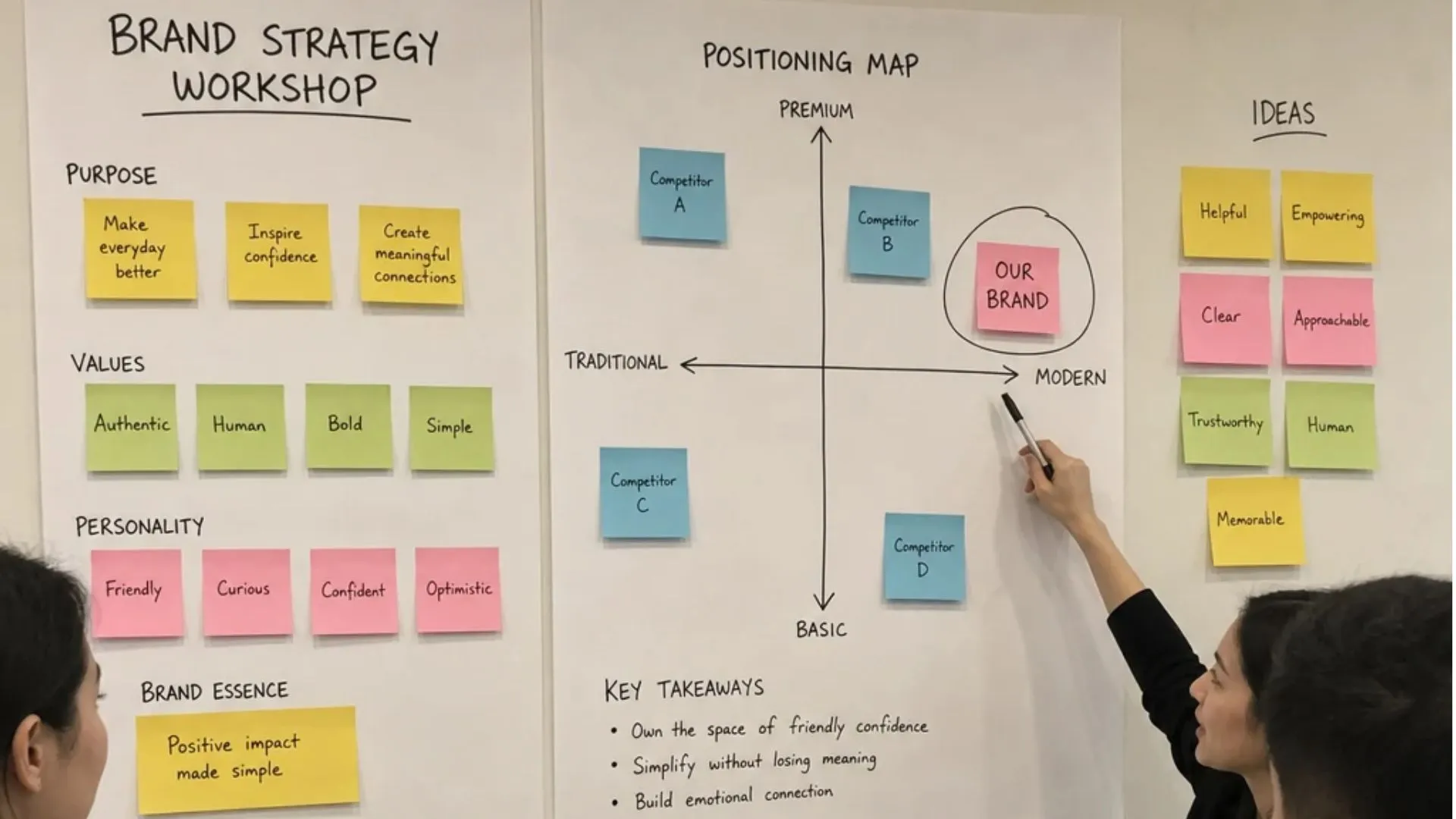
Choosing between Branding services and a Brand strategist comes down to the problem you need solved. If you need visual identity, marketing assets, naming, or a complete launch system, a branding agency or service package may be the right fit. If you need clarity before design—positioning, audience insight, messaging, differentiation, or a roadmap—a brand strategist or Brand strategy consultant is often the smarter first hire.
For startups and small businesses in the United States, the best choice is rarely “agency or consultant” in the abstract. It is the provider whose process, deliverables, timeline, and budget match your stage of growth.
Branding services usually create or refine the tangible parts of a brand, while a Brand strategist defines the thinking that should guide those assets. In simple terms, strategy decides what the brand should stand for, who it is for, why it is different, and how it should show up; branding services turn that direction into identity systems, content, design, and rollout materials.
This distinction matters because many businesses jump straight into logos, websites, colors, or templates before they have answered harder questions about market position. That can create attractive work that does not help sales, hiring, investor conversations, customer trust, or category differentiation. On the other hand, strategy without execution can leave a founder with a polished deck and no usable materials.
A useful way to think about branding services vs brand strategist is this:
Choose brand strategy first when your messaging is inconsistent, your audience is unclear, your market has shifted, your startup is preparing to launch, or your small business needs a sharper competitive position.
Choose brand identity services first when your strategy is already clear but your visuals, website, pitch deck, packaging, sales collateral, or content system look fragmented or outdated.
Choose both together when you are naming a company, launching a new product, repositioning, merging brands, entering a new market, or investing in a full rebrand.
Branding decisions become easier when you separate outside services from internal roles. The names sound similar, but the responsibilities are different.
A branding agency, studio, or service provider typically offers a defined package of strategic, creative, and production work. If you are wondering what do branding services include, common deliverables include brand discovery, competitor review, positioning support, naming, messaging, logo design, visual identity, typography, color system, brand guidelines, website direction, templates, packaging, and launch assets.
For branding services for small business, the scope is usually narrower: a practical identity system, clear message hierarchy, sales-ready collateral, and a website or landing page foundation. For larger organizations, the work may include research, stakeholder interviews, brand architecture, internal rollout, training, and governance.
A Brand strategist helps define the logic behind the brand. Their work often includes customer research, market analysis, differentiation, positioning, value proposition, brand narrative, voice, messaging pillars, naming strategy, and a roadmap for implementation.
If you plan to hire a brand strategist for startup, look for someone who can connect brand decisions to product-market fit, fundraising conversations, customer acquisition, pricing perception, and early trust signals. A startup does not need bloated theory; it needs strategic clarity that founders, designers, marketers, and sales teams can actually use.
A Brand manager usually works inside a company and is responsible for maintaining, growing, and protecting an existing brand. A practical brand manager job description and responsibilities may include campaign planning, agency coordination, brand consistency, budget oversight, content review, product launch support, performance tracking, and cross-functional alignment.
In the brand strategist vs brand manager comparison, the strategist often defines or refines the brand direction, while the brand manager keeps that direction alive in daily execution. For the related question of brand manager vs product manager, the brand manager focuses on perception and market presence, while the product manager focuses on product roadmap, user needs, features, and delivery.
A Product marketing manager connects product, sales, customer insight, and go-to-market strategy. Typical product marketing manager roles and responsibilities include positioning a product, defining buyer personas, building launch plans, creating sales enablement, analyzing competitors, and translating product value into market-facing messages.
People searching how to become a product marketing manager usually need experience in messaging, market research, launches, sales enablement, and cross-functional communication. The role overlaps with brand strategy, but it is usually more product-specific and revenue-adjacent.
Brand strategy services are useful when a business needs decisions before design. A good strategy engagement should reduce ambiguity: what you say, who you say it to, what makes you credible, what your category expects, and where you should deliberately break from convention.
For brand strategy services for small business, that might mean narrowing a broad “we help everyone” message into a specific market promise. For a local service company, it might mean clarifying why customers should choose them over similar providers in the same city. For a startup, it might mean explaining a new category in language that buyers, investors, and early employees can repeat.
Typical brand strategy deliverables include:
Audience segments, buyer motivations, and decision barriers.
Competitive positioning and category analysis.
Core promise, value proposition, and differentiation.
Brand personality, voice, and messaging principles.
Messaging pillars for website, sales, and content.
Naming strategy or naming evaluation when relevant.
Brand architecture for multiple products, services, or audiences.
A practical roadmap for design, content, and rollout.
The best strategy work is not just a document. It gives your team a shared decision filter. When a new website headline, ad campaign, product page, sales deck, or content marketing campaign is created, the team can ask, ‘Does this match the position we chose?
Brand identity is the recognizable system people see, hear, and remember. It includes your logo, color palette, typography, imagery, icon style, tone of voice, messaging patterns, and rules for consistent use. Brand identity services for startups often focus on creating enough of a system to launch confidently without overbuilding.
Brand development services are broader. They can include strategy, identity, messaging, collateral, website direction, and implementation support. The phrase Brand development often describes the full journey from business insight to market expression.
The difference between brand identity design vs branding services is scope. Brand identity design is usually the visual system. Branding services may include research, strategy, naming, messaging, design, guidelines, templates, and rollout.
A practical brand development process step by step often looks like this:
Discovery: business goals, customer context, current brand audit, internal interviews.
Research: audience needs, competitors, category language, market gaps.
Strategy: positioning, promise, personality, voice, architecture, messaging.
Identity: logo, visual system, design direction, templates, usage rules.
Activation: website, pitch deck, collateral, campaigns, internal rollout.
Management: governance, measurement, refresh cycles, and brand consistency.
For brand development services for startups, the process should be lean enough to match runway and urgency. For established small businesses, it should respect existing equity rather than replacing everything simply because a new design trend exists.
Use this framework before searching for branding services agency near me, brand development services near me, or a freelance brand strategist for hire. Geography can matter for workshops, local market knowledge, and relationship-building, but fit matters more than proximity for many strategy and identity projects.
Start by naming the business problem, not the deliverable. “We need a logo” may actually mean “customers do not understand what we do.” “We need a rebrand” may mean “our offer changed, but our market message did not.”
Ask yourself:
Are customers confused about our value?
Do sales calls require too much explanation?
Are we attracting the wrong audience?
Do we look less credible than competitors?
Are teams describing the company in different ways?
Are we launching, repositioning, merging, or expanding?
If the answers are mostly about clarity, differentiation, audience, or messaging, start with strategy. If the answers are mostly about outdated visuals or inconsistent assets, start with identity or branding services.
A pre-seed startup may not need a large agency. It may need a senior strategist, a naming expert, or a compact brand identity package. A funded startup preparing for a national launch may need professional branding services for startups that combine positioning, identity, website, and investor-ready materials.
A small business with steady revenue may need a focused brand development strategy for small business: sharpen the message, modernize the identity, and create templates the team can use. A multi-location or multi-product company may need deeper brand architecture and brand management support.
If you already have designers, marketers, or a web team, hiring a strategist may be enough. If you need the work produced from start to finish, choose an agency or integrated branding services provider.
Compare your options this way:
Freelance brand strategist: best for focused positioning, messaging, naming direction, or founder advisory.
Brand strategy consultant: best for deeper diagnosis, stakeholder alignment, research, and strategic roadmap.
Brand identity studio: best for visual identity, guidelines, and design systems.
Branding agency: best for strategy plus execution across identity, website, content, and launch assets.
Internal brand manager: best once the brand needs ongoing governance and cross-team consistency.
Product marketing manager: best when product positioning, launches, sales enablement, and competitive messaging need constant ownership.
Budget depends on scope, seniority, research depth, market complexity, number of decision-makers, and how many assets must be created. Current marketplace data from Clutch shows many branding projects in the $10,000 to $49,999 range, with average listed branding agency rates around $100 to $149 per hour; use that as a directional benchmark, not a universal rule. (clutch.co)
For a small US business, a realistic planning range might look like this:
Basic logo or identity refresh: lowest investment, but limited strategy and fewer usage rules.
Startup identity package: moderate investment for logo, visual system, simple guidelines, and core templates.
Strategy-only engagement: useful when you need positioning, messaging, audience clarity, or naming direction before design.
Full brand development: higher investment covering research, strategy, identity, messaging, guidelines, website direction, and launch support.
Enterprise or multi-stakeholder rebrand: highest investment because research, approvals, brand architecture, legal review, and rollout complexity increase.
When evaluating brand strategy consultant cost, do not compare hourly rates alone. A senior consultant who resolves positioning in four focused weeks may be more valuable than a cheaper provider who produces vague strategy over three months. Likewise, branding services pricing packages should be judged by deliverables, decision quality, revision process, ownership rights, and implementation support.
Salary searches can also provide context if you are deciding whether to hire in-house. The U.S. Bureau of Labor Statistics groups many related leadership roles under advertising, promotions, and marketing managers, reporting a May 2024 median annual wage of $126,960 for advertising and promotions managers and projecting 6% employment growth for the broader group from 2024 to 2034. (bls.gov)
Third-party salary guides vary by source, role definition, location, and seniority; one 2025 digital marketing salary guide listed a national Brand Manager median around $105,111, while a 2026 recruiting guide listed Product Marketing Manager ranges from $80,000 to $160,000-plus depending on experience level. (sourcelabsearch.com)
That context helps with searches like brand manager salary in the USA, brand strategist salary in the United States, and product marketing manager salary in the United States, but it should not replace a role-specific compensation review for your city, industry, and seniority level.
A lean strategy project may take a few weeks. A strategy plus identity engagement may take one to three months. A complex rebrands with research, stakeholder alignment, website redesign, legal review, and internal rollout may take longer.
Common timeline phases include:
Week 1: Discovery and audit: The provider reviews your business model, customers, competitors, current materials, and goals. Expect questionnaires, interviews, analytics review, and a working session.
Weeks 2–3: Research and strategy: The team defines audience insights, positioning, brand promise, voice, messaging, and strategic direction. You should receive clear recommendations, not just observations.
Weeks 4–6: Identity and messaging development: Visual concepts, messaging drafts, naming options, or brand system components are created and refined. Decision criteria should be tied back to the strategy.
Weeks 7–10: Guidelines and activation: The final system is documented. Assets may include guidelines, templates, website copy direction, pitch materials, social templates, or launch messaging.
Post-launch: Brand management: Your team applies the system, measures response, and keeps usage consistent. This is where internal brand management becomes important.
A strong provider will explain what is included, what is not included, how revisions work, who owns the files, and what support is available after delivery.
Use this checklist whether you are comparing the best branding services companies in the USA, researching top brand strategy consultants in the US, or looking for brand development companies in the US.
Confirm the business goal: launch, reposition, growth, credibility, alignment, acquisition, or retention.
Decide whether you need strategy, identity, execution, or ongoing management.
Review the provider’s process, not just their portfolio style.
Ask for sample deliverables or anonymized examples.
Clarify whether research is included or assumed.
Check who will actually do the work: senior strategist, designer, account manager, or contractor.
Ask how they handle stakeholder disagreement.
Confirm file ownership, font licensing, image licensing, and usage rights.
Ask what happens after the final presentation.
Avoid providers who promise a “timeless brand” without learning your market.
Avoid packages that include only visuals when your real issue is positioning.
Avoid strategy decks that do not translate into website, sales, or content decisions.
Good questions reveal whether a provider thinks strategically or simply sells deliverables.
Ask a strategist:
How do you define positioning for a business at our stage?
What research methods do you use when budget is limited?
How do you turn strategy into messaging our team can use?
What decisions will we be able to make better after this engagement?
How do you measure whether the strategy is working?
Ask a branding agency:
What do your branding services include and exclude?
Is strategy included, or is this mostly identity design?
Who owns the final files and brand guidelines?
How many concepts and revision rounds are included?
Can you support website, launch, packaging, or sales collateral after identity approval?
Ask an in-house candidate:
How have you managed brand consistency across teams?
How do you balance brand standards with campaign performance?
How do you work with product, sales, design, and leadership?
What would you prioritize in the first 90 days?
A founder preparing to launch a B2B SaaS product may search for brand identity services for startups and assume the first need is a logo. But if prospects cannot understand the category, the better first step is a brand strategist or product marketing-minded consultant.
The engagement might define the buyer, pain points, product promise, category language, objections, homepage messaging, and pitch deck narrative. After that, a brand identity studio can create the visual system. The result is not just a better-looking startup; it is a startup that can explain itself faster.
A successful local business may search brand development services near me because referrals are strong but online conversion is weak. In this case, the issue may be both message and presentation.
A practical project could include customer interviews, competitor review, a sharper service promise, updated identity, website copy framework, photography direction, and sales collateral. The goal is not to look like a national enterprise; it is to communicate trust, specialization, and local relevance.
A company with multiple campaigns, channels, and product lines may no longer need only outside help. It may need a Brand manager to maintain standards or a Product marketing manager to own launches and sales enablement.
This is where brand management becomes operational. External consultants can still help with major strategy decisions, but internal owners keep the brand from drifting.
Searches for best brand strategy services in the USA, top brand identity services companies in the US, and best branding services companies in the USA can produce long lists, but “best” depends on your stage, category, budget, and internal capabilities. A beautiful portfolio is not enough if the provider lacks the process your decision requires. That same principle applies to digital visibility: a strong brand needs content that clearly communicates its expertise to both traditional search engines and emerging AI-powered search.
Look for evidence of:
Clear strategic thinking before creative execution.
Experience with businesses at your size and stage.
Strong discovery and research methods.
Practical deliverables your team can use.
Transparent scope, pricing logic, and timeline.
Ability to collaborate with founders, executives, marketers, and designers.
Candid discussion of tradeoffs and constraints.
If you are a startup, prioritize speed, clarity, and usefulness. If you are an established small business, prioritize consistency, credibility, and implementation. If you are a larger company, prioritize governance, stakeholder alignment, and scalable systems.
Whether you're a startup, growing business, or established company, connect with InfineneTech for the strategic clarity, branding expertise, and implementation support to turn your brand into a scalable business asset.
No. Brand strategy services define the direction: audience, positioning, differentiation, messaging, and brand role. Branding services may include strategy, but they often focus on creating the identity and assets that express that direction.
Yes, if your audience, offer, positioning, or message is unclear. A designer can make a brand look better, but a strategist helps decide what the brand should mean and why people should care.
Yes. A freelance strategist can be a strong fit when you need focused clarity without a full agency scope. Just make sure they provide actionable outputs, not only abstract recommendations.
Hire a brand manager when the brand already exists and the ongoing challenge is consistency, coordination, campaigns, and governance. A consultant may build or refresh the system; a manager keeps it working.
Product marketing matters most when your challenge is product positioning, launches, sales enablement, competitive messaging, and adoption. Brand strategy is broader; product marketing is closer to specific offers and revenue motions.
Do not start with the provider category. Start with the decision you need to make: what you stand for, who you serve, how you differ, what you need to launch, and who will maintain the system afterward.
Choose a Brand strategist when clarity is missing. Choose Branding services when execution is the gap. Choose both when you are building or rebuilding the brand from the inside out. For US startups and small businesses, that sequence can prevent wasted budget, reduce rework, and turn brand development into a practical growth asset rather than a cosmetic project.