


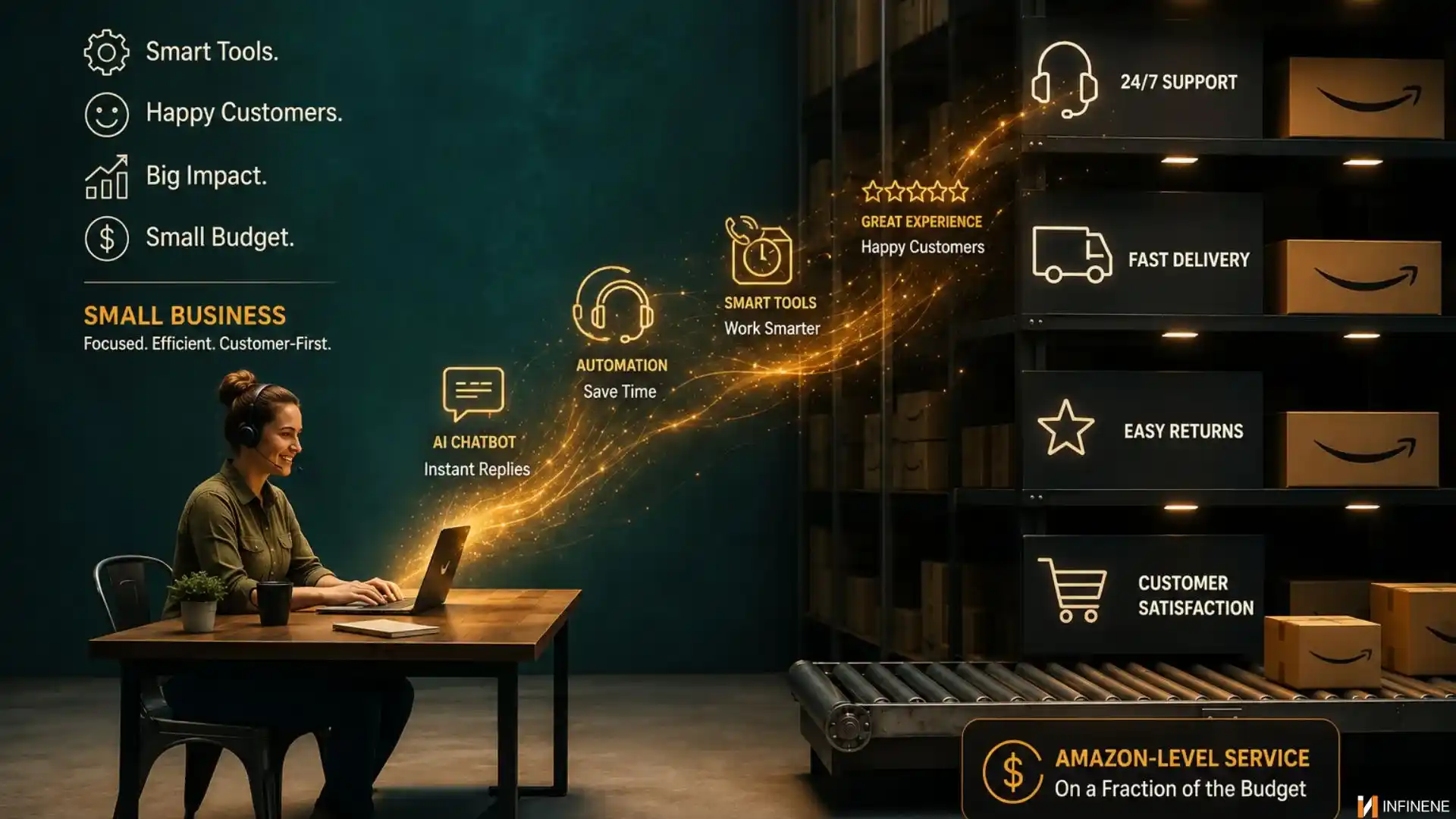
When people talk about competing with Amazon, they usually mean price, delivery speed or product range. Understandably so. Those are the battles small businesses know they can't win outright. But there's a subtler competition happening that gets far less attention. It's the one where the playing field is a lot more level than most business owners assume. And its customer service.
Amazon has spent around three decades and untold billions in building a customer service experience that feels this frictionless. Instant answers. Fast refunds. A support agent who somehow always seems to know exactly what you ordered and when. It's set the bar so high that customers now expect that same standard from a five-person online retailer in Ohio or a boutique consultancy in Austin, whether that's realistic or not.
The good news, if you run a small business, is that matching Amazon's customer service isn't actually about matching Amazon's budget. It's about understanding what Amazon-level customer service really means to a customer. And then building something smaller, more human, and often more effective around that same core promise. This is where the right customer service software for small business operations comes in, alongside a handful of habits that cost far more in discipline than in dollars.
Most businesses misread what customers are actually expecting when they say they ask for Amazon-level customer service. It's rarely about scale. Customers don't expect a small business to have a warehouse network or same-day delivery. What they're really responding to is a feeling. The feeling that their problem will be solved quickly. They won't have to repeat themselves three times or fight for it. Break Amazon's service model down into its parts. And it looks less intimidating:
Speed. You get answers in minutes, not days.
Consistency. The experience is the same whether you're chatting at 9 am or 11 pm.
Personalization. The company already knows who you are and what you've ordered.
Low friction. Complaints or returns require minimal effort to resolve.
None of those four things require a huge nine-figure budget. They require intent, some smart software choices, and a willingness to treat customer service as a growth function rather than a cost center. This, frankly, is where most small businesses go wrong before they've even started.
There's an irony in the small-business-versus-Amazon framing that's worth calling out directly: small businesses actually have structural advantages here that Amazon can't replicate at scale. A small business owner can personally know their top 50 customers. They can spot a pattern in complaints within a day, not a quarter. They can make a judgment call on a refund without routing it through four layers of policy. Amazon's scale is its strength in logistics and its weakness in service. It's notoriously difficult for a customer to get a real, empowered human being on the phone when something goes properly wrong.
That's the opening. Small businesses that lean into familiarity and human judgment aren't trying to out-Amazon Amazon. They're competing on a different axis entirely. And it's one where bigger isn't automatically better.
A lot of the customer service best practices for small business circulating online haven't been meaningfully updated in years. "Respond quickly" and "be polite" are important. But they're not strategies. They're the baseline of customer experience. Here's what actually separates businesses that compete with Amazon customer service, not just talk about it.
1. Treat response time as a KPI. Amazon's expectation-setting has slowly reset customer patience across every industry. Waiting 48 hours for an email reply was once considered acceptable. But now it reads as a red flag. Small businesses don't need massive staff to fix this. They need clear service-level targets. It could be something as simple as "respond within four business hours" and a system that actually tracks whether that target is being hit.
2. Centralize every channel into one view. One of the most common failure points for small teams is fragmentation. A customer emails, then messages on Instagram, then calls. Three different people respond with three different answers. A shared inbox or helpdesk tool that pulls email, social, and chat into a single thread is now close to a baseline requirement for looking organized.
3. Let your team make the call. Amazon's frontline reps often can't deviate from a script. Yours can. Giving employees the authority to resolve a complaint on the spot, without needing manager sign-off for anything under a set dollar threshold, is one of the cheapest, highest-impact changes a small business can make.
4. Follow up before customers have to chase you. A single proactive follow-up does more for perceived service quality than almost anything else on this list. And it costs nothing but a bit of process discipline.
Most business owners think that if they want to improve customer service, they need more staff. That’s the wrong approach, most of the time. These small business customer service tips are more about wringing extra value out of the team and tools that are already in place.
Batch and template thoughtfully. Canned responses get a bad reputation. But a well-written template for common questions like refund status and shipping timelines frees up time for the complex cases that actually need a human touch.
Build a living FAQ from real tickets. Every recurring question is a sign that you’re missing something. Businesses that handle support tickets like they’re product feedback, instead of just answering them, often see the ticket volume thin out over time.
Set expectations up front. A simple line like "we typically reply within one business day" does more to manage perception than actually speeding up the reply itself. Amazon manages expectations obsessively. Small businesses can pull off the same thing with only a fraction of the infrastructure.
Personalize using what you already have. Even a basic CRM lets a rep bring up order history before they respond. So, it’s not just “we got your info.” That one small detail, “I can see you ordered on the 14th”, kind of telegraphs a level of attentiveness that a lot of bigger retailers seem to not fully deliver.
The question of how to improve customer service usually gets answered with advice that assumes a call center's worth of resources. Small businesses need a version of that advice scaled to reality.
Start with measurement. Most small businesses have no formal way of knowing whether their service is actually good or just feels fine internally. A simple post-interaction survey creates a feedback loop that a lot of larger companies have buried under bureaucracy.
Next, audit the handoffs. Service quality tends to collapse at the seams: the moment a query moves from chatbot to human, or from sales to support. Mapping out exactly where a customer might get dropped or repeat themselves is often more revealing than any amount of new hiring.
Finally, invest in training over headcount. Because a well-trained team of three can outperform an undertrained crew of eight. Numbers don’t tell everything. Include role-playing difficult conversations. Work on tone guidelines and giving staff real examples of "great" versus "adequate" responses. This tends to move the needle faster than adding another seat.
Customer service software for small businesses isn’t optional. They are the multipliers that make everything above actually achievable without burning out a small team.
The category has matured considerably. A few years ago, "customer service software" effectively meant an enterprise-grade platform priced for enterprise-grade budgets. That's no longer true. There's now a real tier of affordable customer service solutions built specifically for teams under 20 people, often priced per seat at a level that a small business can absorb without a second thought. What to actually look for:
A unified inbox that brings email, live chat, social DMs, and SMS together at once. Thus, not letting anything slip through the cracks between platforms.
Then there’s basic automation plus AI chatbots that can take care of the repetitive 60% of questions without a human needed for every little thing. Thus, freeing the staff for conversations that really require judgment.
Built-in CRM context even if it’s just a lightweight version. So, anyone on the team can see a customer’s history the second the conversation starts.
Simple reporting like response time, resolution time, and customer satisfaction. So, improvement becomes measurable instead of just assumed or guessed.
And self-service options such as a searchable help center that helps reduce incoming volume before it even gets to a live agent.
None of this requires the kind of investment that would make a business owner wince. Several well-regarded platforms in this space offer functional plans in the range of $15 to $50 per agent per month. This is a rounding error compared to what a single unresolved bad review can cost in lost future business.
The phrase "customer service on a budget" conjures images of doing less with less. The businesses that actually pull this off successfully are doing something closer to doing less, better. That means resisting the urge to be everywhere. A small business trying to offer full support across email, phone, and socials simultaneously will inevitably do all of them badly. It's better to pick two or three channels’ customers actually use and staff them properly. Be visibly excellent there instead of spreading thin across everything.
It also means automating the boring stuff. A chatbot that instantly confirms a shipping date is good service. A chatbot that traps a frustrated customer in a loop with no way to reach a human is exactly the kind of experience Amazon, for all its faults, generally manages to avoid at the point of real escalation. The businesses getting this right combine automation for the routine and humans for the meaningful conversations.
It means treating existing customers as the cheapest acquisition channel available. Excellent service turns one-time buyers into repeat customers. More valuably, they become word-of-mouth advocates. For a small business, that's often worth more than any comparable spend on paid acquisition.
Abstract advice is easy to nod along to and hard to act on, so it's worth grounding this in how it actually plays out for a small business. Picture a ten-person online homeware brand. It can't offer two-day shipping on the scale Amazon does. It can't staff a 24-hour call center. But it can do a handful of things that, stacked together, produce a service experience customer genuinely rate above the marketplace giants they also shop on.
It puts a shared inbox in place. So that a customer who emails on Monday and DMs on Instagram on Wednesday gets a consistent answer. Because the same rep can see both conversations in one thread. It sets a public commitment. Then quietly beats that target most of the time, which does more for trust than any marketing copy could. It gives its two-support staff standing authority to issue refunds under $75 without asking permission, cutting what used to be a three-day approval chain down to minutes. And it uses a basic AI chatbot to answer the fifteen questions that show up in almost every conversation. So, its human reps spend their time on the customers who actually need a person.
None of that requires a call center. It requires roughly $30 a month per seat in software. A short internal policy document and a decision to treat service as something worth designing. Multiply that kind of disciplined consistency across a year. You will see it compounds into the kind of reputation that shows up in reviews and repeat purchase rates. These are the metrics that determine whether a small business survives its first few years or fades out.
It's worth flagging where small businesses tend to sabotage their own progress. Because the mistakes are just as instructive as the fixes.
The first is over-promising. A business that advertises "instant support" but takes two days to reply does more damage than the one that never made any such promise. Amazon doesn’t just top the charts with its speed. It's that its promises and its delivery match up almost every time. Small businesses copying the marketing language without the operational backbone to support it end up worse off than if they'd said nothing.
The second is treating software as a substitute for process. Buying a helpdesk platform doesn't automatically fix response times if nobody's actually accountable for checking it. The tools in this space are genuinely good, but they amplify whatever discipline already exists on the team using them.
The third is ignoring the data the support inbox is quietly generating. Every ticket is a small signal about where the business is falling short. Whether that's a confusing checkout page or a product description that doesn't set the right expectations. Businesses that only use their support software to close tickets are leaving half its value on the table.
Competing with Amazon-level customer service was never really about matching Amazon's resources. It's about matching the feeling Amazon has trained customers to expect. And delivering that through smaller, smarter, more human means.
The right customer service software for small business operations closes the gap on speed and consistency. Empowered staff and a genuine willingness to personalize closes the gap on trust. And a business that picks its channels deliberately will often outperform far bigger competitors on the metric that actually keeps customers coming back.
For a small business owner weighing where to spend the next available dollar, this is one of the rare areas where the return is both fast and compounding. Better service doesn't just reduce refunds and complaints. It turns customers into the kind of repeat buyers and word-of-mouth advocates that no advertising budget can reliably manufacture. Amazon spent billions teaching customers what good service should feel like. Small businesses just have to spend the discipline to deliver it. Amazon set the bar. It didn't buy the only ladder to reach it.