


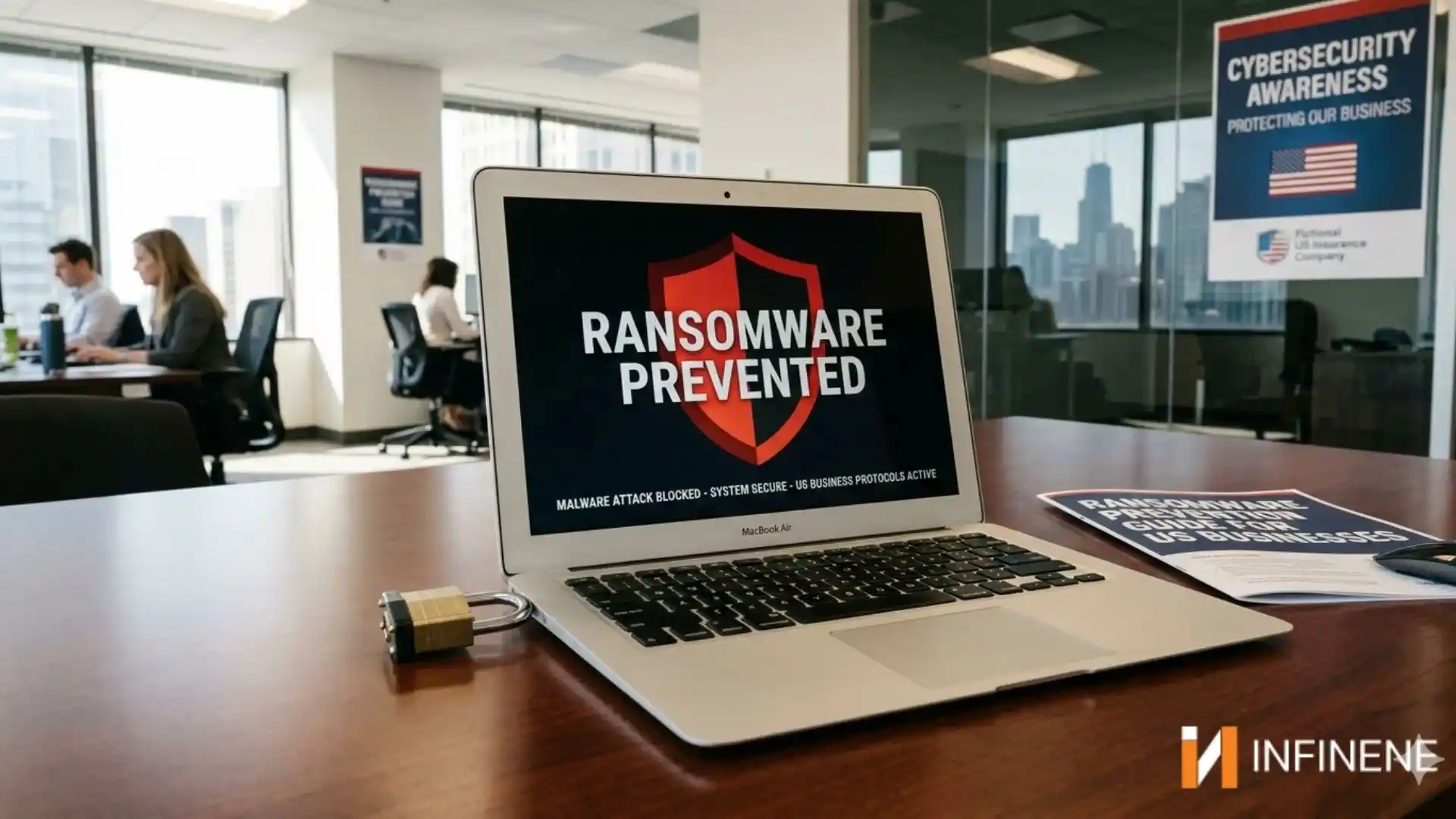
Ransomware doesn't behave like traditional cybercrime in 2026. It doesn’t always “break in” loudly or announce itself early. In most cases, a ransomware attack appears silently as a login, a plugin, or a shared file. It only reveals itself when the business operations suddenly stop. At that point, it doesn't just stay an “IT issue”.
It becomes a payroll problem, customer downtime, and stalled sales. In many cases, it leads to a direct financial demand that can range up to millions of dollars. Even smaller ransomware demands go up to $1K to $10K. Many businesses don’t even realize they are already on the radar. These incidents are becoming routine, especially for small and mid-sized businesses.
Attackers aren’t “hacking harder” than before. They are simply exploiting how most businesses are still structured. Flat networks. Weak access controls. Delayed updates. Over-trusting employees. Disconnected backups. These are some of the apparently small issues that are like an open invitation to the hackers. That’s why ransomware prevention in 2026 doesn't only rely on buying more tools. You need to close the predictable gaps in structure before someone else finds them.
The businesses that survive ransomware attacks aren’t necessarily the biggest or the most advanced ones. They just treat business cybersecurity ransomware protection like operational hygiene rather than a necessary action after the problem arises. So instead of reacting after the damage is done. Let's shift our focus to what should be done in practice. Here are 7 proven ways of ransomware attacks prevention for US businesses in 2026.
The concept of network security for small businesses has become obsolete in today's digital environment. The security systems implemented by US businesses require replacement now. They no longer provide effective protection. Modern attackers use stolen credentials to access systems without needing to breach security firewalls.
The Zero Trust security model has emerged as an essential element of modern cybersecurity. It protects businesses from ransomware attacks. The Zero Trust system requires organizations to verify all access requests from users, devices and applications throughout their entire network. Organizations must confirm user authentication through continuous verification methods that monitor their activities.
The organization requires Multi-Factor Authentication (MFA) to protect all its systems and cloud platforms. MFA establishes an additional security barrier that prevents unauthorized access even when credentials are compromised.
Role-based access control (RBAC) establishes another vital security measure that restricts employee access to essential systems and data. The attack surface reduction process creates less security risk as it limits potential damage to systems from a compromised account.
The advanced security systems use continuous session monitoring together with adaptive authentication which evaluates access rights based on user activities, device condition and geographic location.
Most contemporary ransomware attacks originate from credential theft. With valid login credentials, attackers can easily navigate through the system while gaining higher access privileges to launch widespread attacks. The complete process can be blocked at the first point because Zero Trust security interrupts the initial step. Zero Trust serves as the primary network security for small businesses in the USA. Expensive security equipment stays useless without the foundational security framework.
In 2026, most reported ransomware attacks start at endpoints. Organizations need to consider every laptop, remote workstation and mobile device together with cloud-connected systems as potential security breaches. Businesses across the United States now maintain hybrid and remote work environments which create substantial increases in their operational security threats. Modern ransomware attacks can easily defeat traditional antivirus systems. But these systems depend on their current knowledge of established threat patterns.
EDR technology enables users to track endpoint activities by monitoring user behavior throughout their computing activities. The system analyzes typical behavior patterns to detect security threats through active monitoring. The most effective EDR systems provide these essential functions.
Detects security threats in real time while generating alerts about potential dangers.
Analyzes user behavior patterns to detect new ransomware threats that have not yet been identified.
Enables security teams to take immediate action for network security for small businesses through automated device isolation features. This option protects infected devices from further access.
The speed of response holds essential importance in this situation. Ransomware attacks can start to encrypt data within their first execution hour. The primary purpose of EDR tools is to identify security breaches which they then block to prevent extensive harm while protecting the system from further damage. The system functions as a constant protection. It secures all devices while decreasing the need for human intervention to safeguard against ransomware threats. EDR along with Zero Trust, creates a strong security system to protect organizations from current ransomware threats.
In case of a cybersecurity attack, the worst possible point is when you realize that nothing is accessible anymore. All files become encrypted. All systems become inaccessible because of security restrictions. All production activities stop. A ransom note emerges in an inbox which demands payment for a decryption key that probably would not even work. The main inquiry after such an event is whether recovery is feasible without making payments. Here, immutable backups help.
Immutable backups maintain their state for a specific time period because attackers cannot modify or erase them. Ransomware cannot penetrate these systems. They function as an impenetrable defense. The process of recovery enables organizations to reach their goals without engaging in negotiations. Business cybersecurity ransomware protection serves as the primary security measure that all organizations need to implement for effective cybersecurity ransomware attacks prevention. US businesses should follow these recommended practices:
Backing up data in air-gapped systems.
Implementing write-once-read-many (WORM) storages to prevent data alteration or encryption.
Implementing automated daily backup systems, as manual backup procedures can mistakenly be skipped.
Performing testing for restoration processes to establish actual recovery capabilities instead of relying on theoretical recovery methods.
Many businesses without a reliable backup architecture end up facing a painful decision which is to pay the attacker or shut down operations for days or even weeks. They find it easier to pay than to deal with the expenses of downtime. But this decision often leads to repeated targeting.
Maintaining Immutable backups removes that leverage entirely.
Modern ransomware attacks begin when users perform one basic click. It could be a phishing email that comes off as a convincing email. The fake invoice attachment or a deceptive document. A single error lets attackers obtain the necessary system access which enables them to navigate throughout the network.
Network security for small businesses programs require employees to function as security personnel instead of basic system users. The goal of the program is to train your employees to operate as a human firewall. The training program includes the following components:
Regular business cybersecurity ransomware protection awareness sessions, which demonstrate real attack scenarios.
The company conducts phishing simulations to assess employee behavior during controlled testing situations.
Establishing reporting systems that enable employees to report any suspicious activities without delay.
Creating straightforward rules that protect employees from decision fatigue. For example, employees must verify any login or payment request that occurs outside their normal workflow.
Advanced business ransomware attacks prevention will fail when a worker accidentally opens access points. The reverse situation is also valid. An employee can stop a potential attack by responding to it properly. Continuous training programs help organizations reduce successful ransomware attacks by 70%. Attackers depend on human mistakes as their main method to breach security. Ransomware defense operations in 2026 require organizations to develop security awareness as a standard practice to create instinctive security behavior among employees.
The business operations are like freight ship operations. The ship possesses structural strength and solid construction. Yet when one compartment starts taking on water and there is no physical barrier, the complete ship faces danger. Ransomware operates in the same way in poorly organized systems through uncontrolled spreading to all system areas.
The strongest yet most undervalued approach to protect businesses from ransomware attacks is through network segmentation. Network segmentation separates IT systems into multiple controlled spaces. It separates access instead of maintaining complete system connectivity. The system functions as a secure space in which each segment operates according to its own security protocols. The process works in this way.
The organization creates distinct network sections that keep their systems separate from each other (financial, human resources, operational, and guest access).
The organization restricts system access so that users can only access required resources.
The system is monitored continuously to detect any unexpected activities occurring between these protected areas.
When there are ransomware attacks on unsegmented networks, the attackers get unrestricted movement through the entire system and encrypt all files, servers and backups within a few minutes. A segmented network system creates movement limitations that restrict the threat between two defined boundaries. This small business ransomware protection US solution offers a revolutionary approach because it protects against attacks by limiting damage without needing extensive system upgrades or costly enterprise systems. Basic system segmentation through the office system and critical database separation can protect organizations from ransomware attacks.
Outdated systems create major security vulnerabilities which attackers use to launch security attacks. Segmentation contains damage while updates function as security measures that stop unauthorized access. Most ransomware campaigns do not use advanced hacking techniques as their only method of attack. The attackers use unpatched software vulnerabilities that already have direct fix solutions available to the public. The attackers do not need to break into the building because they can enter through the unsecured entrances that remain open. The operational procedures which businesses should follow include:
Automated software updates for all devices and applications.
Security patches should be immediately updated instead of waiting for periods of convenience.
Establish a complete record of all systems, tools, plugins and third-party software.
The reason this matters so much is that a large percentage of ransomware incidents begin with known security flaws that were never patched. The solution has already been developed, yet it remains unimplemented. Skipping software updates can lead to a complete failure to respond to any security alerts generated by the system. The US needs small business ransomware protection to implement patch management as an essential security measure against ransomware attacks.
Your business security against cyber-attacks relies on your chosen software architecture and infrastructure design. Ransomware attacks occur when hackers use multiple minor system vulnerabilities against you. Development teams cannot identify these security gaps as threats because they appear harmless. But hackers search for these specific vulnerabilities across multiple systems.
The system foundation requires robust security. Every subsequent system component will inherit its basic vulnerabilities. Strong development partners transform business operations through their security integration. This especially becomes important in product design and infrastructure development.
The project requires:
Designing secure software solutions that utilize a security-first architectural design to create their security framework.
Secure application programming interfaces which protect data through encryption, multi-factor authentication and advanced security protocols.
Complete US cybersecurity standards compliance plus adherence to all relevant industry standards.
Continuous monitoring through observation and the detection of unusual activities.
All businesses should adopt this business cybersecurity ransomware protection method. It establishes a sustainable foundation for ransomware defense according to business needs. The organization established protective systems to automatically defend against threats instead of needing to combat them after they occur. The shift from post-deployment security patching to infrastructure development creates a fundamental yet straightforward approach to security. Modern small business ransomware protection US strategies develop through a process that transforms organizations from reactive defense systems into resilience-based protection systems.
In reality, the ransom payment is often the smallest part of the damage. Whether it’s a minor incident in the ransomware attacks or a larger breach demanding, the real cost comes from what happens before and after the attack. Hidden costs quickly multiply and often hit harder than the ransom demand itself. Operational downtime, data loss, Legal and compliance penalties, etc.
Even a seemingly “small” ransomware incident can escalate into tens of thousands of dollars in total impact. And when attacks scale higher, the consequences are not just financial, they become operational crises that can threaten long-term survival. That’s why ransomware can’t be treated as a one-time IT problem. It is a business continuity risk.
You just need to outsmart attackers. With the right approach and consistent execution of proven strategies, US businesses can significantly reduce risk. In today’s environment, cybersecurity is a core business strategy.
Ransomware isn’t just an IT problem—it’s a business risk you can’t afford to ignore. We help you build secure, resilient systems with proactive cybersecurity strategies that protect your operations before threats strike.
Don’t wait for an attack to expose the gaps—contact us today to strengthen your security and stay ahead of ransomware.