


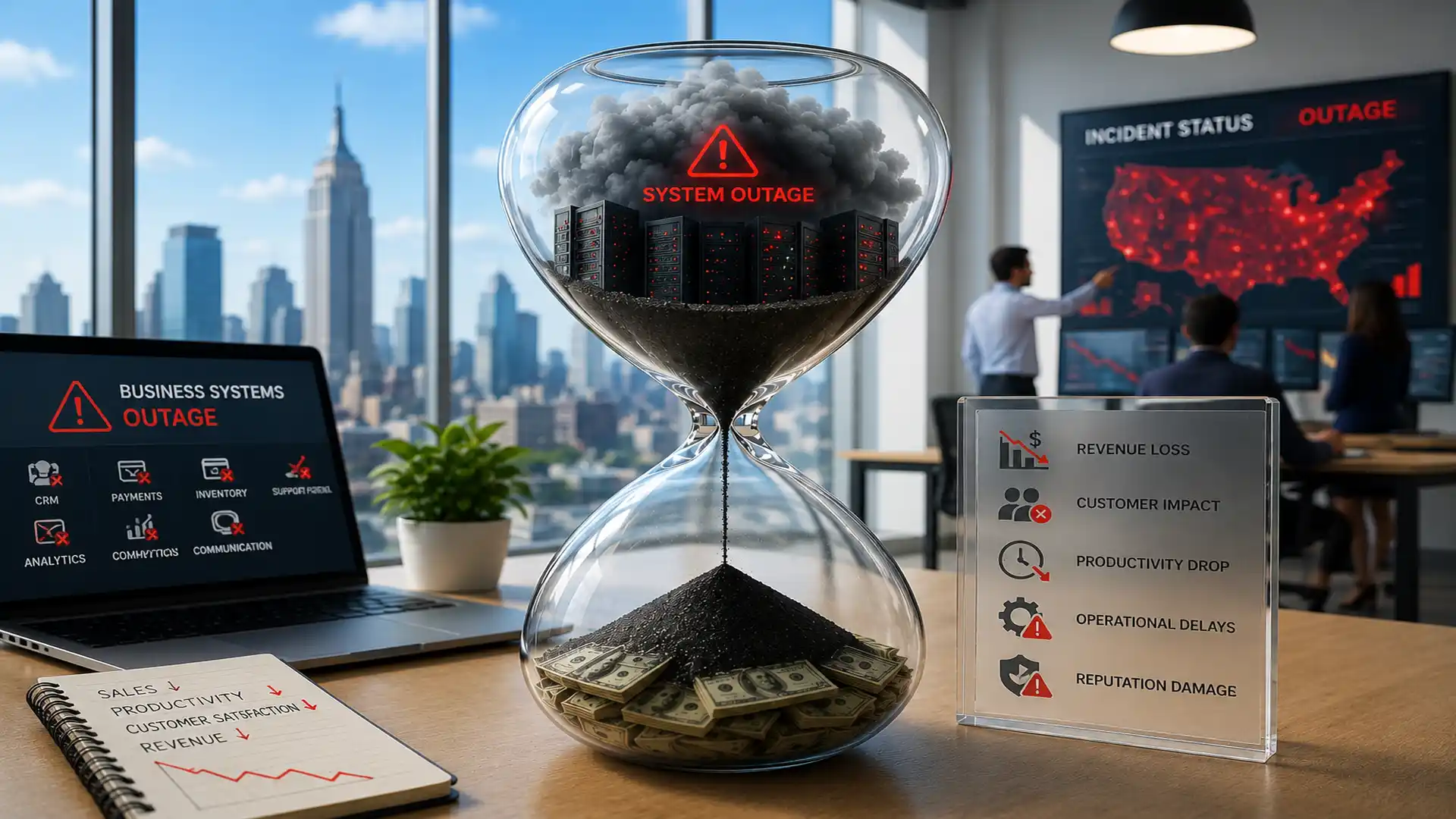
Most business leaders can quote their customer acquisition cost down to the dollar. Ask the same person what an hour of system downtime costs their company, and the answer is usually a guess. That gap, between what businesses carefully track and what actually threatens their bottom line, is becoming an expensive issue. IT downtime isn't a rare event anymore. For US businesses in 2026, it's routine enough that it belongs on the same balance sheet as any other major cost. Most companies still haven't put it there. Let's see what IT system downtime actually costs and why it is so important to track US businesses in 2026.
Ask a business owner what an hour of downtime costs them. And you'll usually get a shrug or a guess. The answer would rarely be a real number. That gap matters. Because the figures have shifted a lot over the past decade. Gartner's old benchmark of $5,600 a minute still gets quoted constantly. Even though the research behind it is over ten years old. More recent studies paint a rougher picture.
ITIC's 2024 Hourly Cost of Downtime Survey found that more than 90% of mid-size and large enterprises now lose over $300,000 for every hour their systems are down. EMA Research put the average even higher for smaller organizations, at roughly $14,000 a minute across industries, up about 60% for companies with fewer than 10,000 employees compared to just a few years back.
Small businesses don't escape this either. According to ITIC, 57% of businesses with 20 to 100 employees report downtime costs above $100,000 an hour. Even micro businesses under 25 staff average close to $1,670 a minute once you count lost sales and the scramble to fix things. Depending on the industry and company size, US businesses typically fall somewhere between $5,000 and $50,000 an hour in downtime cost. These numbers keep climbing irrespective of where a given company lands on that cost range.
Most businesses do the easy math. Lost sales multiplied by hours offline. That figure is real. But it only tells part of the story. There's usually a longer list of costs stacked underneath it.
Lost revenue is the obvious one. No transactions, no bookings, no checkouts. Retail and e-commerce feel this hardest. Amazon's downtime has been estimated at over $13 million an hour, which is an extreme case, but the same logic applies at any scale. If your systems handle revenue, every offline minute is a minute of nothing coming in.
Then there's paid labor sitting idle. Employees keep earning a wage. Even if the systems are working or not. A 50-person company paying an average salary of $80,000 is still burning about $1,900 an hour in wages. That’s even before you count a single lost sale.
Recovery costs add another layer. Getting everything back online rarely comes free. Emergency IT support. After-hours vendor calls. Rushed hardware swaps. These almost always cost more than the maintenance that would have prevented the outage in the first place.
Reputation takes a hit too. It won’t show up right away. But a customer who can’t finish checking out or can’t get through to support won’t always come back. That cost doesn't show up on the day of the outage. It shows up months later, in the churn numbers nobody connects back to the incident.
In regulated fields like healthcare, finance, and insurance, there's compliance exposure on top of everything else. An outage that gets into patient records or financial data can trip reporting obligations that a lot of businesses don't really have on their radar until they’re in it for real. Add all of that together and it’s kind of easy to see why companies keep underestimating their actual downtime cost by 300% to 400%. They total up what they can see, and that's it. Everything else gets missed.
Downtime rarely happens because of one big dramatic failure. It’s more like a handful of small and avoidable gaps that stack up. Then something finally gives in.
Cyberattacks are usually at the top of that list. Ransomware doesn’t only lock up your files. It can also knock the whole operation offline for days. IBM’s 2026 Cost of a Data Breach Report noted that breaches are now taking an average of 247 days to get fully contained. Its honestly pretty wild. Every hour an incident stays unresolved adds roughly $1,100 to the bill. In practice, a cyberattack is just a very long and expensive system outage.
Human error causes its share too. A botched update, an accidental deletion, a certificate that quietly expired because whoever owned it left the company six months ago and nobody reassigned it. None of these are exotic scenarios. They show up constantly in incident reports.
Hardware failure plays a big role. Especially for smaller companies running on one server. When that single machine goes down, there's nothing else to catch the load.
Third-party and cloud outages are trickier. Because your business doesn't have to do anything wrong to be affected. If your cloud host, payment processor, or software vendor goes down, you go down with them. The CrowdStrike incident from July 2024 is one of the clearest recent examples. One faulty software update ended up grounding flights and messing with hospital systems. It also took point-of-sale terminals offline all around the world. Parametrix estimated the direct cost to Fortune 500 companies at $5.4 billion. That works out to an average loss of roughly $44 million per affected company. None of those companies had actually created the issue themselves.
Power and connectivity issues round out the list. Still common, and honestly one of the easier problems to plan around with the right setup.
None of this is particularly exotic or unpredictable. Most outages trace back to something a business had the chance to prepare for and didn't.
Big abstract figures are easy to skim past. Specific incidents tend to stick.
Take CrowdStrike again. A single faulty update from a cybersecurity vendor grounded flights and shut down hospital systems. All within a matter of hours. Parametrix estimated the direct cost to Fortune 500 companies at $5.4 billion. Roughly a quarter of them were affected. Healthcare and banking took the biggest hits.
Or Delta Air Lines back in 2016. A failed power control module at one data center caused a five-hour outage. Flights were grounded. Passengers were stranded. The airline later put the total cost around $150 million. Most of that cost came after the systems were already back up. Rebooking and recovery dragged on for weeks.
Facebook's 14-hour outage in 2019 cost around $90 million. It was mostly the lost advertising revenue during the window it was down.
These are extreme cases most businesses will never come close to. But the underlying pattern is the same. A single failure points. A slow response and a bill that keeps growing the longer the fix takes. Only the scale changes.
Downtime cost doesn't land evenly across industries. Some sectors take a much bigger hit than others when things go down.
Financial services and banking sit near the top, driven by high transaction volume, regulatory obligations, and customer trust that's genuinely hard to win back once it's gone.
Healthcare carries a different kind of weight entirely. An outage there isn't just a financial event. It can delay patient care, block access to records, and trigger HIPAA reporting requirements. IBM's research has kept healthcare at the top of breach and outage cost rankings for well over a decade.
Retail and e-commerce feel it immediately. A checkout page that stalls during a busy sales window doesn't just cost that hour's revenue. It costs some portion of the customer's willingness to try again.
Manufacturing deals with a slower-moving but wider mess. A halted production line rarely stays contained to one facility. It ripples out through supply chains, delivery schedules, and contract penalties.
Professional and IT services land somewhere in the middle, typically $145,000 to $450,000 an hour depending on the size of the company, since the product they're selling is often the system itself.
If your business falls into any of these categories, chances are your downtime cost sits above the general SMB average rather than below it.
There's a common assumption that downtime is mostly an enterprise problem. Bigger companies, bigger systems, bigger losses. The reality runs the other way. Enterprises have redundancy built in. Backup servers. Failover systems. IT teams working shifts around the clock. When one-piece breaks, something else usually picks up the slack.
Smaller businesses rarely have that opportunity. One server. One connection. One person who actually understands how the pieces fit together. When that single point of failure gives out, the whole operation goes with it. That's why, relative to revenue, downtime often does more damage to a small business than a large one. A company pulling in $500,000 a year and losing $2,000 an hour is bleeding a much bigger share of its income than a Fortune 500 company losing ten times as much. Smaller companies also tend to experience downtime more frequently. Since they have fewer safeguards catching problems before they turn into outages. Each incident ends up costing more to recover from.
Not all downtime shows up as a dramatic outage with alarms going off. A lot of it is quieter.
Slow logins. A printer that needs restarting three times a week. A VoIP system that keeps dropping calls during busy hours. None of it feels like a crisis in the moment. Each one just chips away ten or fifteen minutes of productivity per employee, per day. That sounds minor until you multiply it out. Across a company with a hundred employees, that adds up to hundreds of lost working hours over a year. There's no single incident to point to, no outage report filed, just a business running a little slower than it should, day after day. This is the part of downtime cost most companies never track, simply because there's no obvious moment when it happens. No red status pages. No alert. Just friction, quietly compounding.
Not all downtime is the same kind of problem. Planned downtime covers mostly scheduled maintenance and software updates. It’s kind of deliberate. You can time it for off-peak hours and make sure it is communicated ahead of time. It's a cost a business chooses to accept in exchange for a more stable system afterward.
Unplanned downtime works differently. It shows up without warning, often at the worst possible moment, and gives a business no time to prepare. This is where the real downtime cost tends to live, not in the maintenance window scheduled for 2 a.m. on a Sunday, but in the outage that hits at 11 a.m. on a Tuesday in the middle of a product launch or a payroll run.
The businesses that handle this best aren't necessarily the ones that never go down. They're the ones that manage to shift more of their downtime from the unplanned column into the planned one, through monitoring, maintenance, and systems that degrade gracefully instead of collapsing all at once.
None of this makes downtime unavoidable. It just means the businesses that take prevention seriously react a lot better to these issues.
Moving from reactive to proactive IT support is the most effective shift. Structured monitoring and patching catch problems long before they turn into outages.
Redundancy matters also. Backup systems and cloud-based redundancy reduce the chances that one single point of failure can knock the entire business offline. A documented disaster recovery plan helps. But only if it stays current and actually gets exercised. Not some file nobody has opened since the day it was written.
Tracking downtime like any other business expense is often missed. Logging the cause and the financial impact of each incident is basically the only real way to tell if the spending on prevention is really working.
For a lot of small to mid-sized businesses, managed IT support ends up being the most sensible path. Building 24/7 monitoring in house plus a dedicated response team is pricey. A managed IT partner can close that gap. So, downtime becomes a rare and well-managed inconvenience.
It varies a lot, by company size and industry, you know. In ITIC's 2024 survey, they found that over 90% of mid-size and large enterprises lose more than $300,000 per hour of downtime, like pretty consistently. For small businesses it’s more like they land somewhere between $5,000 and $100,000 per hour. Overall, it depends mostly on revenue and how many systems go down at once.
A common approach adds lost revenue per hour, idle employee wages, recovery and emergency support costs, and estimated customer churn value. If you want a faster estimate, take the monthly revenue and divide by 720 hours, then multiply by three. This is to cover revenue loss and the broader business ripple effect, even if it’s not super precise.
People often treat downtime and system outage as the same thing. But in practice, a system outage usually means one specific moment. The server crashes or the cloud provider goes down. Downtime, on the other hand, is the bigger umbrella. It’s the full window where the systems are just not available. Whether that comes from one outage or a couple of smaller incidents stacked together.
For some, yes. Especially in retail, e-commerce, and healthcare where the systems are connected directly to earnings or patient care. Most small businesses will end up below that. But the number is still quite big compared to their total revenue. The major point of concern is that most owners have never actually calculated their own figures.
Proactive monitoring, redundant infrastructure, a tested disaster recovery plan, and, for businesses without the resources to manage all this internally, a managed IT services provider that handles monitoring and response around the clock.