


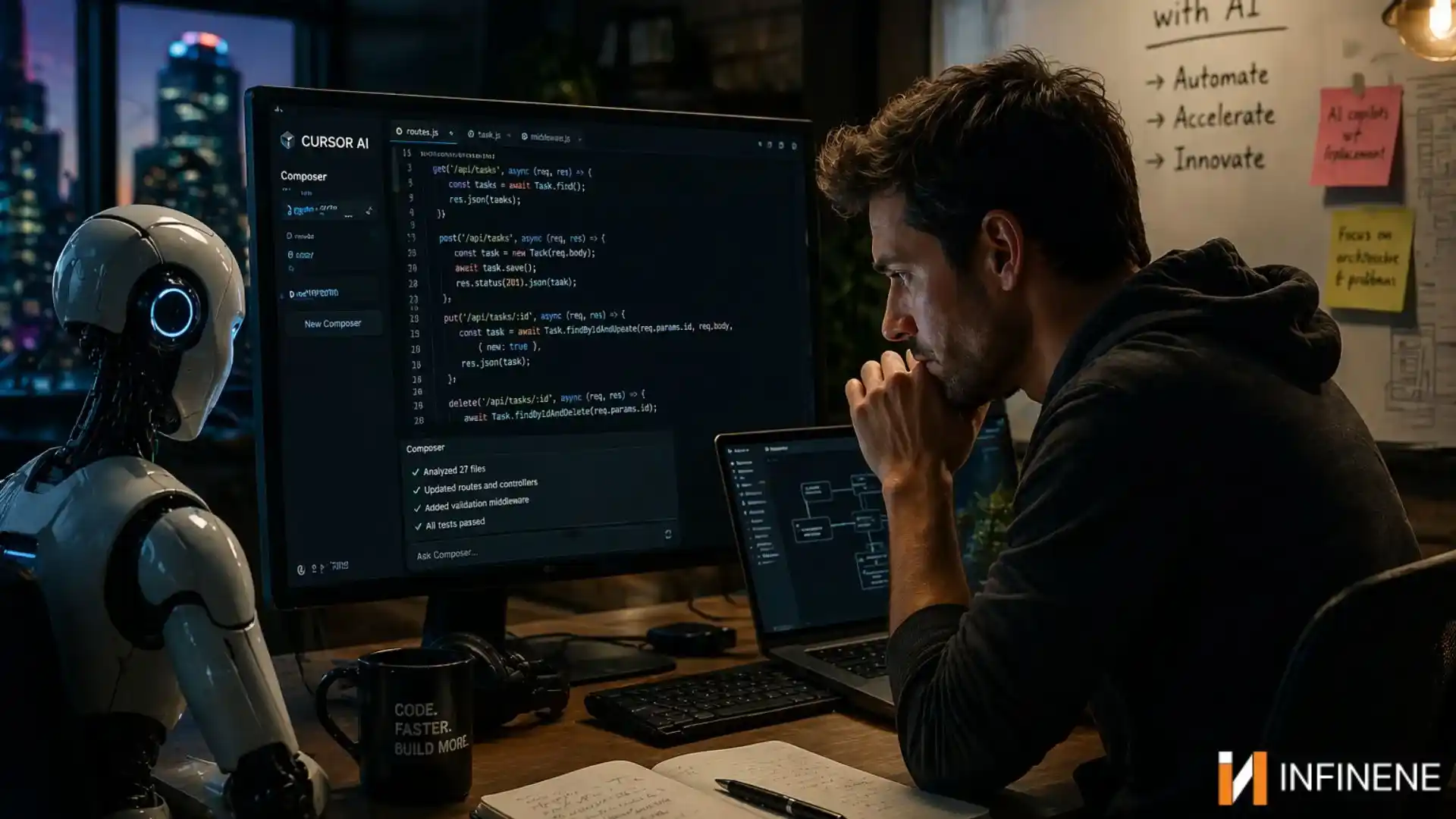
A startup CTO in Austin recently shared something that didn’t trend publicly but quietly moved through engineering circles.
He described shipping a production feature that normally takes a small team nearly two weeks. He finished it alone in under two days using Cursor AI.
There was no announcement around it. No marketing pushes. Just a simple observation that the work had changed shape.
Other engineers didn’t react with surprise. They reacted with recognition. Many had already seen similar patterns inside their own teams.
That is usually how structural change begins in software. Not with headlines, but with quiet adjustments in what teams consider “normal output.”
And increasingly, Cursor AI is becoming part of that shift.
It is now widely discussed in conversations about AI coding tools replacing programmers, not because of speculation, but because of what developers are experiencing in real workflows.
Cursor AI is a code editor built by Anysphere, a San Francisco-based startup. On the surface, it looks like a modern version of VS Code. Underneath, it behaves very differently.
Instead of acting as a traditional editor with added AI features, Cursor integrates AI into the entire development process. The tool is built around the idea that software development does not need to be line-by-line anymore.
At the center of it is a system called Composer.
Composer allows developers to describe what they want in plain language. Not code, just intent.
From there, Cursor reads the full project structure, understands how files interact, and generates changes across multiple parts of the system at once.
It does not just complete lines. It builds systems.
A developer might write a request like building authentication, payment integration, or an analytics dashboard. Cursor then creates the structure, writes supporting logic, adjusts dependencies, and prepares working code that fits into the existing project.
This is why Cursor AI is increasingly grouped with the best AI coding tools for developers, especially in discussions about productivity shifts in US engineering teams.
The real change is not speed. It is abstraction. Developers are moving from writing code to defining outcomes.
The rise of AI coding tools replacing programmers did not start with Cursor. It started when developers began relying on AI for more than suggestions.
Earlier tools like GitHub Copilot were simple in comparison. They helped complete lines of code or suggested short snippets. At the time, this felt like a productivity boost.
But over time, expectations changed.
Writing repetitive code manually started to feel unnecessary. Developers began adjusting workflows around AI assistance rather than treating it as optional.
By 2026, the category has evolved into something much more powerful.
AI coding tools now behave less like assistants and more like active participants in development workflows. They can interpret instructions, generate full implementations, and even handle testing and debugging loops.
This shift has created a new category often referred to as:
AI pair programming tools
Autonomous coding AI tools
AI software development automation systems
In practice, this means developers are spending less time writing code and more time reviewing and refining it.
A typical workflow today might look like this. A developer defines a feature in natural language. The AI generates a working version. Tests are created automatically. Errors are fixed through iteration. The developer then reviews the final result.
What used to take hours or days of manual work is now compressed into structured cycles of generation and validation.
This is where discussions around AI tools replacing programmers 2026 become relevant, not as prediction, but as observed behavior in teams.
This is the question that keeps appearing in engineering discussions across the US.
The honest answer is more layered than most headlines suggest.
Software demand is still growing. Nearly every industry now depends on software systems. Healthcare, logistics, finance, retail, and even manufacturing is building more digital infrastructure than ever before.
At the same time, the number of engineers needed per product is decreasing.
AI coding tools reduce the amount of manual implementation work required to build software. Tasks that once required multiple developers can now be handled by smaller teams using tools like Cursor AI.
This creates a shift in hiring patterns.
Entry-level roles are the most affected. Companies that once hired large junior cohorts are now reducing intake or reshaping those roles. Mid-level roles focused on repetitive coding are also shrinking. Senior engineers, however, are becoming more valuable.
So, the reality is not replacement of software engineers as a whole.
It is the replacement of specific categories of engineering work.
The profession is not disappearing. It is being reorganized.
And that reorganization is directly tied to the rise of AI coding tools replacing programmers in day-to-day workflows.
The AI development tool space has become crowded, but differences between tools are becoming clearer.
GitHub Copilot remains one of the most widely used tools. It integrates directly into editors like VS Code and JetBrains and is known for smooth inline suggestions. It fits naturally into existing workflows and requires minimal adjustment from developers.
Cursor AI takes a different approach.
Instead of focusing on suggestions, it focuses on full project awareness. It reads entire codebases, understands structure, and performs changes across multiple files simultaneously. Its Composer system allows it to execute tasks that resemble full development cycles rather than incremental edits.
The distinction is important.
Copilot helps developers write code faster.
Cursor helps developers build systems faster.
Other tools in the space include Windsurf, Amazon Q Developer, Replit AI, and Tabnine. Each has a specific focus, from enterprise integration to browser-based development or privacy-focused workflows.
But Cursor continues to stand out in conversations about AI developer tools comparison because it moves closest to autonomous system generation rather than assisted coding.
The future of programming careers in the US is not a simple story of job loss. It is a shift in how engineering work is structured.
Software development is splitting into layers.
The first layer involves routine coding tasks. This includes repetitive logic, basic APIs, and boilerplate systems. This layer is shrinking rapidly as AI tools take over execution-heavy work.
The second layer involves AI-assisted development. Developers here work closely with tools like Cursor AI, guiding outputs through prompts and refining results.
The third layer is system architecture and design. This includes decision-making around scalability, security, and complex system behavior. This layer is becoming more important, not less.
This restructuring is why AI software development automation is not just a productivity story. It is a workforce transformation.
By 2030, developers will likely spend far less time writing code manually and far more time designing systems, reviewing AI output, and managing workflows between automated components.
The role is shifting from execution to orchestration.
The most important shift for developers today is adaptation.
Using AI tools occasionally is not enough. They are becoming core infrastructure in development workflows.
Regular use of tools like Cursor AI helps developers understand where these systems perform well and where they fail. This includes recognizing incorrect logic, incomplete implementations, and architectural mistakes that AI systems can introduce.
Another important shift is in thinking style. Syntax-level coding is becoming less important. System-level thinking is becoming more valuable.
Developers who can clearly define problems, structure requirements, and evaluate system behavior are adapting more effectively to this new environment.
There is also growing importance around communication with AI systems. Writing clear, structured instructions has become a practical engineering skill.
In many ways, developers are shifting from builders to directors of automated systems.
This is the direction behind AI coding tools replacing programmers, not as elimination, but as redistribution of effort.
Cursor AI represents more than a productivity tool. It represents a shift in how software is created.
The center of gravity in development is moving away from manual implementation and toward system-level design and oversight.
The question is no longer whether AI will replace programmers entirely.
The real question is how much of programming will remain manual over the next decade.
And that shift is already visible in real engineering teams today.
We help businesses and development teams adapt to this shift
with AI-powered software solutions and modern engineering practices.
If you're looking to integrate AI into your workflow or build faster with tools
like Cursor AI, get in touch
with us today.
What is Cursor AI and how does it work?
Cursor AI is an AI-powered code editor that understands entire codebases and
generates multi-file software implementations based on natural language
instructions.
Will AI coding tools replace programmers completely?
No. They reduce manual coding significantly, but engineers are still needed for
system design, logic, and decision-making.
Is Cursor AI better than GitHub Copilot?
Cursor is stronger for full-system development and multi-file changes, while
Copilot is better for inline coding assistance.
Are software engineering jobs at risk because of AI?
Entry-level roles are most affected, but senior and architecture-level roles
are becoming more important.
What are the best AI coding tools in 2026?
Cursor AI, GitHub Copilot, Windsurf, Amazon Q Developer, and Replit AI are
leading tools.
Can AI fully replace human software developers?
Not currently. AI handles implementation, but humans remain essential for
design, reasoning, and system architecture.