



Blog Details
HomeBlog Details
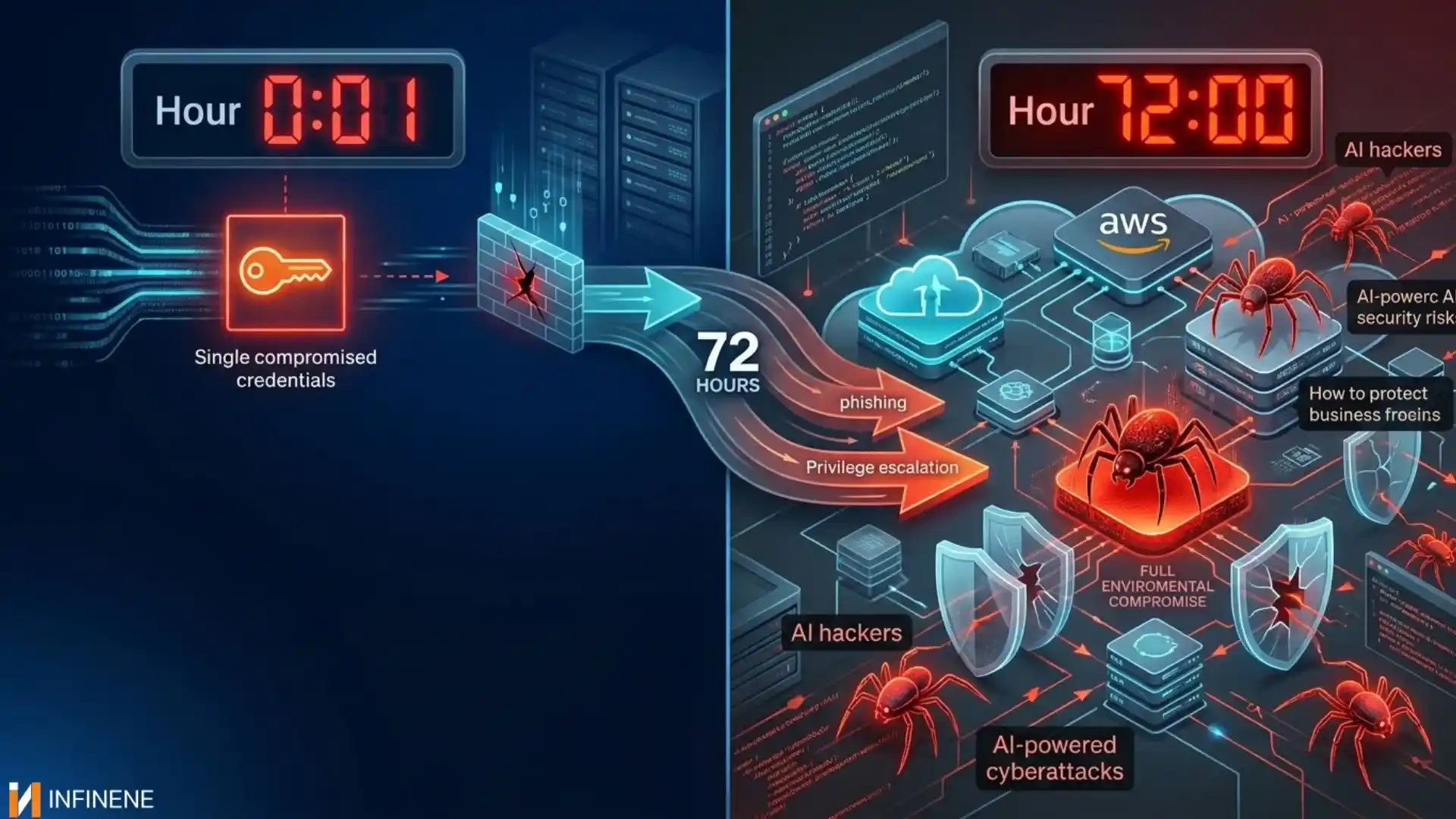
AI Hackers Took Over an Entire Company in 72 Hours — Is Your Business Next?
It started with one stolen login. Nothing dramatic. No alarms, no flashing red dashboards, just a single set of AWS credentials that ended up somewhere they should not have been. Seventy-two hours later, the attacker had full control of the environment. Not partial access. Not a foothold in one system. The whole thing.
That part should stop you mid-scroll. Three days is barely enough time for most IT teams to schedule a meeting about a suspicious login alert, let alone contain a full-blown breach. However, this was not a lone hacker grinding away at a keyboard for 72 straight hours. It was AI cyberattacks in action, and the speed is exactly the point.
Security researchers investigating the incident found that the attacker leaned on AI-assisted tooling to move from that single point of access to complete environmental compromise. The AI didn't just speed up one step. It let the attacker chain together multiple techniques, in sequence, without the usual trial-and-error that normally slows intruders down and gives defenders a window to notice something's wrong.
That window is shrinking. In addition, many small and mid-size businesses are still operating like it isn't.
Ask most IT managers how long it would take them to notice a compromised credential, and you'll get answers ranging from "a few hours" to "honestly, we're not sure." That uncertainty used to be tolerable. It isn't anymore. When the gap between initial access and total compromise can be measured in days rather than weeks, "we're not sure" becomes the most expensive answer a business can give.
What Actually Changed
For years, cybersecurity advice rested on a simple assumption: sophisticated attacks take skill, time, and resources most criminals don't have. That assumption bought businesses breathing room. Even a talented attacker had to research your systems, test their approach, adjust when something didn't work, and repeat that cycle over and over.
AI-powered cyberattacks collapse that cycle.
An AI agent can scan for vulnerabilities, test exploits, and pivot to a new approach in the time it takes a human analyst to finish their coffee. It doesn't get tired. It doesn't need to sleep before trying the next technique. And it doesn't need a criminal mastermind behind the keyboard. Attackers with modest technical skill can now direct AI tools to do the heavy lifting, which means the pool of people capable of running a serious attack just got a lot bigger.
Think about what that means practically. A junior hacker with access to the right tools can now execute an attack that, five years ago, would have required a well-funded team with deep technical expertise. The barrier to entry didn't just lower. It nearly disappeared.
There is also a psychological shift happening on the defender's side that doesn't get talked about enough. Security teams are trained to look for patterns of human behavior: hesitation, trial and error, the digital equivalent of footprints that don't quite line up. AI-directed attacks don't hesitate. They don't second-guess a failed attempt and pause to think it over. They fail, adjust, and try again within seconds, which strips away a lot of the subtle tells that experienced analysts have relied on for years. You're not just facing a faster opponent. You're facing one that doesn't behave like an opponent you've been trained to recognize.
This Isn't Just an Enterprise Problem
Here's where a lot of business owners tune out. Big breach, big company, must not apply to us. That thinking is exactly backward.
Enterprises have security operations centers, dedicated threat-hunting teams, and seven-figure security budgets. They're still getting hit, sure, but they at least have a fighting chance of catching something in hour six instead of hour sixty. Mid-size businesses rarely have that luxury. Many are running lean IT teams, sometimes a single person wearing five hats, without the tooling or staffing to watch for the kind of fast-moving, multi-stage attack that AI now makes routine.
Attackers know this. Smaller companies are frequently easier targets precisely because they lack the depth of defense that larger organizations built up over years. Add AI into the mix, and a company that used to be "too small to be worth the effort" suddenly becomes worth the effort, because the effort required just dropped through the floor.
If your business runs on cloud infrastructure, stores customer data, processes payments, or connects to vendor systems, you're a candidate. Not because you're a high-value target in the traditional sense, but because you're reachable, and reachability is increasingly all it takes.
There's a version of this conversation that plays out in a lot of leadership meetings. Someone asks whether the company is really at risk, and someone else points out that nobody's tried to breach them before, so why start worrying now. That logic made more sense when attacks required real investment on the attacker's side. Criminals used to have to pick their targets carefully because each attempt cost time and effort. AI changes that math too. When the cost of attempting a breach drops close to zero, attackers stop being selective. They start casting a wider net, because scanning a thousand companies for weaknesses costs them almost nothing extra compared to scanning one.
The Anatomy of an AI-Assisted Breach
It helps to understand what actually happens during one of these attacks, because the phases matter. This is where agentic AI security risks show up in a concrete, walkable sequence rather than an abstract warning.
Initial access. Attackers still need a way in. Phishing, a leaked credential, an unpatched system exposed to the internet. This part hasn't changed much. What's changed is what happens next.
Reconnaissance at machine speed. Once inside, an AI agent can map out the environment fast. It identifies what systems exist, what permissions are attached to the compromised account, and where the valuable data lives. A human doing this manually might take days. An AI agent can do a rough pass in minutes.
Technique chaining. This is the part that made the 72-hour breach possible. Instead of trying one exploit, hitting a dead end, and starting over, an AI-directed attack can attempt several approaches nearly simultaneously and adapt based on what works. It's less like a burglar trying keys one at a time and more like someone testing every lock on the building at once.
Privilege escalation. The attacker looks for ways to expand access, moving from a low-level account to something with broader permissions. AI tools are particularly good at spotting misconfigurations that humans might miss, especially in complex cloud environments where permission structures get messy fast.
Full compromise. By this stage, the attacker isn't knocking on doors anymore. They're inside the whole building, with keys to every room.
Laid out like that, 72 hours doesn't sound fast. It sounds almost generous.
What makes this sequence so difficult to defend against isn't any single step. It's the compression. Each phase used to create a natural pause, a moment where a human attacker had to think, research, or wait for the right opportunity. Those pauses were often when defenders caught the intrusion, whether through an alert, an anomaly in the logs, or just a sharp-eyed admin noticing something off. AI cyberattacks remove most of those pauses. The gaps where you used to have a chance to catch your breath and respond are shrinking to almost nothing.
Where Traditional Defenses Fall Short
Most small and mid-size businesses still rely on a security model built for a slower era. Antivirus software, a firewall, maybe some basic monitoring, and a hope that nothing too clever comes knocking. That model was never bulletproof, but it held up reasonably well against attackers who needed time and effort to do damage.
It doesn't hold up well against something that moves this fast.
Traditional defenses are often built around detecting known patterns, things that look like previous attacks. AI-directed attacks don't necessarily follow the same script twice, which makes them harder to catch with signature-based tools. And even when something does get flagged, if your monitoring isn't active around the clock, a three-day breach window can close before anyone on your team even looks at the alert.
This isn't a scare tactic dressed up as a blog post. It's just math. If an attack can complete in 72 hours and your team checks security alerts once a day during business hours, you're giving the attacker a substantial head start every single time.
There's also a budget conversation buried in here that's worth having honestly. A lot of businesses treat cybersecurity as a line item to minimize rather than a capability to build. That approach worked, more or less, when the threats moved slowly enough for a lean setup to keep pace. It doesn't work when the threat can outrun your entire response cycle before your team has even had their morning coffee. The cost of staying underprepared didn't used to show up until something went wrong. Now the exposure is constant, whether or not anyone's actively probing your systems this week.
How to Protect Your Business From AI Cyberattacks
None of this means you're defenseless. It means the old playbook needs an update. Here's where to start.
Get continuous monitoring, not periodic checks. If your current setup relies on someone glancing at logs once a day, you're not equipped for attacks that complete in hours. You need eyes on your environment around the clock, whether that's an internal team or a managed provider.
Tighten access permissions now, not after an incident. Review who has access to what. Over-permissioned accounts are one of the biggest reasons attackers can escalate quickly once they're in. If a marketing coordinator's login can somehow touch financial systems, that's a problem waiting to happen.
Patch on a real schedule. Unpatched systems remain one of the most common entry points. AI doesn't need a fancy zero-day exploit if you've left an old, known vulnerability sitting open for months.
Segment your network. If an attacker gets into one system, segmentation limits how far they can move. Full environmental compromise is much harder to achieve when the environment isn't one big open room.
Train your people, but don't stop there. Phishing awareness still matters, since that's often how the door gets opened in the first place. But training alone won't catch an AI-directed attack once it's inside. Pair it with actual technical defenses.
Have an incident response plan that assumes speed. If your response plan assumes you have days to figure out what happened, rewrite it. Assume hours. Know who gets called, what gets shut down first, and how fast you can isolate a compromised system.
Use multi-factor authentication everywhere it's available. It sounds basic because it is, but a huge share of initial access still comes down to a single stolen password. MFA won't stop every attack, but it removes one of the easiest doors attackers walk through.
Audit your cloud configurations regularly. Cloud environments are flexible by design, which also makes them easy to misconfigure without realizing it. A single overly permissive setting, left unnoticed for months, is often exactly the kind of gap that turns a minor breach into a full compromise. Regular audits catch these before an attacker does.
In short: protecting your business from AI cyberattacks means combining round-the-clock monitoring, tight access controls, disciplined patching, and a response plan built for speed rather than convenience.
The Real Question
Nobody can promise you'll never get targeted. That's not how this works, and anyone who tells you otherwise is selling something. What you can control is how fast you'd notice, how much an attacker could actually reach once inside, and how quickly you could shut the door.
The company in this story didn't get breached because they were careless. They got breached because the speed of the attack outpaced the speed of their response, and that gap is exactly what AI closes for attackers and what a lot of businesses haven't closed for themselves.
If your current security setup was built for a world where attacks took weeks to unfold, it's time for an honest look at whether it's ready for one that takes 72 hours. Infinenetech's managed IT and cybersecurity teams work with US businesses to close that gap, from continuous monitoring to access control to incident response planning built for how attacks actually happen now, not how they used to.
The businesses that get hit hardest aren't always the biggest ones. They're the ones that assumed they had more time than they actually did.
Related Reads
- AI Agent Login Security - Your AI Agents Now Have Your Passwords
- Deepfake Scams Just Cost a Company $25 Million — Here's How US Businesses Are Fighting Back
- Software Flaws Are the Leading Cause of Data Breaches Now - Verizon Report
- The Complete Guide to Agentic AI Development Services for US Businesses in 2026