


A server goes down at 8 a.m. on a Tuesday. Your internal guy is on vacation. Your "IT vendor" goes to voicemail. That scenario plays out thousands of times a week at American small businesses — and it's almost always avoidable. The problem usually isn't bad luck. It's a bad contract. Choosing the right IT support services for businesses takes about two hours of research and the right questions. Most owners skip that step, sign whatever the salesperson hands them, and spend the next two years paying for it.
This article is for three types of readers: small business owners figuring out whether to outsource IT at all, marketing managers at mid-size companies trying to compare vendors on a real budget, and founders who want to know what they'll actually pay before they get on a single sales call. No filler. Just the stuff that matters.
Managed IT services have gotten more expensive — not because the technology got harder, but because the market got crowded and pricing got murkier. Providers structure their fees in ways that make apples-to-apples comparisons almost impossible on purpose. One contract bundles backup and cybersecurity. The next charges for both separately. A third quotes you a low per-user rate and then adds a "platform fee" on page four of the agreement.
The businesses getting burned the most right now are the ones in the 15 to 75 employee range. They're too big for a single freelance tech to handle reliably, but not big enough that vendors treat them like enterprise clients. They end up with enterprise-style contracts stripped of enterprise-level service — paying $120 per user per month for a help desk that takes four hours to answer a ticket.
IT support pricing has real range, and understanding that range before you talk to anyone is the only way to walk into a vendor conversation without getting taken.
Here's the honest version of managed IT services pricing, without the sales spin.
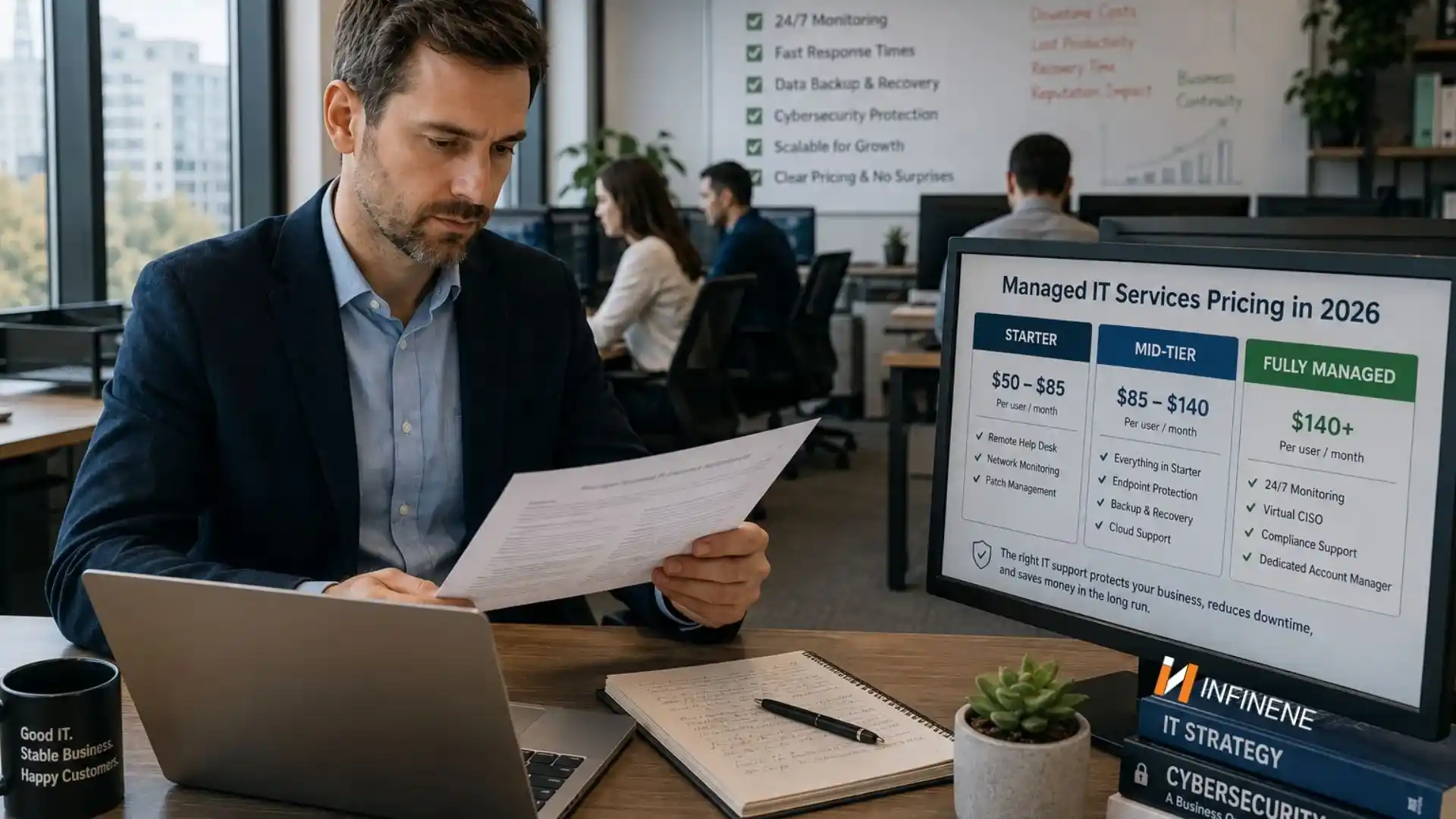
The most common model is per-user monthly billing. For a starter plan — remote help desk, basic monitoring, patch management — most providers charge $50 to $85 per user. That's the entry point. It covers the basics but leaves gaps, especially around cybersecurity.
A mid-tier plan, which adds endpoint protection, cloud support, and backup, runs $85 to $140 per user per month. That's where most small and mid-size businesses should realistically land. If you're handling customer payment data, medical records, or anything that touches a compliance framework, the standard tier isn't enough.
Full-managed or enterprise plans — the ones that include 24/7 monitoring, a virtual CISO, compliance support, and dedicated account management — start around $140 and go up from there. For a 50-person company, you're looking at $7,000 to $10,000 a month at that level. It sounds like a lot until you price out what a single ransomware incident costs in downtime, recovery, and reputation damage.
Some providers, particularly smaller regional shops and independent consultants, still sell block-hour plans — typically 10 to 20 hours a month prepaid at $1,000 to $1,500 per block. These work fine for businesses with very light, predictable needs. The trap is that once you burn through your hours, additional support hits at premium rates, usually $150 to $200 an hour. One bad month and you've blown your IT budget.
Per-device pricing is the third model. Rates run $25 to $75 per device per month. If your team uses shared workstations or a lot of dedicated hardware, this can work in your favor. For most office-based businesses where everyone has a laptop and a phone, per-user pricing ends up being more predictable.
This is where buyers get surprised most often. "Managed IT services" is a category, not a specification. Two providers can both call their offering fully managed and include completely different things.
Remote help desk is almost always included, though hours vary widely. Some providers cover 8 a.m. to 6 p.m. business days. Others offer 24/7. That difference matters enormously if your team works odd hours or across time zones.
Network monitoring — watching your infrastructure for failures, unusual traffic, and performance issues — is standard in most plans above the starter tier. Patch management, meaning keeping your operating systems and software updated automatically, is also common across most contracts.
What tends to get sold separately: cybersecurity training for employees, backup and disaster recovery, cloud platform management, compliance support for frameworks like HIPAA or PCI-DSS, and hardware procurement. One IT support company might bundle backup into every plan. Another charges $12 to $20 per user extra for it. Neither is inherently dishonest — the problem is when buyers assume it's included and find out otherwise after an incident.
Ask every provider you evaluate for a written list of what's in scope and what triggers an additional charge. If they push back on that request, walk away.
Size shapes everything in this decision — more than industry, more than budget, more than any feature comparison.
For businesses under 50 employees, outsourced IT support almost always makes more financial sense than hiring in-house. A capable IT generalist in most US markets earns $60,000 to $80,000 a year before you add benefits, hardware, and the reality that one person can't cover everything. A managed service provider handling the same scope typically costs $2,500 to $6,000 a month depending on team size and what's included. The math is straightforward, but the coverage difference is what most owners underestimate. One employee takes vacations and gets sick. A provider's help desk doesn't.
IT services for small businesses should start simple. Get the help desk right, make sure your backups are automated and tested, and get basic endpoint security in place. That foundation handles 80% of the problems most small teams actually face.
For companies in the 50 to 250 employee range, the situation gets more nuanced. You likely have at least one internal IT person by now. The question isn't whether to outsource — it's how much to outsource. A co-managed model, where a provider handles monitoring, security, and after-hours coverage while your in-house hire focuses on projects and relationships, is often the most efficient setup at this scale. Business IT support services structured this way let your internal team focus on work that actually moves the company forward instead of spending Fridays resetting passwords.
Most providers sound identical on an intro call. They all promise fast response times, proactive support, and a team that feels like an extension of yours. The way to separate real from rehearsed is to ask specific questions and pay attention to how they answer — not just what they say.
Ask what their average response time is on a Priority 1 ticket, and then ask how they define Priority 1. Vague answers here are a red flag. Ask whether cybersecurity monitoring is included in the plan they're quoting or an add-on. Ask who specifically handles your account on a day-to-day basis and what the technician-to-client ratio looks like. If one tech is managing 80 clients, that response time promise starts to look very different.
Ask what happens if they can't resolve something remotely — how onsite support works and whether it's billed separately. Ask about the exit clause. If the contract locks you in for two or three years with no performance-based out, that's a provider betting you'll give up before you complain loudly enough. A confident provider offers a 60 or 90-day satisfaction window in writing.
References matter more than testimonials on a website. Ask for two current clients you can actually call, specifically companies similar in size and industry to yours. If they hesitate or offer case studies instead of phone numbers, that's the answer.
The in-house versus outsource debate gets framed as a cost question, but it's really a coverage question.
A single internal hire gives you one person's skill set, one person's availability, and one person's bandwidth. That works reasonably well if your IT environment is simple and your team is small. It starts breaking down when you need after-hours coverage, when you have a security incident that exceeds their expertise, or when that person leaves and takes institutional knowledge with them.
Outsourced IT support gives you access to a team — different specialists for networking, security, cloud infrastructure, and end user support — under one monthly contract. The coverage is broader and more consistent, and it scales without another hiring process.
The cost comparison isn't as lopsided as MSPs make it sound. A strong in-house hire at $70,000 a year plus benefits costs roughly $85,000 to $95,000 all-in. A mid-tier managed services contract for a 20-person company runs about $30,000 to $40,000 a year. But a 20-person company getting one hour of help desk per week from an in-house hire isn't the same as having a full team available on demand. The question is what coverage you actually need, not just what costs less on paper.
Most small and mid-size businesses pay between $85 and $140 per user per month for a solid mid-tier managed IT plan. Starter plans start around $50 per user but leave gaps in cybersecurity and backup coverage. Enterprise plans with 24/7 NOC, compliance management, and virtual CIO services start around $140 per user. For a 25-person company on a mid-tier plan, expect to budget $2,500 to $4,500 per month.
Managed IT services run on a flat monthly fee. Your provider monitors your systems, handles maintenance, and responds to issues proactively. Break-fix means you call when something breaks and pay hourly — typically $125 to $200 per hour. Managed services almost always cost less over a full year and respond faster because the provider is already watching your environment, not starting from scratch every time something goes wrong.
The core services are similar — help desk, monitoring, endpoint protection, backup — but the depth and scope are different. IT services for small businesses typically focus on keeping operations running reliably and affordably. Enterprise-level plans go further with dedicated account managers, compliance frameworks, vendor management, and strategic planning support. Small businesses rarely need that full stack, but growing companies often find themselves wanting it sooner than expected.
Ask for their average response time on urgent tickets in writing, not just verbally. Ask what specifically is out of scope in your contract. Ask for a reference from a current client in your industry. Ask what the process looks like if you want to exit the contract in year one. The answers to those four questions tell you more about a provider than their entire marketing deck.
Take an hour and write down what your business actually needs from IT support — not a Wishlist, just the essentials. How many users need coverage? Do you have compliance requirements? Does your team work outside standard business hours? What's been the biggest IT headache in the past 12 months?
That list turns every vendor conversation from a sales pitch into a real evaluation. Run the same questions by three providers and compare how they respond — not just the price, but the specificity of their answers and whether they push back thoughtfully or just tell you what you want to hear.
If you want a head start, Infinenetech.com works with US-based businesses across size ranges and budgets. Reach out for a straightforward conversation about what your setup actually needs — no contract required to get started.