


Walk into almost any US engineering org in 2026. You'll find the same quiet shift happening. A growing share of the code shipping to production was never typed by a human, at least not the first draft. AI coding tools have gone from a novelty extension in a handful of IDEs to the default starting point for how software gets written. The numbers back that up. More than nine in ten organizations now use AI to assist with coding, and 86% have moved past the experimentation phase into deploying AI coding agents for production code, with enterprises leading adoption at 91%, compared with 83% for small and mid-sized businesses. That's not a pilot program anymore. That's infrastructure.
For US businesses, the appeal is obvious. Faster shipping. Smaller backlogs. But the same speed that makes AI coding tools attractive is also what makes them risky. Code that's generated quickly still has to run reliably. It has to hold up under load. It can't open a door for attackers. A lot of businesses are learning that fast and production-safe are two different problems. They need two different answers. This is the part of the AI coding story that gets less airtime than the productivity headlines. What happens after the code is generated? Who's actually responsible for making sure it's safe to ship?
It's tempting to think of AI coding tools as something individual developers opted into. A Copilot subscription here. A Cursor license there. That undersells what's actually happening. Developer adoption is now near universal. At big tech companies, AI is generating from 25% to 90% of new code depending on the organization. The overall market is growing at roughly 24% a year. As of January 2026, 90% of developers report using at least one AI tool at work. That’s 85% more in just six months. And it’s not only the adoption rate that’s increasing. It’s more like how central AI has become to daily engineering routines. Eighty nine percent of developers now use generative AI day in and day out. 68% rely on it to improve code quality. 56% use it specifically to catch mistakes before they ship. That's a meaningful detail. AI coding tools aren't just being used to generate new functionality faster. They're increasingly part of the quality control layer too.
Enterprise adoption tells a similar story from a different angle. GitHub Copilot alone has reached 40% adoption among companies with more than 5,000 employees, and 90% of Fortune 100 companies now use it in some capacity. But single-tool dominance isn't really the pattern anymore. In-house engineering teams are now running a median of 3.1 different AI coding tools per developer, stacked into a single workflow rather than picked as one assistant.
For a US business owner or CTO watching this from the outside, the takeaway isn't "should we adopt AI coding tools." That decision has effectively already been made across the industry. The real concern is what happens to the code once it's written. Does the business have a process built for a world where a meaningful chunk of its codebase was never manually typed line by line?
Here's where the story gets more interesting than a straightforward adoption curve. Usage of AI coding tools keeps climbing. Trust in what they produce is going the opposite direction.
Only 29% of developers say they trust AI-generated code output as of 2026. This is down from 40% just two years earlier. Even as the share of developers using these tools has kept rising. A separate 2026 industry survey found something similar. 96% of developers say they don't fully trust AI-generated code, despite 72% of AI coding tool users relying on it every single day.
Read that again. It's the crux of the whole issue. Developers are using AI code generation constantly and don't fully trust the output. They're shipping it anyway, at scale, because the alternative of writing everything by hand isn't competitive anymore. It’s not really a contradiction. It's more like an adaptation. Experienced engineers have learned to deal with AI generated code the way a good editor handles a first draft. Like, you don’t just paste it and call it done. You quietly review, shape, and refine. Useful but never assumed to be correct until it's been checked.
The practical effect of that shift is showing up in how developers actually spend their time. Developers are now saying they spend about 11.4 hours a week looking over AI produced code compared with the 9.8 hours they used to put into writing fresh code from scratch. Honestly, it feels like reviewing is becoming the main grind now. This is a reversal of the pattern from just two years ago when writing still outpaced reviewing. Review has become a bigger job now. That's an important correction to a narrative that's been floating around US boardrooms for the past couple of years. The idea that AI coding tools mostly replace the writing part of software development. In practice, they've shifted the bulk of engineering effort toward verification. The work didn't disappear. It moved.
The risk with AI code generation isn't usually a broken build that fails immediately and gets caught in CI. Those errors are cheap. They get flagged and fixed within minutes. The expensive failures are the ones that look completely fine.
Multiple 2026 industry reports point to the same pattern. The biggest frustration developers have with AI coding tools isn't obviously bad output. It's code that appears correct, passes a casual read through, and contains a subtle logic error, an edge case that wasn't handled, or a dependency with a known vulnerability baked in. That's a different category of risk than a typo or a syntax error. It demands a different kind of defense. You can't catch it by glancing at the diff. You need to process.
This matters even more for US businesses in regulated industries such as healthcare, finance, and insurance, where a subtle data handling bug in AI-generated code isn't just an engineering embarrassment. It's a compliance exposure. Current market data suggests non-tech enterprises in regulated sectors are actually adopting AI coding tools at higher rates than big tech companies themselves, which flips the assumption that only fast-moving startups are leaning into AI code generation. Regulated businesses are in the mix. That makes the governance question a lot more urgent, not less.
Analysts covering enterprise AI adoption have landed on a consistent recommendation. It's not "slow down." It's "build the guardrails." Both IDC and Gartner recommend governance and structured risk assessment for AI coding tool rollouts. In practice, that means enterprises pairing AI coding tools with access controls, activity logging, and an approved list of models. Policy gates built directly into the CI/CD pipeline, instead of letting developers use whatever tool they want. That's the model worth borrowing, regardless of company size. A production-safe approach to AI-generated code generally rests on a few concrete practices.
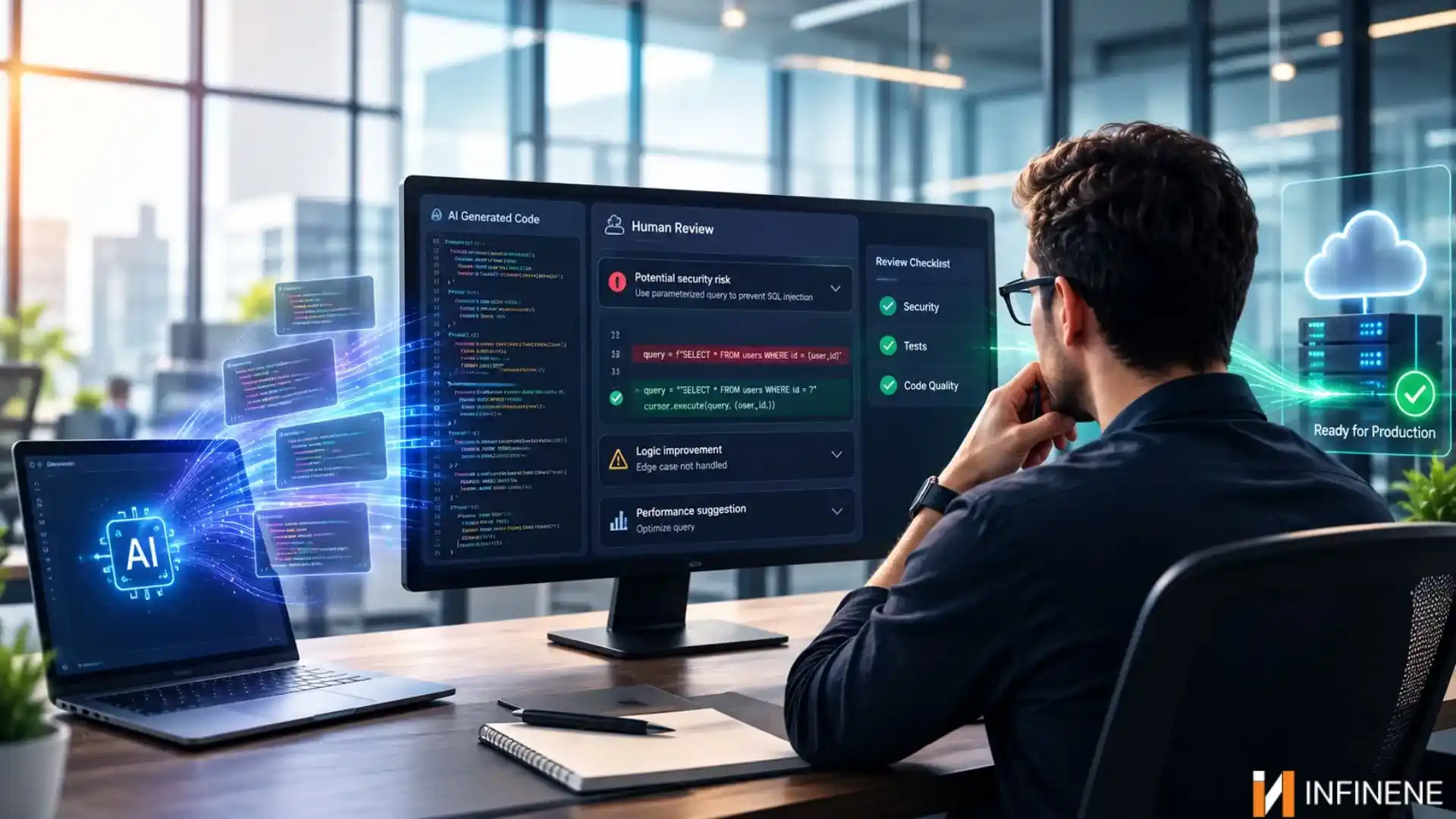
Mandatory human review before merge. No AI-generated pull request goes into main without a developer who understands the system, not just the syntax, actually reading it. This sounds obvious. It's also the single most commonly skipped step under deadline pressure. It's the one most directly tied to the incidents that make headlines.
Automated security and dependency scanning on every AI-assisted commit. AI code generation tools are trained on massive amounts of public code. Some of it may be outdated or written with vulnerabilities baked in. Static analysis and dependency scanning should run on AI generated code with the same rigor as code written by humans.
Model and tool approval lists. With teams running multiple AI coding tools at once, an unmanaged sprawl of assistants creates unmanaged sprawl of risk. Standardizing on a vetted, approved set of tools gives a business one consistent set of behaviors and outputs to govern, instead of a dozen.
Sandboxed testing environments for agentic workflows. Agentic AI coding tools that can execute multi-step tasks such as refactoring, writing tests, or even deploying carry more risk than simple autocomplete. They can act on more of the system at once. Running those workflows in sandboxed environments before anything touches production isn't optional caution anymore. It's becoming standard practice.
Treating AI-generated code as authored, not autonomous. The healthiest mental model isn't "the AI wrote this feature." It's "a developer used a tool to draft this feature, and that developer is accountable for what ships." That framing keeps responsibility where it needs to be. With a person who can be asked to explain a decision.
None of this is an argument against AI coding tools. The productivity case remains genuinely strong for US businesses, especially smaller ones competing against better resourced rivals. Developer’s report saving close to 3.6 hours a week on average by using AI coding tools, and organizations that build real governance around the practice are the ones capturing that time savings without absorbing the downside risk.
There's a useful data point buried in a 2026 developer survey worth flagging for any leadership team setting expectations. Self-reported productivity gains usually jump pretty sharply. It uplifts by about 34% in the first 60 days of using an AI coding tool. Then it kind of flattens out. After that, the real long-lasting gains seem to be focused on a handful of tasks, instead of being spread evenly across all engineering work. AI code generation isn't a permanent multiplier on every task a team does. It's a strong accelerant on some categories of work, such as boilerplate, test scaffolding, documentation, and first draft implementations. It's a much smaller one on the architectural, judgment heavy decisions that still need a human in the driver's seat.
Businesses that internalize that distinction tend to get the governance question right almost automatically. They know where to lean on AI coding tools hard, and where to slow down and keep a senior engineer firmly in charge.
Part of what makes governance harder right now is that the tools themselves aren’t really standing still. The AI coding tools market in 2026 looks like it’s moved on in a way that feels totally different from what it was even eighteen months ago. Businesses that picked a main tool in 2024 might already be out of step with the curve. The gap can show up faster than people expect. Claude Code and Cursor now account for over half of primary tool selections among developers, at 28% and 24% respectively, even though most developers run a three-tool stack rather than committing to a single assistant.
That matters for two reasons. First, a business standardizing its governance process around one specific tool risks building a policy that's obsolete within a year, as developers migrate toward whichever assistant fits their existing IDE, terminal, and review habits most cleanly. Second, pricing itself has become a moving target. GitHub shifted all paid Copilot plans to usage based, AI credit billing in mid-2026, and cost volatility is now one of the top ranked pain points cited by teams running AI coding tools at scale. Expect more vendors to experiment with hybrid seats plus usage pricing and capped enterprise agreements as the market keeps maturing. A governance policy built once and left alone will need revisiting more often than most businesses are used to for developer tooling.
None of that is a reason to wait. It's a reason to build a governance process that's tool agnostic. Rules about review, testing, and security scanning should apply no matter which AI coding tool a developer reaches for that week. A policy written around Copilot specifically will need a rewrite the moment half the team migrates to something else. A policy written around "any AI-generated code, from any tool, gets reviewed and scanned before merge" doesn't.
For a founder, CTO or an engineering manager who’s trying to figure out if their own organization is really production-safe, not just fast, here are a handful of honest questions that usually bring those hidden gaps to the surface.
Can anyone tell you which pull requests started as AI-generated code? If the answer is no, there's no way to track quality outcomes or defect rates tied to AI coding tools specifically. There's no way to know if the practice is actually working.
Is there a documented list of approved AI coding tools, or is usage informal? Shadow AI usage is one of the most commonly cited governance gaps in 2026 industry surveys. It's almost always invisible until something breaks.
Does AI-generated code get the same security scanning as everything else, or more? AI code generation tools are trained on public code that sometimes includes outdated dependencies or known vulnerabilities. Treating AI-generated code as lower risk than human-written code has the logic backward.
Who is accountable when AI-generated code causes a production incident? If the answer is "nobody's quite sure," that's the clearest sign the governance structure isn't finished yet. Regardless of how good the tooling itself is.
None of these questions require slowing down AI adoption. They require making sure the business can answer them before an incident forces the conversation.
If your business is evaluating a development partner in 2026, whether that's an in-house hire, a freelancer, or an agency, the presence of AI coding tools in the workflow shouldn't be the question anymore. Nearly every credible team is using them in some form. The question worth asking is much sharper. What happens to that code between generation and deployment?
A team that can answer clearly who reviews AI-generated code, what gets automatically scanned, which tools are approved and why, how agentic workflows get sandboxed before touching anything live is a team that's treating AI code generation as a serious engineering input, not a shortcut. A team that can't answer that question, or answers it with "we just use Copilot and it's pretty good," is one where the risk hasn't been priced in yet.
The trend line is not ambiguous. AI coding tools are writing more of the world's software than they were a year ago. They'll be writing more of it a year from now. Forty-two percent of organizations already trust these tools to lead development work under human oversight, a meaningful shift in how engineering teams are structured, and a sign that this isn't a passing phase. The businesses that come out ahead won't be the ones that adopted AI coding tools first. They'll be the ones that built the review process, the security scanning, and the accountability structure to make sure what ships are actually safe, every single time, not just most of the time. That's the unglamorous part of the AI coding story. It's also the part that determines whether a business's next production incident makes the local news or never happens at all.