


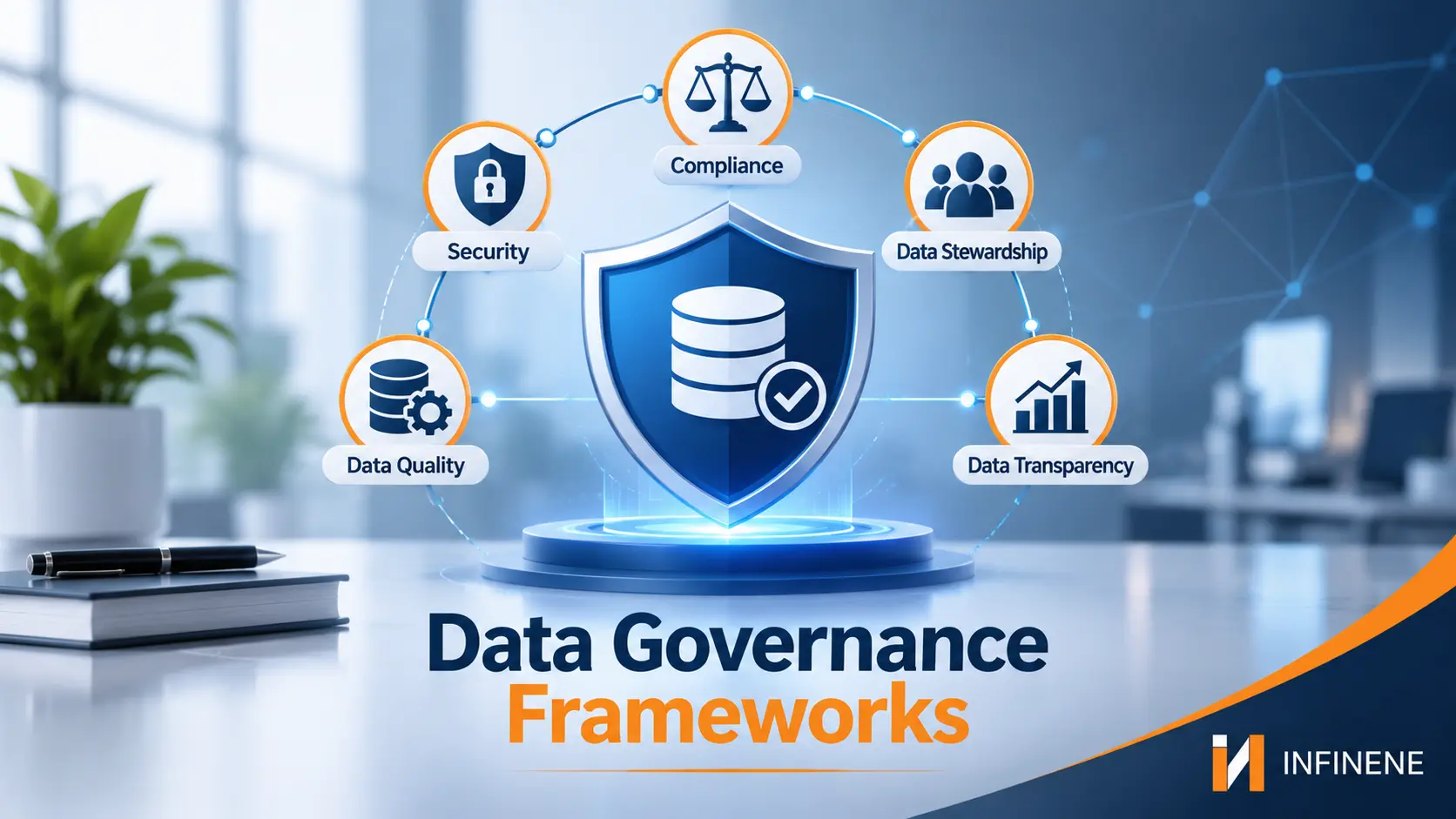
What is data governance if not the system that stops your AI initiatives from becoming expensive science experiments? Consider your AI pilot just failed its second audit. The data governance models work fine in testing, but production data tells a different story. There are conflicting customer records, unclear ownership, and no audit trail for the training data. The data science team blames infrastructure. IT blames unclear requirements. Meanwhile, the budget for this "innovation initiative" keeps growing with nothing to show for it.
This scenario plays out repeatedly. Gartner predicts that 60% of AI projects will be abandoned through 2026 due to inadequate AI-ready data. That's not a technology failure. It's a governance failure. Organizations that treat data governance as a strategic operating layer rather than a compliance checkbox see a 40% higher return on their analytics investment. Here's what actually works: the governance models that fit different organizational structures, the data governance frameworks worth adopting, and the practices that separate programs delivering results from those collecting dust.
Data governance is the system of decision rights, accountabilities, data governance policies, and processes that determines how data is collected, stored, used, protected, and disposed of across an organization. It's not a tool you buy or a project you complete. It's an ongoing organizational capability spanning people, processes, and technology.
The distinction that matters most is between governance and management. Governance sets the rules, definitions, permissions, ownership, and usage policies. Data management executes them through infrastructure and daily operations. Conflate the two, and you get dashboards that look governed but return conflicting answers the moment someone asks a different question.
A useful data governance framework transforms good intentions into decisions, roles, and controls that operate every day. It defines who owns the data, who may use it, which rules apply, and how compliance is proven.
Governance models describe where decision rights sit. Most organizations default to one of three shapes or a hybrid.
A single team owns all governance decisions and develops the data governance policies everyone else follows. This is common in highly regulated industries like healthcare, where small deviations from policy can create major security or compliance exposure. The trade-off is speed. Centralized governance moves slowly, and business units often experience it as a bottleneck.
Each business unit governs its own data. If a department generates or interacts with data, it's responsible for the rules. The upside is agility and local ownership. The downside is fragmentation. Without deliberate cross-team documentation, decentralized governance produces data silos and inconsistent definitions that undermine enterprise trust.
Federated governance centralizes policy while decentralizing management. A core team sets broad standards, non-negotiable controls, and shared tools. Individual business units apply those standards to their own domains. This is the model most large enterprises are converging on, especially as AI pushes governance beyond IT and into the C-suite. Gartner predicts that by 2028, about half of organizations will adopt zero-trust data governance and appoint a dedicated AI governance leader to oversee policies and risk management. The federated model isn't a compromise. It's a recognition that governance fails when it's either too far from the work or too fragmented to enforce anything.
Frameworks are reference data governance models describing what good governance looks like. They're not plug-and-play solutions. Each was built to solve a different problem, and choosing the wrong one doesn't create immediate failure. It creates slow drift away from what the business actually needs.
The most comprehensive data governance framework, covering the entire discipline of data management. It's the default starting point for healthcare and organizations needing a broad, discipline-wide reference model. DAMA-DMBOK is heavy. Most organizations use it as a dictionary rather than a step-by-step data governance implementation guide.
Built for financial services. DCAM focuses on capability assessment and maturity, making it a strong fit for organizations that need to demonstrate governance rigor to regulators and auditors.
An IT governance framework that extends into data governance. Useful for organizations wanting to connect data controls to broader IT risk and compliance structures.
The Data Governance Institute framework organizes governance around decision rights, accountabilities, policies, controls, and a Data Governance Office. It's lighter than DAMA-DMBOK and often used by universities and organizations needing a practical, decision-oriented structure.
The NIST Privacy Framework pairs naturally with DAMA-DMBOK in healthcare and any environment where privacy risk is a primary concern. The NIST AI Risk Management Framework (AI RMF) and ISO/IEC 42001 add the layer classic frameworks were never designed for: governance for models that act on data. No single data governance framework is complete. Strong programs combine a core framework with an operating-model edge and an AI governance layer.
Policies are the enforceable rules inside a program. A policy isn't the same as a framework. The framework describes what good looks like. The policy is a single rule. While a data retention policy is a classification policy that someone can actually apply.
The failure mode is familiar. Data governance policies exist in a folder, but the controls that would enforce them sit somewhere else. Governance becomes a documentation exercise while analysts and AI agents continue returning conflicting answers.
The fix is treating policies as part of an operating system, not a library. Connect policies to ownership, quality standards, lineage, and technical controls so the rule travels with the data. Data quality is the clearest test case: governance defines common quality standards, how issues are identified and corrected, and who maintains reliable data across systems. But if those standards aren't embedded in the pipeline, they're just aspirations.
Organizations getting results aren't the ones with the thickest policy manuals. They're the ones connecting governance to specific business decisions, risks, or reporting problems so the program has a clear purpose. So the data governance best practices have shifted from control-first to value-first.
The fastest way to stall a governance program is trying to govern everything at once. Start with one domain and one measurable business problem. Tools come after people and process. A working governance motion in a single high-value domain builds credibility and creates a template for expansion.
Governance existing only for compliance will always be treated as overhead. Map priorities to strategic outcomes. It includes AI readiness, analytics trust, regulatory exposure, operational efficiency. So the program demonstrates measurable value beyond a clean audit.
Leadership backing signals that data ethics, quality, and accountability matter at every level. Without it, governance initiatives struggle for funding, authority, and cross-functional buy-in. But sponsorship alone isn't enough. Gartner recommends diversified and dynamic stewardship: governance roles should be distributed across the business with clear accountabilities at the domain level, not concentrated in a single team.
Traditional data governance frameworks were built for structured data and relatively stable systems. AI operates differently: continuous ingestion, dynamic pipelines, unstructured data, and model inputs and outputs creating new risk layers. Adding an AI governance layer before AI touches governed data is now a baseline requirement, not an advanced maturity step.
The only metric that matters is whether governance changes behavior. Measure whether people use and trust governed data, then refine definitions, controls, and training from what you learn. A policy that exists but isn't followed is worse than no policy. It creates false assurance.
Implementation doesn't require radical organizational surgery. It requires sequencing. Successful organizations treat data governance implementation as a phased operating-model build, not a technology deployment.
Phase one: Assessment. Document existing governance processes, assess maturity, and identify gaps that matter most.
Phase two: Sponsorship and structure. Secure executive backing, form a governance council, and define decision rights for the first domain.
Phase three: Policy and control design. Define data governance policies for that domain and connect them to enforceable technical controls.
Phase four: Measurement. Pick smart metrics and track whether governed data is actually being used and trusted.
A 30/60/90-day playbook works better than a three-year transformation roadmap. It forces the program to show value early and creates a feedback loop between policy design and operational reality.
Frameworks aren't a silver bullet. Data governance models aren't a permanent organizational chart. Data governance policies aren't a compliance artifact. Organizations that get governance right treat all three as part of a single operating system: the framework describes the target, the model defines who decides, the policies set the rules, and the data governance implementation makes the rules real.
Start with one domain. Connect governance to a business outcome. Add the AI layer before models touch governed data. Measure trust, not documentation. That's what separates a governance program from governance theater.
Software Flaws Are the Leading Cause of Data Breaches Now - Verizon Report