


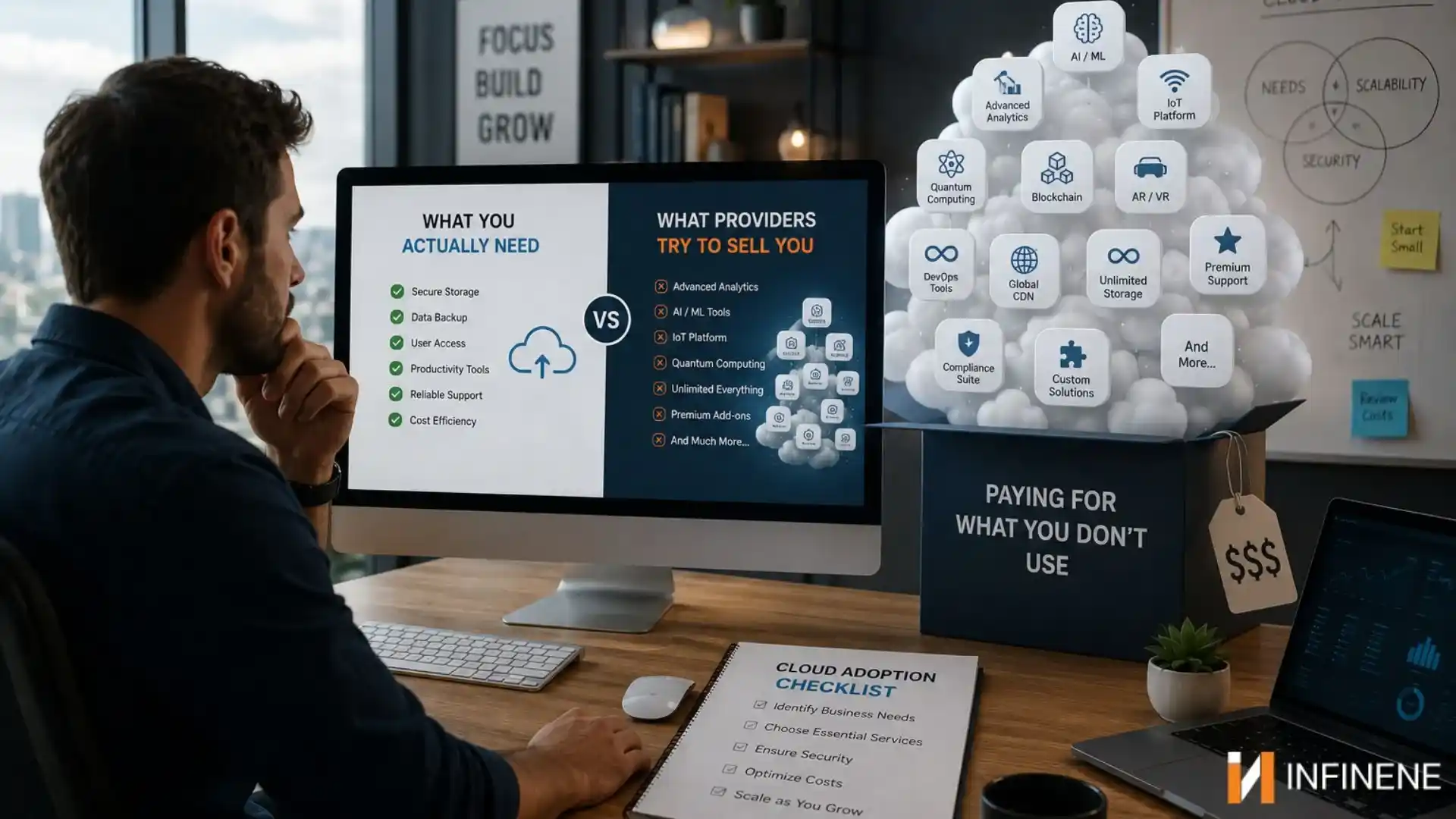
These days, the average small business tends to lean on a mix of cloud-based tools to handle day to day operations, talk with customers, and keep records. But a lot of business owners are asking basically the same thing:
“Are we paying for stuff we actually need?”
And yes, it is a fair concern. Cloud providers have gotten really good at bundling more advanced features into service packages that look super appealing. The catch is, the solutions that were built for big companies are often being sold to businesses with ten employees or thin IT bandwidth.
So, in the end, lots of organizations end up paying extra for cloud services they barely use while still underinvesting in the resources that actually do the work. The best cloud plan isn’t about having the most options packed in a bundle. It’s about choosing the right ones. Knowing essential cloud services versus unnecessary add-ons can guide small businesses toward better tech decisions.
Cloud computing changed how organizations deal with their tech setup. Instead of paying out for expensive hardware and then babysitting inner servers all day, companies can tap into software, storage, and computing power through the internet. And because of those perks, cloud adoption often seems enticing, especially for small and medium sized businesses who want to stay relevant without dumping a lot of upfront cash. You end up with a handful of advantages too, for instance:
Reduced Upfront Technology Costs: Businesses can skip big purchases for servers, network gear, and other physical hardware. Instead, they can just pay for the cloud resources that they actually use.
Remote Access for Employees: With cloud-based tools, employees can securely access files and company systems from just about everywhere there’s an internet connection.
Improved Collaboration: Teams can access and work on shared documents. They can coordinate being present in the same place.
Better Data Backup and Recovery: Lots of cloud services offer automated backup features that help keep the critical business info safe. They also let you bounce back pretty quickly if something unexpected occurs.
Automatic Maintenance: Cloud providers usually handle updates and maintenance themselves. So internal teams don’t have to carry all that weight. Plus, the systems tend to stay current this way.
Scalability as the Business Grows: With cloud resources, you can scale up or dial back pretty fast depending on what the business needs right now. So, organizations can adapt without major infrastructure investments every time.
Even with the huge amount of cloud products out there, most small businesses really only need a handful of core cloud services to keep things running smoothly. a lot of organizations end up seeing better results when they concentrate on what matters most, not when they pour money into every fresh feature or platform that shows up in the market. The real trick is figuring out which technologies actually help with everyday operations. For most small businesses, the following cloud services tend to offer the most solid base for lasting success.
Every business generates really valuable data from different sources daily. Without a solid storage solution, it can turn into a problem fast. Managing and safeguarding everything becomes messy.
With cloud storage, employees are able to access files from anywhere and securely trade documents with clients. They can keep a version trail, so the whole “which copy is the right one” situation doesn’t happen as often. Cloud storage also helps shield critical information from device breakdowns or office disruptions. For many small businesses, dependable cloud storage is basically the backbone of their whole cloud plan, even if they don’t call it that.
Productivity tools are often the very first cloud services companies bring in. They make a quick difference in day-to-day stuff. Whether the team is actually in the office or working from home, these platforms keep everyone aligned and connected. They reduce the back and forth and cut down on little inefficiencies. These setups can end up delivering some of the strongest returns on technology investments.
A lot of business owners think data loss is this thing that happens to other companies, until it also happens to them. Like, a ransomware attack or accidental file deletion can basically freeze operations. And then it becomes a huge problem when critical data can’t be recovered.
A solid cloud backup plan usually means automated backups and fast restoration features. With those pieces in place, an organization can rebound more quickly after unplanned incidents.
While lots of providers spend their time selling shiny new features and whole applications, security should really be the top priority for every small business. Cybercriminals are going after smaller organizations more and more because they sometimes have fewer resources set aside for guarding their systems and data.
Key cloud security components tend to include multi factor authentication and protection for endpoints as well as ongoing threat monitoring. Putting money into cybersecurity doesn’t just keep sensitive business information safe, it also supports customer confidence.
For customer-based businesses, a CRM system can turn into one of the most useful tools. Rather than juggling customer data across spreadsheets and disconnected systems, a CRM pretty much gathers everything in one spot.
Cloud hosted CRM platforms make sales tasks feel smoother. That said, most small businesses often get more value from a straightforward and scalable CRM setup than from a heavy enterprise platform full of extra functions.
Cloud vendors naturally want to push for more revenue. So, a lot of businesses end up getting marketed with product and service bundles they may not even need. And while some of the more advanced solutions do provide actual value, plenty of them are really tuned for big enterprises. Because of that, small businesses often find themselves paying for features they rarely use which adds extra complexity to their tech landscape. If organizations can recognize these usual upsells, it becomes easier to make better cloud investment choices. Here are a few common examples.
A lot of cloud providers advertise enterprise grade platforms, packed with advanced capabilities that are made for organizations that operate at a massive scale. Even if these solutions can be pretty powerful, they’re often put together with companies in mind that have dedicated IT departments and way over a few thousand employees.
Stuff like advanced workflow automation and multi region infrastructure can sound really great on paper. But in reality, most small businesses don’t end up using it all the way. And a lot of the time paying for features you never really tap just adds extra spend without creating any real business value.
Storage upgrades are one of the most common upsells in the cloud world, mostly because they’re pretty easy to sell. A lot of providers encourage companies to buy quite a bit more storage than they need right now.
Sure, planning for growth matters. But paying for a big stack of unused storage can slowly and quietly raise monthly expenses over time. A better idea is to pick a scalable solution. So capacity can grow when business needs really start to shift. This means resources stay aligned with real demand, not just guesswork.
Security shouldn’t be sidelined, but throwing in more security tools doesn’t automatically mean you get better protection. In fact, many businesses buy several products that kind of do the same thing without realizing it which leads to extra expenses and extra admin headaches.
For example, organizations might pay for multiple antivirus products that overlap or run monitoring platforms that cover the same ground. Instead of stacking tools with no real plan, businesses should work on a more unified security framework, one that keeps coverage broad but stays relatively simple to handle.
Artificial intelligence has become one of the biggest selling points in modern cloud services, and lots of providers now throw in AI powered abilities inside their product packages. In practice, these features can go from automated content generation and predictive analytics to chat-like virtual assistants as well as more advanced business intelligence toolsets.
Now, some AI features can genuinely bring value. But others feel more like marketing frosting than a business must. Before a small business pays extra for AI enabled services, it should really figure out if the technology solves a particular operational snag or if it only adds yet another option that likely won’t get touched very often.
Managed services are often pretty great, especially when a business doesn’t have enough in house IT knowhow. When you hand off certain technology duties to a third party, things can run more smoothly, and the internal teams don’t end up carrying every single burden all at once.
Still, not every provider is kind about it. Some will wrap a broad assortment of managed services into those “premium” packages, and it usually ends up costing more than a small business actually needs. Before you sign anything, take a careful look at what tasks truly require outside attention, what workflows can be automated, and what responsibilities you can actually manage on your own. The whole idea is to land a sensible compromise where you get dependable backing without losing cost efficiency.
Too many organizations end up buying solutions because the sales talk looks polished or because a technology is trending. Later on, they find out the cloud setup doesn’t quite map to their real day to day needs.
Instead of beginning with one cloud product straight away, try figuring out what results you want and what hinders the business from getting there in the first place. If a cloud service can’t directly fix a particular issue or isn’t moving you toward a quantifiable goal, then it might not be a smart investment.
Cloud solutions need to be picked based on the actual size and needs of your workforce. Like, a company with five employees usually needs a totally different kind of setup than an organization with 200 users who are spread across several locations. Picking the right sized solution means you pay for what you require right now. But still keep some slack for future growth.
Not every business deal with the exact same regulatory workload. Certain sectors tend to come with tougher rules around data protection and personal privacy.
When it’s time to pick a cloud provider, companies should first figure out if they’re required to meet particular compliance standards, and also check that their cloud setup can actually support those duties. Making cloud decisions that line up with regulatory expectations can cut down on exposure and build more customer confidence.
One of the biggest perks of cloud computing is that you can flex resources when business needs do the whole change. And sure, it might not really feel worth it to buy too much capacity all at once, but you still really should pick services that can grow with your organization, not against it. This method helps you dodge pricey overbuying early on and also avoids constant technology migrations each time the business shifts a little.
When you’re sifting through cloud services, businesses should look past the monthly subscription amount. The real price of a given solution isn’t just that simple number, it’s a whole mix of things that can quietly mess with long-term value.
For example, there are implementation and setup costs plus employee training requirements, and the effort needed for integration with your existing systems. Then you still have the ongoing management expenses and sometimes support fees too. In some scenarios, a cheaper plan can turn into a pricier headache later.
One of the biggest trouble spots with cloud services is that overspending can slide by without anyone really noticing, like it just quietly sneaks in. Businesses might keep adding subscriptions and extra options over time without taking a breath to see whether it’s actually doing something useful. If you’re not fully sure you’re getting the most out of your cloud investments, keep an eye out for these common “uh oh” signals:
Employees rarely use the features. If teams are using only a small slice of what’s included in your cloud subscriptions, you could be paying for capabilities that feel fancy but don’t really help in practice.
Software adoption rates stay low. When people keep depending on older routines or other workarounds, it may suggest the cloud solution is more complicated than expected or maybe simply not required.
Technology costs keep climbing, but there’s no measurable payoff. If the numbers go up and the benefits don’t, it might be time to revisit how you’re spending.
Multiple tools end up doing the same job. When you’ve got several apps covering the same things, it can create unnecessary expenses and an extra operational mess.
The provider talks more about upgrades than business results. If every discussion loops back to new features or premium packages and not about solving the actual business problems, you might be running into upselling that doesn’t really belong.
The best cloud plans are usually the simplest ones. Instead of throwing money at every cloud service that shows up in an ad, small businesses should aim for a sturdy basis that actually works. For most companies, that basis tends to include a few key pieces like
Secure Cloud Storage - Giving you one central and protected place for business files and other important data, while still letting staff reach it from pretty much anywhere.
Productivity and Collaboration Tools - These help people talk and steer projects whether they are in the office or working from home.
Essential Cybersecurity Protections - Keeping business systems and sensitive data safer with things like threat monitoring and access controls.
Then you add other services only if they match a specific goal or resolve a clear problem. In other words, don’t chase every shiny new technology fad, just pick cloud options that boost efficiency and support growth that can last without drama.
Choosing the right cloud services should not feel like a total blur. At Infinene, we help small businesses cut through the noise and build cloud environments that match what they actually want, not some random upsells that don’t matter. No two businesses line up the same way, so we make time to understand your objectives before we suggest solutions. The aim is simple, get the most value out of your cloud investments while sidestepping unneeded complexity and extra costs.
So, if you’re ready to align your cloud strategy to your business goals without really stretching your budget, reach out to Infinene today. Grab a Free cloud consultation and let InfineneTech guide you on building a cloud strategy that supports your business right now and grows with your plans tomorrow.