


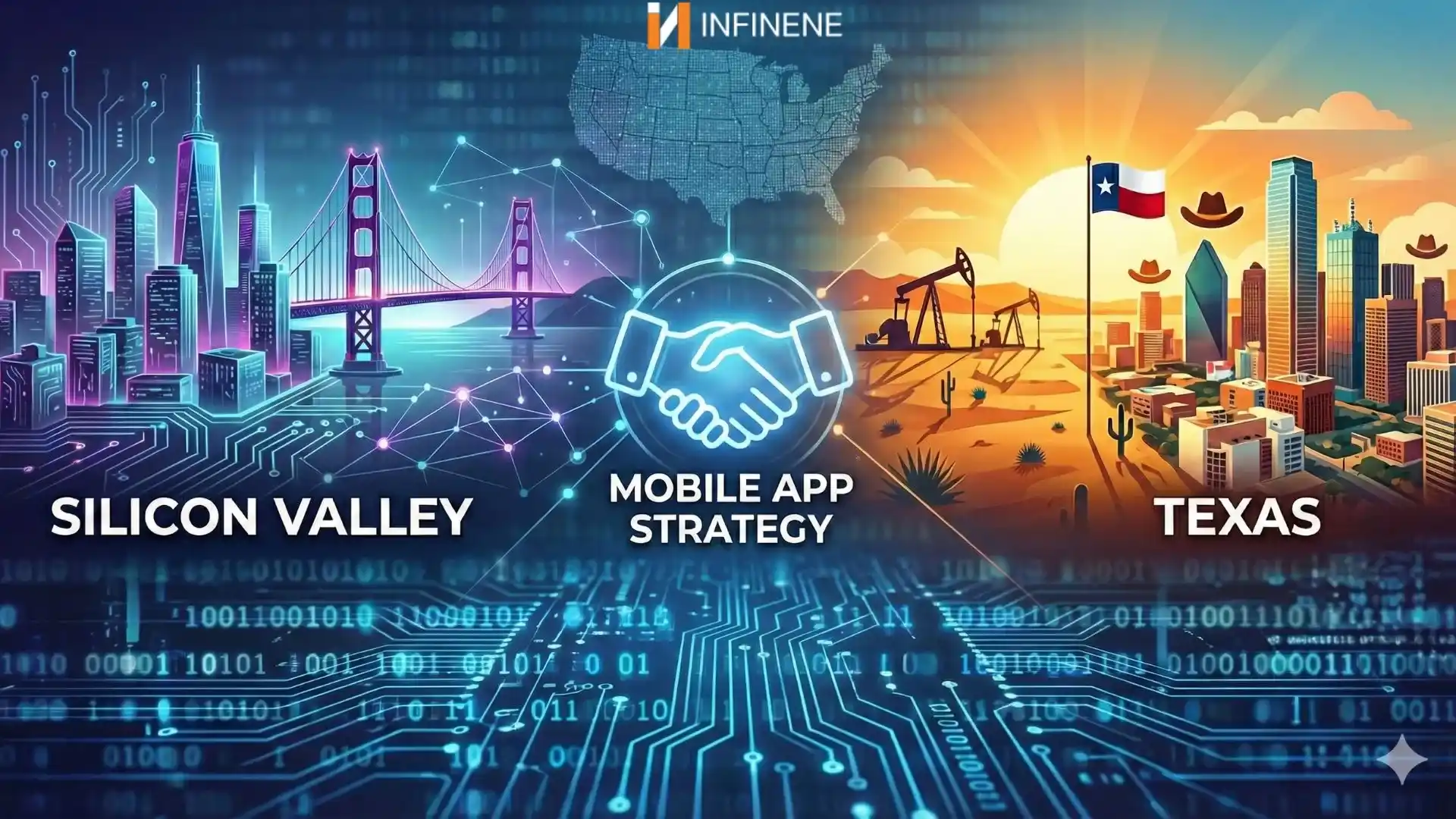
For years, the tech industry has obsessed over a false binary: are you staying in Silicon Valley, or are you joining the "exodus" to Texas? If you read the headlines, it sounds like a divorce. But if you look at the balance sheets of the most resilient unicorns, you’ll see it’s actually a marriage.
We are entering the era of the Coast-to-Coast Advantage. This isn't about moving your headquarters to save on taxes; it's about strategic bifurcation. It’s about keeping your "Zero to One" innovation engine running hot in the Bay Area while building your "One to One Million" scale engine in the efficient, robust terrain of Texas.
For CTOs and founders, this shift changes how you build software. It changes how you vet a mobile app development company and how you structure your product roadmap. Here are why the most dominant products of the next decade will be born in San Francisco but raised in Texas.
Designing a mobile app growth strategy that bridges these two hubs is the ultimate competitive advantage. A smart mobile app business strategy recognizes that the "move fast and break things" energy of a Silicon Valley app strategy is perfect for your first 10,000 users, but you need the disciplined Texas mobile app strategy to support your first 10 million. By splitting your focus, you keep your creative visionaries focused on the "wow" factor while your scale engineers build a bulletproof foundation. This geographic "checks and balances" system is how the next generation of unicorns will dominate the market.
There is a reason why Mobile App Development in San Francisco retains a mythic status. Despite the rise of distributed teams, the Bay Area remains the global capital of user psychology. It is the only place on earth where "friction" is treated as a mortal enemy.
When you are in the MVP phase—fighting for that initial traction—you aren’t just building code; you are building a behavior. This is where the specific expertise of an iOS app development agency becomes non-negotiable. The talent pool here understands the subtle, unwritten rules of the Apple ecosystem: the fluid physics of a swipe, the haptic feedback of a success state, and the visual hierarchy that separates a "utility" from a "brand."
If you are looking for a custom mobile app development company to define your product’s soul, you look to the coast. This is where you find the visionaries who are willing to take high-stakes risks on features that haven't been standardized yet. The R&D burned here is expensive, yes, but it buys you the "wow" factor that commoditized code cannot replicate.
Once you have product-market fit, the game changes. You stop worrying about "will they like it?" and start worrying about "will it break?"
This is where the Lone Star State takes the baton. Mobile App Development in Texas is driven by a different, equally valuable DNA: scalability and logistical precision. While SF focuses on the happy path, Texas engineering culture—steeped in enterprise software and telecom—obsesses over the edge cases.
Consider the complexity of the Android ecosystem. Unlike the walled garden of Apple, Android requires your product to perform flawlessly across thousands of screen sizes and OS versions. An android app development company operating out of Austin or Dallas often brings a rigorous, systems-level discipline to this fragmentation. They don't just ship features; they stress-test stability.
Furthermore, the unit economics of Texas allow for aggressive team expansion. When you need to ramp up distinct engineering pods for maintenance or backend integration, you can hire android app developer talent in Texas that rivals the coast in skill but offers significantly better retention rates and operational efficiency.
Read more: How to Choose the Best Mobile App Development Company in Palo Alto - Your 2026 Guide
The smartest companies don't just split their offices; they merge their technical philosophies. This often manifests in cross platform mobile app development strategies that leverage the best of both worlds.
By using frameworks like React Native or Flutter, a top-rated mobile app development company can deliver the premium UI fidelity demanded by San Francisco design standards while utilizing the efficient deployment pipelines championed by Texas engineers.
If you are vetting vendors, be wary of generalists. The best mobile app development company for a hybrid strategy is one that can articulate the difference between these two "modes" of development.
Ask about their Design Phase: Do they have a presence or deep experience with Mobile App Development in Bay Area trends? Do they understand behavioral design?
Ask about their Scale Phase: Do they have the infrastructure to handle custom mobile app development at an enterprise level? Can they manage the heavy lifting of backend integration?
Check their Platform Specifics: A partner offering generic solutions is a red flag. They should offer specialized iOS app development services that feel distinct from their Android offerings, even if the underlying logic is shared.
The narrative of "SF vs. Texas" is outdated. The future belongs to the companies that can synthesize the two.
You need the spark of the Bay Area to ignite the fire, and you need the fuel of Texas to keep it burning. Whether you are sourcing mobile app development services or building an internal team, look for the intersection. That is where the Coast-to-Coast Advantage lives, and that is where the next generation of market leaders will be built.
Ready to build a product that combines Silicon Valley vision with Texas reliability? Contact us today for mobile app development services designed to scale with your ambition.