



Blog Details
HomeBlog Details
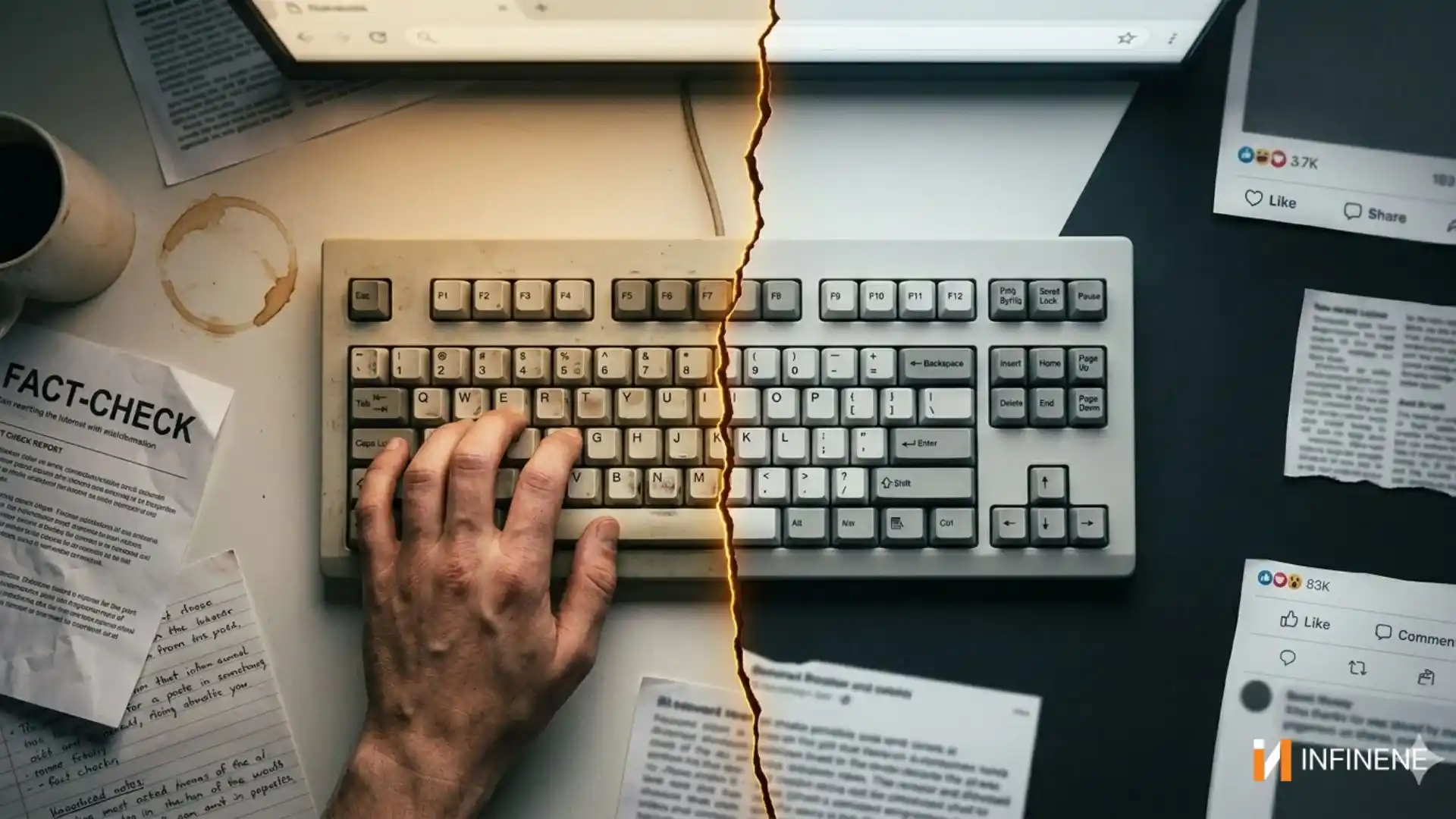
What's Real Anymore — AI Is Rewriting the Internet Faster Than Humans Can Verify It
“From fabricated news clips to ghost-written search results, AI generated misinformation has become the defining information crisis of our time. Here's what's actually happening — and what you can do about it.”
Somewhere between the scroll and the share, something broke. It didn't happen overnight — but if you've spent time online in the past two years, you've felt it. A news story that seems slightly off. A viral quote from a politician that their office never issued. A photograph of a disaster zone that local witnesses say never looked that way. The internet has always had a garbage problem. Now the garbage has a turbocharger.
AI generated misinformation is not a future threat. It is the present-tense reality of how information travels in 2026. Generative AI systems can now produce thousands of believable news articles, social media posts, images, and video clips per hour — at a cost close to zero. The humans tasked with verifying that content — journalists, moderators, researchers, and ordinary readers — operate on human timescales. The math is not encouraging.
This isn't a story about robots taking over. It's a story about infrastructure. About how AI is changing the internet at its foundation, and why that matters for anyone who reads, shares, or trusts anything online.
The Scale Nobody Wanted to Admit
For years, the concern about AI and misinformation was theoretical. Researchers warned about it. Policy papers flagged it. Tech executives promised their systems had safeguards. Then 2025 happened.
AI content farms began operating at industrial scale — networks of automated systems generating articles, product reviews, local news summaries, and political commentary without any human writing a single original sentence. These aren't clumsy, obviously robotic outputs. Modern large language models write with enough fluency that distinguishing AI-written text from human-written text, without specialized tools, is genuinely difficult even for trained readers.
The problem accelerated further on social media. AI spreading misinformation on social media evolved from a novelty concern into a documented pattern. During the 2025 municipal election cycle in several major US cities, researchers at Stanford's Internet Observatory tracked coordinated networks of AI-generated accounts pushing fabricated candidate quotes — accounts that collectively amassed millions of engagements before platforms could act.
And then came the images. The videos. If AI fake news in text form was a slow-boiling crisis, deepfakes made it acute. In early 2026, AI-generated footage purporting to show military strikes during the Iran conflict racked up over a billion views globally before major platforms issued corrections. Corrections that, by that point, most people never saw.
"The correction never catches the lie. In the attention economy, speed is the only currency that matters."
How the Internet Got Rewritten
To understand why AI is changing the internet so rapidly, you have to understand the economics of online content. For most of the internet's history, producing content at scale required humans. Writers, photographers, videographers, editors. That created a natural bottleneck — a cost floor below which misinformation couldn't spread efficiently unless it was truly viral.
Generative AI dissolved that floor. A single bad actor — or a well-funded influence operation — can now generate and publish thousands of unique, plausibly-written articles per day across dozens of fake domains, all targeting specific search queries, all pointing to the same political conclusion or commercial outcome. This is what AI content farms on the internet actually look like in practice. Not one shady website. A constellation of them, cross-linking, reinforcing each other's search rankings, flooding the information space with synthetic consensus.
The result is something researchers call "epistemic pollution" — an environment where the sheer volume of AI-generated content degrades the signal quality of genuine information. When everything looks credible, nothing is.
Search Engines Are Not Immune
Which brings us to a question a growing number of Americans are quietly asking: can you trust AI search results?
The honest answer is: it depends, and less than you probably assume. AI-powered search systems — including features now built into Google, Bing, and several alternative search engines — synthesize answers from indexed web content. When that indexed content includes AI-generated articles from content farms, the AI search system can cite, paraphrase, or amplify fabricated information with the same confidence it applies to verified sources.
This is not a bug that engineers overlooked. It is a structural challenge with no clean fix. AI search results are only as reliable as the content they draw from. And right now, the web they're drawing from is increasingly synthetic.
Can you trust AI search results for breaking news, medical information, or political claims? Treat them as a starting point, not a conclusion. Cross-reference. Click through to primary sources. Notice whether the AI is citing specific outlets and whether those outlets exist and published what the AI claims.
Deepfakes: When Seeing Is No Longer Believing
Text-based AI generated misinformation is serious. Visual misinformation is where the psychological impact becomes truly destabilizing.
Deepfake news examples from the past eighteen months include fabricated footage of world leaders making statements they never made, AI-generated images of mass casualty events that never occurred, and synthetic video of corporate executives announcing fake acquisitions — the last category causing measurable disruption in financial markets before corrections issued.
The technology behind AI generated fake images in news contexts has improved dramatically. Early deepfakes were detectable by their blurry edges, strange hand geometry, and uncanny facial movements. Today's systems, especially those generating still images, produce outputs that can fool not just casual viewers but trained journalists viewing content under deadline pressure.
Learning how to spot a deepfake video still matters — but the tells are getting harder to find. Look for inconsistent lighting between a person's face and their background. Watch for unnatural blinking or micro-expressions that don't track correctly with spoken words. Check whether the video exists anywhere beyond the platform where you encountered it. A legitimate piece of footage from a real event almost always has a trail — other angles, other witnesses, original broadcast records.
For still images, free deepfake detection tools online include platforms like Hive Moderation's public checker and AI or Not, both of which use classifier models to assess the probability that an image is synthetically generated. These tools aren't perfect — they miss some fakes and flag some real photos — but they add a meaningful layer of friction to viral spread.
AI Spreading Misinformation on Social Media: The Amplification Problem
Generating false content is only half the equation. The other half is distribution, and social media platforms are extraordinarily efficient at it.
AI spreading misinformation on social media operates through several overlapping mechanisms. Inauthentic accounts — some fully automated, some human-operated but using AI assistance — generate high volumes of engagement signals (likes, shares, comments) on targeted content. Platform recommendation algorithms, optimized for engagement rather than accuracy, interpret those signals as indicators of quality and push the content to wider audiences. By the time human moderators or automated safety systems flag the content, it may have reached millions of people.
The speed asymmetry is brutal. A fabricated story about a public health emergency can circulate for 36 to 48 hours on major platforms before a definitive fact-check publishes. That fact-check, even if widely distributed, reaches a fraction of the audience that saw the original claim. This is not a new dynamic — it predates AI. But generative AI has collapsed the cost of producing the initial fabrications to near zero, dramatically increasing the volume of false content entering the system.
How to verify news online — a working checklist
Search the claim in quotation marks — see what sources actually published it
Check the outlet's About page and publication history
Run the image through Google Reverse Image Search or TinEye
Use fact-checking tools: Snopes, PolitiFact, FactCheck.org, AP Fact Check
Look for primary sources — official statements, original filings, direct recordings
Ask: who benefits if this story is believed? Motivation matters.
How to Spot AI Generated Content: A Practical Guide
Knowing how to spot AI generated content has become a genuinely useful life skill in 2026 — the informational equivalent of learning to recognize phishing emails in the 2010s.
The clearest tells in written content involve what researchers call "confident vagueness." AI-generated articles frequently make sweeping claims without specific sourcing. They'll reference "experts say" or "studies show" without naming the experts or the studies. They produce fluent sentences that, on closer inspection, don't actually commit to a verifiable fact. They also tend toward a particular cadence — well-structured, transitionally smooth, remarkably free of the idiosyncratic voice that characterizes human writers with real opinions and real experiences.
On how to tell if something is AI written, look for these patterns: unusually even paragraph length, an absence of genuine humor or irony, factual claims that are slightly off (a wrong date, a misattributed quote, a statistic that doesn't match its supposed source), and a tendency to present multiple sides of an issue in a mechanically balanced way that reads as fairness but contains no actual perspective.
Several fact checking AI content tools now exist specifically to assist readers. GPTZero, Originality.ai, and Copyleaks all offer varying degrees of AI content detection. These tools are useful but not definitive — they produce false positives and false negatives, and they struggle with content that mixes AI-generated and human-edited text. Use them as one signal among several, not as a final verdict.
The most reliable detector remains an informed, skeptical human mind. Ask yourself: Does this article have a genuine perspective, or does it read like a summary of other summaries? Does the byline author have a verifiable history of writing on this topic? Does the publication have editorial standards you can actually look up? These questions slow down the reading experience. They're supposed to. Slowing down is the point.
Generative AI and Disinformation: A Structural Problem
It would be convenient if generative AI and disinformation were a problem caused by a small number of obviously bad actors — foreign influence operations, criminal enterprises, fringe political movements. Some of it is. But the more uncomfortable reality is that the economic incentives of the attention economy make AI-generated content attractive to entirely mainstream commercial actors as well.
Why is the internet full of AI content? Because attention generates revenue, content generates attention, and AI makes content cheaper than any alternative. A marketing team that once employed five writers can now produce ten times the content with two. A media startup that can't afford reporters can publish daily using AI tools. A product review site that used to pay freelancers can now generate unlimited synthetic reviews at effectively zero cost.
None of this requires malicious intent. The result — an internet increasingly dominated by synthetic, engagement-optimized, accuracy-optional content — is the aggregate output of thousands of individually rational economic decisions.
AI rewriting the internet is, in this sense, less a conspiracy than a tragedy of the commons. The shared resource being depleted is not clean air or clean water. It's epistemic trust — the collective confidence that the information environment we navigate is anchored to something real.
"The most dangerous misinformation in 2026 isn't the outright lie. It's the almost-true, algorithmically optimized, synthetically fluent content that nobody bothered to verify."
What the Research Actually Says
The academic literature on AI generated misinformation is evolving quickly, and not all of it is alarming. Some researchers argue that AI-generated content, while voluminous, is not necessarily more deceptive than human-generated misinformation — and that the real problem is the underlying information ecosystem, not the generation technology specifically.
That's a fair point with limits. The volume question matters enormously for trust and navigation, even if individual AI-generated items are no more sophisticated than pre-AI fabrications. An information environment flooded with synthetic content creates cognitive overload that benefits bad actors regardless of any single item's quality.
What the research does agree on: media literacy interventions work. Studies consistently show that brief "inoculation" training — teaching people to recognize manipulation techniques before they encounter them — meaningfully reduces susceptibility to AI generated misinformation. The challenge is scale. Getting that training to the 270 million American adults who use the internet daily is not a solved problem.
What Verification Looks Like Now
Professional fact-checkers have adapted. The Associated Press, Reuters, and major broadcast networks have developed internal AI detection workflows — not to replace editorial judgment, but to flag content for additional scrutiny. Several newsrooms now use AI tools specifically to identify AI-generated content in the material they're asked to verify, a recursive quality worth pausing on.
For individual readers, the verification toolkit has expanded. Reverse image searches have become a first-line reflex for journalists. Browser extensions that check a domain's registration date (very new domains publishing very confident political content are a red flag) have gained adoption. Cross-referencing claims against archived versions of websites — using the Internet Archive's Wayback Machine — has become standard practice for anything that seems engineered to disappear.
The underlying principle is lateral reading — opening multiple tabs, checking what others say about a source rather than evaluating a source in isolation. It's the method professional fact-checkers use. It works. It takes practice and a willingness to slow down that runs against the grain of how most people consume online content.
That friction is not going to disappear. The information environment is not going to clean itself up. The responsibility has, to a larger degree than most of us would choose, landed with individual readers. That's frustrating. It's also just true.
FAQs: AI Generated Misinformation
What is AI generated misinformation and how is it different from regular fake news?
AI generated misinformation is false content produced by AI systems at a scale and speed no human operation can match — thousands of convincing articles, images, or videos per day at near-zero cost. Unlike traditional fake news, the AI doesn't know it's lying. It generates what's statistically probable, which means confident falsehoods delivered in the same authoritative tone as facts.
Can you trust AI search results for news and factual information?
Not without verification. Independent analysis found Google AI Overviews produce errors in 9–15% of responses — with no signal to the reader that this particular answer is wrong. Use AI search to orient yourself, then follow the links to actual primary sources before acting on anything consequential.
How do I spot AI generated content in articles and social posts?
Watch for confident claims with no named sources, suspiciously even paragraph rhythm, and statistics that don't check out when you click through. AI content is fluent but voiceless — no genuine opinion, no individual perspective, just a smooth summary of other summaries. If a distinctive phrase appears verbatim across dozens of unrelated sites, you've found a content farm.
How is AI spreading misinformation on social media and what are platforms doing about it?
AI-generated accounts flood platforms with engagement signals that trick recommendation algorithms into amplifying false content before any moderator can intervene. Platforms have responded with disclosure labels and demonetization policies, but these kick in after content has already spread — not before. The core problem is structural: platforms profit from engagement, and AI spreading misinformation on social media is engineered to be maximally engaging.
How do I spot a deepfake video now that the obvious tells are mostly gone?
Skip the visual inspection first — check for corroboration. Real events have multiple camera angles, wire photos, and broadcast records. If dramatic footage exists only in one format on one platform, that alone is your biggest red flag. When you do look closely, watch for lighting mismatches between the face and background, lip movements that drift off hard consonant sounds, and background objects that warp near frame edges.
Why is the internet suddenly so full of AI content and is it going to get worse?
Producing a thousand articles now costs roughly the same as producing one, so any business relying on content volume adopted AI tools or got outcompeted by those that did. The result is a self-reinforcing loop where AI generates content, search systems cite it as authoritative, and readers encounter it as a verified result — no human editorial decision required anywhere. Yes, it is getting worse: generation technology is improving faster than detection technology, and the economics driving it have not changed.
What are the best free tools to fact check AI content and verify news online?
For text: GPTZero and Copyleaks flag probable AI content for free. For images: Google Reverse Image Search, TinEye, and Hive Moderation's free checker — use at least two. For news: Snopes, AP Fact Check, and Reuters Fact Check cover most viral claims. For source credibility: the Internet Archive's Wayback Machine tells you how long a "news site" has actually existed — the most underrated check of all.