


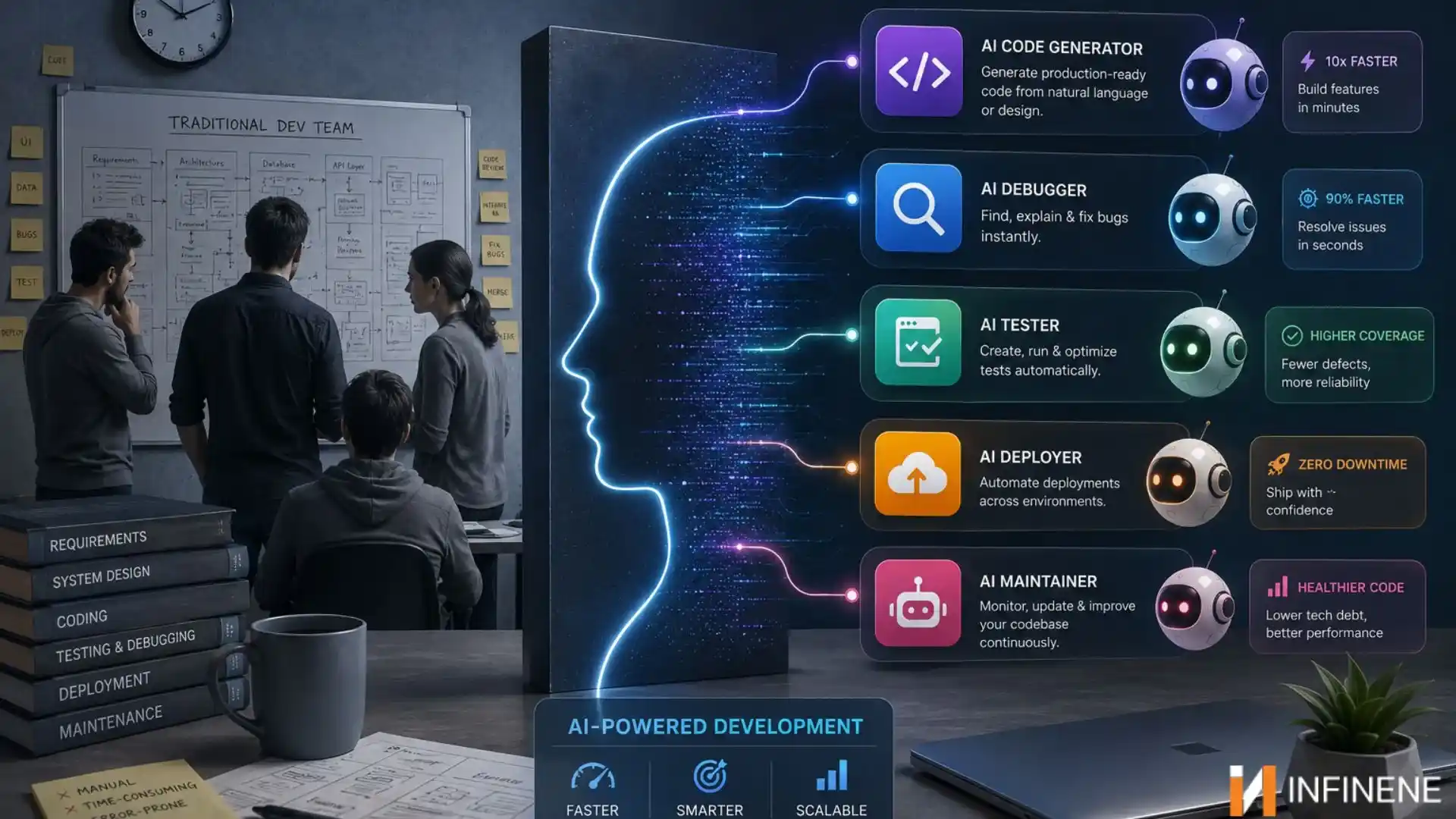
Software companies used to treat scaling like this straightforward idea of hiring more developers, creating more departments, and building bigger engineering teams. But artificial intelligence is slowly and silently breaking this setup apart.
By 2026, some startups are shipping complete applications with only two or three engineers. Things that used to need separate frontend groups, backend specialists, QA testers, and DevOps experts can now be handled by smarter AI coding tools in a way that takes far less time than before. This isn’t just yet another productivity wave. AI software development is turning into an actual business strategy. Companies are relying on intelligent developer productivity tools to automate coding, testing, and even release workflows. Sometimes, with barely any extra hands in the process. The result is faster releases, lower costs, and smaller teams building products at startup speed. At the same time, the debate around no code vs AI development is becoming more intense. While no-code platforms simplified app creation for beginners, modern AI coding systems are going much further by generating scalable, production-ready software from simple instructions. The traditional development team structure is starting to evolve. And in some cases, disappear entirely. Here are five AI coding tools that are changing the future of software engineering in America.
GitHub Copilot has become one of the biggest reasons the software industry is moving so quickly now. Different from older coding assistants that mostly throw out simple autocomplete, Copilot sort of acts like an AI-powered development partner, right there next to the programmer as things go on in real time. It’s built with advanced large language models so it can pick up the context inside a repo, and then help developers write whole code sections in a matter of seconds.
A developer only needs to type a short instruction such as “create a secure login system,” and Copilot starts generating the authentication logic, database queries, API hookups, frontend layouts, and even the testing code. Things that used to eat up hours of manual work can now be done almost immediately. So, AI software development is going at a pace that the usual workflows really can’t keep up with.
The biggest effect shows up in developer productivity. Engineers waste way less time on repetitive boilerplate code and they spend more time on system design, tricky troubleshooting, and product innovation. For startups in the United States, this can become a real advantage, because smaller teams can ship faster without scaling hiring costs to the same degree.
A lot of companies are already reshaping how they run development teams around AI coding tools like Copilot. In some situations, one seasoned engineer using Copilot can manage work that once would have required several junior developers. Software engineers still matter, but the typical structure of dev teams is evolving faster than ever.
Cursor is quickly becoming one of the most talked-about AI coding tools in the American tech industry, because it kind of changes how developers interact with code entirely. Traditional code editors still make engineers manually search through files, inspect functions one by one, and then spend hours tracing bugs across massive projects. Cursor approaches software development kind of sideways, by treating the entire codebase like a conversation, not just a bunch of screens and tabs.
Instead of digging through thousands of lines of code, developers can ask in plain English, “find the reason behind an API failure,” or “refactor this old React component”, or “explain backend architecture,” or even “improve database performance”. The AI gets the bigger structure of the project and then answers with thoughtful suggestions, edits, and solutions that actually work, in real time.
That also leads to a big impact on developer productivity because one of the nastiest productivity sinks in software engineering has always been context switching. People keep jumping between files, documentation, testing environments, and debugging tools, it’s a lot. Cursor reduces a good amount of that friction by analyzing multiple pieces of an application at the same time, then coordinating improvements across the whole system.
So, the end result is a major shift in AI software development workflows. Smaller engineering teams can now take on responsibilities that used to need specialized developers. For startups, that means faster product development cycles, lower operational overhead, and a leaner route to scaling software businesses.
Replit Ghostwriter is kind of changing the whole idea of who can build software and how fast it can actually happen. With traditional development setups, you know… there’s always this complex stuff, infrastructure management, a bunch of external tools, and it takes forever to get everything working right. Ghostwriter is built around cloud-based AI software development, so it feels more like the process starts right away. Everything happens inside the browser, so the building part becomes faster, simpler, and honestly, way more reachable for more people. It has become really popular, mostly because it removes a lot of those technical barriers that used to slow down software creation.
Instead of spending days configuring environments or digging through documentation, users can lean on AI coding tools to generate code and speed up development workflows in real time. It also gets pulled into the bigger no code vs AI development debate. AI-assisted development seems to take a different route. Rather than keeping users locked into fixed templates, tools like Ghostwriter dynamically generate code that’s customizable, and developers can then revise and scale it as the product grows.
This shift is especially strong for solo entrepreneurs. Now, a single founder using advanced developer productivity tools can build and launch applications much more quickly. That kind of efficiency is one reason investors are paying more attention to smaller AI-driven startup teams that can move at an almost unreasonable speed.
Cognition Labs pretty much shocked the technology world when it rolled out Devin AI, a system that a lot of experts describe as one of the first really autonomous AI software development agents. And unlike the usual AI coding tools that only help developers with suggestions, or autocomplete sort of stuff, Devin is built to act more like an independent software engineer that can handle whole development workflows on its own. What makes Devin disruptive is the way it moves past basic code generation. The system can plan engineering tasks, write code, debug applications, run tests, deploy software, and yes, even repair issues after something fails. Rather than waiting around for constant human directions, Devin can look at the objectives, make decisions, and then carry out multi-step development processes with limited oversight.
This is a big turning point for AI software development, because normal engineering teams have always relied on multiple departments working in tandem. Product managers define project aims, developers implement features, QA teams test things, and DevOps people manage releases. Devin kind of bundles many of those responsibilities into one automated workflow, so the need for big dev structures drops a lot.
The effect on developer productivity is bigger than “just” producing code quicker. AI coding tools are starting to automate technical decision-making itself. As these systems keep improving, human developers might end up spending less time on repetitive implementation tasks and more time on strategy and product innovation.
This is why many technology leaders think autonomous AI agents like Devin will end up fundamentally reshaping software engineering jobs, and also how traditional dev teams will be organized over the next decade.
Amazon kinda slid into the rapidly growing AI coding tools market with Amazon CodeWhisperer, which is a platform meant specifically for enterprise-level AI software development. A lot of other AI coding assistants mostly help individual developers crank out code faster, but CodeWhisperer kinda leans into the bigger operational headaches, the ones corporations deal with when they’re running huge cloud infrastructure and tangled software ecosystems.
For large businesses, it’s not really speed only. They’re thinking about secure systems along with scalable architecture and compliance management. CodeWhisperer is shaped around these enterprise priorities, especially for teams that are deeply invested in AWS and cloud-native engineering.
The platform supports engineering groups to automate repetitive backend work and smooth out deployment processes without giving up enterprise-level standards. Instead of manually wrestling with every configuration or each repetitive step, developers can lean on AI software development systems to speed up workflows while also lowering operational complexity, sort of in that low-friction way.
That shift matters in a big way for developer productivity inside large organizations. Engineering inefficiencies can easily cost millions of dollars every year, and AI coding tools like CodeWhisperer help companies keep moving faster while running leaner technical teams with fewer manual bottlenecks.
And more than that, AI development assistants aren’t really treated like “optional” productivity add-ons anymore. They are turning into part of the core infrastructure of modern software engineering. Businesses that don’t quite adopt AI-driven development approaches might later end up in trouble competing with firms that can build, verify, and ship products at much faster rates with smaller teams, kinda. The whole thing is that speed plus capacity becomes a big edge when you’re using smarter systems, and if you miss that shift, you may fall behind gradually.
The future of software engineering is, honestly, way more complicated than those dramatic “AI will replace all developers” headlines that are flooding the internet every week or so. What is actually happening, though, is a big shift in how software gets built, in practice, not just in theory.
Modern AI coding tools are already picking up a lot of the repetitive work that used to chew up huge amounts of engineering time. Boilerplate code, simple frontend layouts, technical documentation, testing routines, and basic debugging can now be done in minutes through advanced AI software development systems. Stuff that previously needed teams of junior developers is getting automated more and more, like it’s no big deal. But that doesn’t mean experienced engineers are going away or becoming irrelevant, not really.
As automation keeps growing, the worth of higher-level technical reasoning becomes even more critical. Organizations still need developers who can design systems. Yes, AI can write code quickly, but it often misses the deeper business context and the creative decision-making that seasoned engineers bring into a project.
This is also why the software industry itself is not disappearing. It is evolving, slowly but surely. And the developers who will do best in the next decade are not the ones trying to compete with AI directly. But the ones figuring out how to work alongside it, without losing the plot. Developers who lean only on traditional coding methods, without adjusting to AI-driven development, may find it harder to keep up with the pace of the modern software industry over time.
The whole back and forth about no code versus AI development will keep going, but honestly, one thing feels pretty clear, artificial intelligence is changing, kind of for good, the way software gets built. For companies in the United States, adopting up-to-date developer productivity tools isn’t just some nice advantage anymore. It’s turning into a competitive necessity, whether people want it or not. The teams that lean into AI-driven building earlier may see real gains in speed, efficiency, and fresh innovation energy over competitors that still lean on purely traditional engineering structures, or so it seems.
Ready to build faster with fewer resources? Contact us today — we help forward-thinking businesses adopt AI-powered development strategies that cut costs, accelerate delivery, and outpace the competition.